
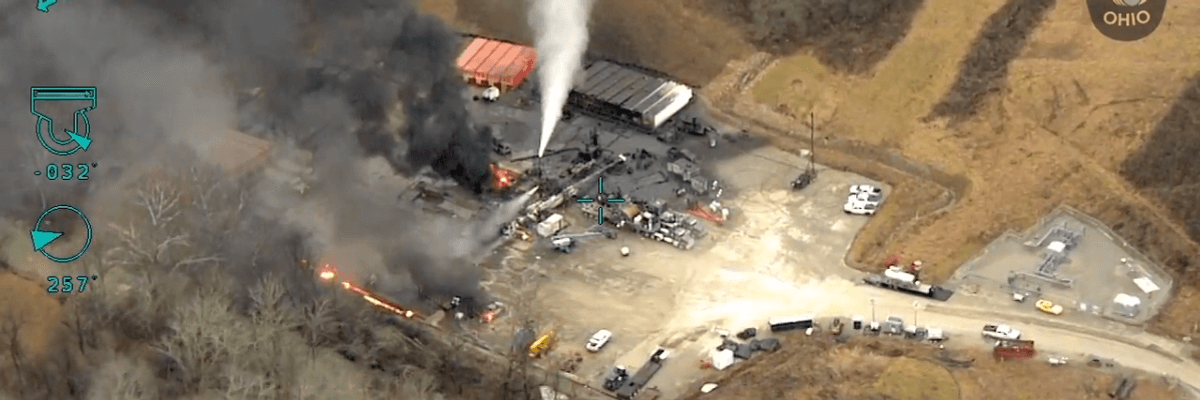
Last year, it took ExxonMobil subsidiary XTO Energy 20 days to get a blowout at a fracked natural gas well in Belmont County, Ohio under control.
Blowout at ExxonMobil Fracking Site Among Nation's Worst-Ever Methane Leaks
New data about the 2018 incident sparks fresh warnings about the dangers of natural gas and renewed calls for a rapid transition to renewable energy.
The revelation Monday that a blowout last year at an Ohio natural gas well owned by an ExxonMobil subsidiary was one of the country's largest-ever leaks of the potent greenhouse gas methane provoked impassioned calls for a rapid, just transition to 100% renewable energy nationwide.
"The next time some paid liar in the fossil fuel industry insists fracked gas is helping solve the climate crisis, remind them that a single Exxon fracking site 'leaked more methane in 20 days than all but three European nations emit over an entire year,'" tweeted David Sirota, a speechwriter and adviser for Bernie Sanders' 2020 presidential campaign.
Sirota quoted The Washington Post's report on the findings of a study published Monday in the Proceedings of the National Academy of Sciences. A team of American and Dutch scientists studied satellite data and found that the Feb. 15, 2018 blowout at a Belmont County well--which was hydraulically fractured or fracked before the incident--resulted in an "extreme" leakage of methane.
The team of 15 scientists explained that "from these data, we derive a methane emission rate of 120 +- 32 metric tons per hour. This hourly emission rate is twice that of the widely reported Aliso Canyon event in California in 2015." The incident in California, which lasted four months, is the largest known accidental methane leak in the United States. Methane is 84-87 times more potent than carbon dioxide over a 20-year period.
"The Ohio episode triggered about 100 residents within a one-mile radius to evacuate their homes while workers scrambled to plug the well," The New York Times reported Monday. "At the time, the Exxon subsidiary, XTO Energy, said it could not immediately determine how much gas had leaked."
Critics of continuing fossil fuel production pointed to new findings about the blowout and its consequences as evidence of the dangers of using natural gas as a "bridge" in a national--and global--transition to 100% clean energy.
Author and activist Naomi Klein tweeted a link to the "terrifying" Times report and highlighted commentary from a scientist at the U.S.-based nonprofit advocacy group Environmental Defense Fund (EDF).
Terrifying story about a blowout in Ohio that released "as much methane as the entire oil and gas industries of some nations release in a year." EDF - which has aggressively pushed NatGas as a "bridge fuel" - explains that this could be happening every day https://t.co/ghGT74IjBx
-- Naomi Klein (@NaomiAKlein) December 17, 2019
"Right now, you have one-off reports, but we have no estimate globally of how frequently these things happen," Steven Hamburg, EDF's chief scientist and a co-author of the new study told the Times. "Is this a once a year kind of event? Once a week? Once a day? Knowing that will make a big difference in trying to fully understand what the aggregate emissions are from oil and gas."
Bill McKibben, co-founder of the global environmental advocacy group 350.org--who also shared the Times report on Twitter--concluded that "natural gas [is] clearly a bridge fuel, it's just that the bridge leads to hell."
Morgan Harper, a progressive Democrat currently campaigning to represent the Ohio's 3rd Congressional District--which includes the state capital, Columbus--also tweeted a short response to reporting on the study: "Green. New. Deal."
ExxonMobil, for its part, did not indicate any intention to reconsider fracking or natural gas production in response to the new findings. Julie L. King, a spokesperson for the fossil fuel giant, told the Post by email that "we deeply regret this incident occurred and are committed to identifying and managing risks associated with our activities to prevent recurrence."
"We are eager to learn more about their study," King added. "ExxonMobil is working with government laboratories, universities, NGOs, and other industry participants to identify the most cost-effective and best-performing technology, including satellites, that can be adopted by all producers to detect, repair, and accurately measure methane."
We are at a crossroads
This country and this world are at a monumental crossroads. In a few short weeks, US voters will have an opportunity to beat back the forces of fascism and confront the billionaires who are rigging the economy, our media system, and our democracy, making it increasingly impossible for ordinary people to get by. We’re not just talking about the election. We’re talking about what must be done once these fascist elements are vanquished from power. We need a bolder set of solutions than what either major party has so far been willing to offer and a working-class movement ready to fight like hell for it. Trump didn't emerge from nowhere. The conditions that fueled MAGA authoritarianism were created by decades of radical neoliberal economic policies and a corrupt political system dominated by corporate interests. They slashed taxes on the super-rich, promising that the benefits would trickle down. They said giveaways to the corporate titans would make life more affordable for the rest of us. It was all bullshit. And when a bitter, betrayed populace searches for someone to blame, right-wing demagogues have little trouble finding scapegoats. People know when they're being lied to, but you won't hear any of this from the corporate media. Only independent journalism—powered and funded by people who believe in building a better world—can deliver truly trustworthy daily news. Our Fall Campaign is underway, and we need your help. To power our newsroom through the rest of the year, we need to raise $125,000 by midnight on October 31. So if you share our vision, please contribute whatever you can to sustain our work. |
The revelation Monday that a blowout last year at an Ohio natural gas well owned by an ExxonMobil subsidiary was one of the country's largest-ever leaks of the potent greenhouse gas methane provoked impassioned calls for a rapid, just transition to 100% renewable energy nationwide.
"The next time some paid liar in the fossil fuel industry insists fracked gas is helping solve the climate crisis, remind them that a single Exxon fracking site 'leaked more methane in 20 days than all but three European nations emit over an entire year,'" tweeted David Sirota, a speechwriter and adviser for Bernie Sanders' 2020 presidential campaign.
Sirota quoted The Washington Post's report on the findings of a study published Monday in the Proceedings of the National Academy of Sciences. A team of American and Dutch scientists studied satellite data and found that the Feb. 15, 2018 blowout at a Belmont County well--which was hydraulically fractured or fracked before the incident--resulted in an "extreme" leakage of methane.
The team of 15 scientists explained that "from these data, we derive a methane emission rate of 120 +- 32 metric tons per hour. This hourly emission rate is twice that of the widely reported Aliso Canyon event in California in 2015." The incident in California, which lasted four months, is the largest known accidental methane leak in the United States. Methane is 84-87 times more potent than carbon dioxide over a 20-year period.
"The Ohio episode triggered about 100 residents within a one-mile radius to evacuate their homes while workers scrambled to plug the well," The New York Times reported Monday. "At the time, the Exxon subsidiary, XTO Energy, said it could not immediately determine how much gas had leaked."
Critics of continuing fossil fuel production pointed to new findings about the blowout and its consequences as evidence of the dangers of using natural gas as a "bridge" in a national--and global--transition to 100% clean energy.
Author and activist Naomi Klein tweeted a link to the "terrifying" Times report and highlighted commentary from a scientist at the U.S.-based nonprofit advocacy group Environmental Defense Fund (EDF).
Terrifying story about a blowout in Ohio that released "as much methane as the entire oil and gas industries of some nations release in a year." EDF - which has aggressively pushed NatGas as a "bridge fuel" - explains that this could be happening every day https://t.co/ghGT74IjBx
-- Naomi Klein (@NaomiAKlein) December 17, 2019
"Right now, you have one-off reports, but we have no estimate globally of how frequently these things happen," Steven Hamburg, EDF's chief scientist and a co-author of the new study told the Times. "Is this a once a year kind of event? Once a week? Once a day? Knowing that will make a big difference in trying to fully understand what the aggregate emissions are from oil and gas."
Bill McKibben, co-founder of the global environmental advocacy group 350.org--who also shared the Times report on Twitter--concluded that "natural gas [is] clearly a bridge fuel, it's just that the bridge leads to hell."
Morgan Harper, a progressive Democrat currently campaigning to represent the Ohio's 3rd Congressional District--which includes the state capital, Columbus--also tweeted a short response to reporting on the study: "Green. New. Deal."
ExxonMobil, for its part, did not indicate any intention to reconsider fracking or natural gas production in response to the new findings. Julie L. King, a spokesperson for the fossil fuel giant, told the Post by email that "we deeply regret this incident occurred and are committed to identifying and managing risks associated with our activities to prevent recurrence."
"We are eager to learn more about their study," King added. "ExxonMobil is working with government laboratories, universities, NGOs, and other industry participants to identify the most cost-effective and best-performing technology, including satellites, that can be adopted by all producers to detect, repair, and accurately measure methane."