
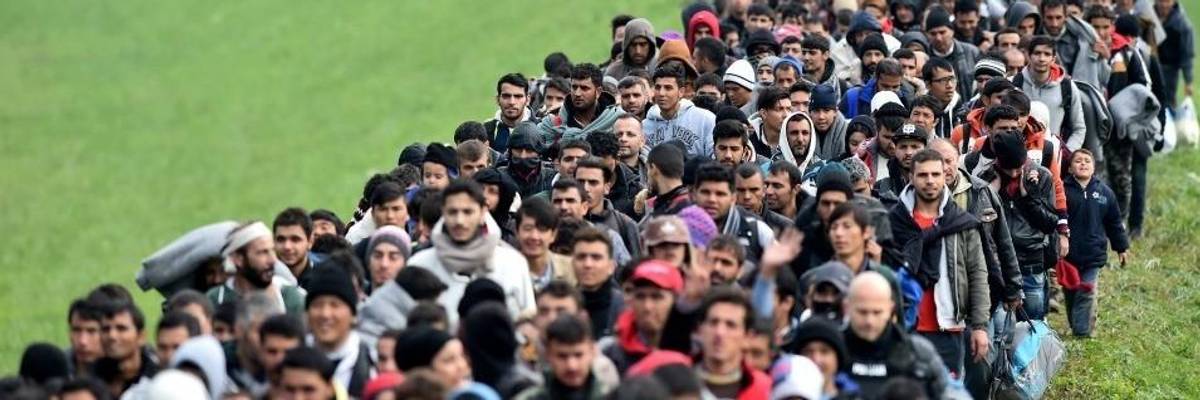
A U.N. ruling earlier this month stated that countries cannot send climate refugees back to their home countries if they apply for asylum. (Photo: Jeff J. Mitchell/Getty)
'Global Precedent' Set as UN Rules Climate Refugees Cannot Be Sent Back to Life-Threatening Conditions
Advocates praised the ruling as an "excellent step forward in refugee rights."
Human rights advocates on Monday applauded a "ground-breaking" ruling by a United Nations panel which stated that climate refugees seeking asylum cannot legally be sent back to their home countries if they face life-threatening conditions due to the climate crisis.
"Without robust national and international efforts, the effects of climate change in receiving states may expose individuals to a violation of their rights," ruled the U.N. Human Rights Committee, "thereby triggering the non-refoulement obligations of sending states."
Amnesty International praised the decision as "good news" and said in a statement that it could help prompt the international community to take concrete action to sharply reduce fossil fuel emissions as quickly as possible in hopes of limiting global warming to 1.5o Celsius.
Dan Sohege of the human rights advocacy group Stand for All called the ruling an "excellent step forward in refugee rights."
The committee handed down its ruling earlier this month in a case brought by Ioane Teitiota, a man who applied for asylum in New Zealand in 2013 after sea level rise and other conditions in his home country of Kiribati forced him and his family to leave.
"The decision sets a global precedent. It says a state will be in breach of its human rights obligations if it returns someone to a country where--due to the climate crisis--their life is at risk, or in danger of cruel, inhuman, or degrading treatment."
--Kate Schuetze, Amnesty International
Kiribati is expected to be uninhabitable in the coming decades--as soon as 10 to 15 years from now, according to Teitiota's case--as rising sea levels leads to overcrowding on the Pacific nation's islands. Teitiota took his case to the committee in 2016 after being deported back to Kiribati by New Zealand's government the previous year.
He argued that the lack of fresh water and difficulty growing crops in Kiribati has caused health problems for him and his family, as well as land disputes.
The committee ultimately rejected Teitiota's case this month, saying in its ruling that since he argued that Kiribati is expected to be uninhabitable in 10 to 15 years, the country and the international community have time to move the population to safety or to make the islands safe.
But, Amnesty International said, the ruling held promise for the 143 million people who are expected to become climate refugees by 2050--many of whom reside in Pacific Island nations.
"The decision sets a global precedent," said Kate Schuetze, Pacific researcher at Amnesty International, in a statement. "It says a state will be in breach of its human rights obligations if it returns someone to a country where--due to the climate crisis--their life is at risk, or in danger of cruel, inhuman, or degrading treatment."
"The message in this case is clear: Pacific Island states don't need to be underwater before triggering those human rights obligations," Schuetze told The Guardian. "I think we will see those cases start to emerge."
Two members of the committee dissented, arguing Teitiota was entitled to protection by New Zealand's government.
"The conditions of life laid out by the author--resulting from climate change in the Republic of Kiribati, are significantly grave, and pose a real, personal, and reasonably foreseeable risk of a threat to his life," said Ambassador Duncan Laki Muhumuza of Uganda.
Prof. Jane McAdam of the Kaldor Center for International Refugee Law at the University of New South Wales agreed with Amnesty's assessment, saying that while the ruling was not in Teitiota's favor, "the committee recognized that without robust action on climate at some point in the future it could well be that governments will, under international human rights law, be prohibited from sending people to places where their life is at risk or where they would face inhuman or degrading treatment."
"Even though in this particular case there was no violation found, it effectively put governments on notice," she told The Guardian.
We are at a crossroads
This country and this world are at a monumental crossroads. In a few short weeks, US voters will have an opportunity to beat back the forces of fascism and confront the billionaires who are rigging the economy, our media system, and our democracy, making it increasingly impossible for ordinary people to get by. We’re not just talking about the election. We’re talking about what must be done once these fascist elements are vanquished from power. We need a bolder set of solutions than what either major party has so far been willing to offer and a working-class movement ready to fight like hell for it. Trump didn't emerge from nowhere. The conditions that fueled MAGA authoritarianism were created by decades of radical neoliberal economic policies and a corrupt political system dominated by corporate interests. They slashed taxes on the super-rich, promising that the benefits would trickle down. They said giveaways to the corporate titans would make life more affordable for the rest of us. It was all bullshit. And when a bitter, betrayed populace searches for someone to blame, right-wing demagogues have little trouble finding scapegoats. People know when they're being lied to, but you won't hear any of this from the corporate media. Only independent journalism—powered and funded by people who believe in building a better world—can deliver truly trustworthy daily news. Our Fall Campaign is underway, and we need your help. To power our newsroom through the rest of the year, we need to raise $125,000 by midnight on October 31. So if you share our vision, please contribute whatever you can to sustain our work. |
Human rights advocates on Monday applauded a "ground-breaking" ruling by a United Nations panel which stated that climate refugees seeking asylum cannot legally be sent back to their home countries if they face life-threatening conditions due to the climate crisis.
"Without robust national and international efforts, the effects of climate change in receiving states may expose individuals to a violation of their rights," ruled the U.N. Human Rights Committee, "thereby triggering the non-refoulement obligations of sending states."
Amnesty International praised the decision as "good news" and said in a statement that it could help prompt the international community to take concrete action to sharply reduce fossil fuel emissions as quickly as possible in hopes of limiting global warming to 1.5o Celsius.
Dan Sohege of the human rights advocacy group Stand for All called the ruling an "excellent step forward in refugee rights."
The committee handed down its ruling earlier this month in a case brought by Ioane Teitiota, a man who applied for asylum in New Zealand in 2013 after sea level rise and other conditions in his home country of Kiribati forced him and his family to leave.
"The decision sets a global precedent. It says a state will be in breach of its human rights obligations if it returns someone to a country where--due to the climate crisis--their life is at risk, or in danger of cruel, inhuman, or degrading treatment."
--Kate Schuetze, Amnesty International
Kiribati is expected to be uninhabitable in the coming decades--as soon as 10 to 15 years from now, according to Teitiota's case--as rising sea levels leads to overcrowding on the Pacific nation's islands. Teitiota took his case to the committee in 2016 after being deported back to Kiribati by New Zealand's government the previous year.
He argued that the lack of fresh water and difficulty growing crops in Kiribati has caused health problems for him and his family, as well as land disputes.
The committee ultimately rejected Teitiota's case this month, saying in its ruling that since he argued that Kiribati is expected to be uninhabitable in 10 to 15 years, the country and the international community have time to move the population to safety or to make the islands safe.
But, Amnesty International said, the ruling held promise for the 143 million people who are expected to become climate refugees by 2050--many of whom reside in Pacific Island nations.
"The decision sets a global precedent," said Kate Schuetze, Pacific researcher at Amnesty International, in a statement. "It says a state will be in breach of its human rights obligations if it returns someone to a country where--due to the climate crisis--their life is at risk, or in danger of cruel, inhuman, or degrading treatment."
"The message in this case is clear: Pacific Island states don't need to be underwater before triggering those human rights obligations," Schuetze told The Guardian. "I think we will see those cases start to emerge."
Two members of the committee dissented, arguing Teitiota was entitled to protection by New Zealand's government.
"The conditions of life laid out by the author--resulting from climate change in the Republic of Kiribati, are significantly grave, and pose a real, personal, and reasonably foreseeable risk of a threat to his life," said Ambassador Duncan Laki Muhumuza of Uganda.
Prof. Jane McAdam of the Kaldor Center for International Refugee Law at the University of New South Wales agreed with Amnesty's assessment, saying that while the ruling was not in Teitiota's favor, "the committee recognized that without robust action on climate at some point in the future it could well be that governments will, under international human rights law, be prohibited from sending people to places where their life is at risk or where they would face inhuman or degrading treatment."
"Even though in this particular case there was no violation found, it effectively put governments on notice," she told The Guardian.