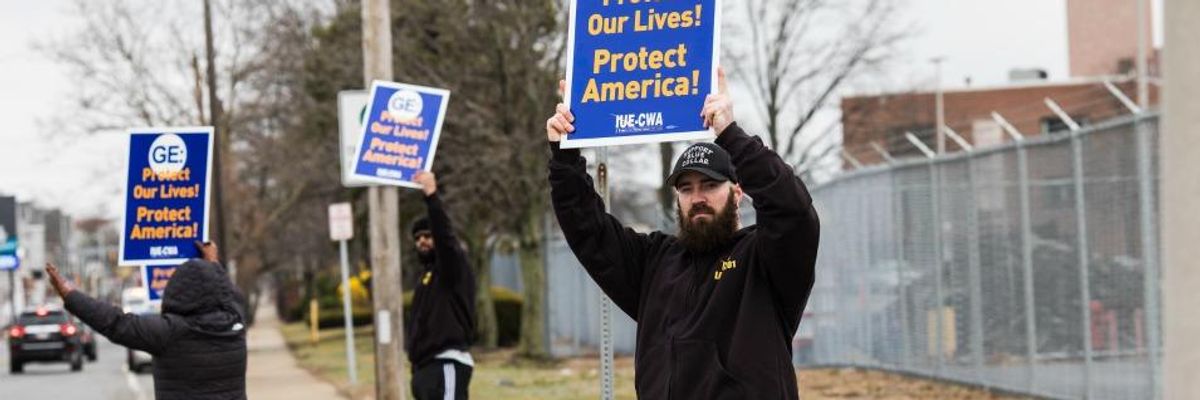
General Electric workers in Lynn, Massachusetts called on the company to allow them to build badly-needed ventilators rather than laying off thousands of employees. (Photo: IUE-CWA)
Facing Layoffs, General Electric Workers Demand Company Put Them to Work Producing Ventilators Instead
"Real leadership from the working class."
As strikes by delivery and grocery store employees on Monday signaled that the coronavirus pandemic is revitalizing the labor movement, workers at General Electric drew national attention to their company's desire to save money rather than keep its workforce employed and mitigate a public health crisis.
Workers at a jet engine factory in Lynn, Massachusetts stood six feet apart at a protest outside the facility, following social distancing guidelines while calling on General Electric (GE) to reverse its recent decision to lay off thousands of workers and instead put them to work building badly-needed ventilators for coronavirus patients. In nearby Boston, GE employees also marched six feet apart to their company's headquarters with the same demand.
The workers' show of solidarity with coronavirus patients and the healthcare providers desperately trying to save lives was applauded by labor advocates on social media.
GE announced last week it was laying off nearly 2,600 workers--10% of its domestic aviation workforce--as the coronavirus pandemic sharply reduced demand in the aviation industry. The layoffs would help GE save between $500 million and $1 billion, the company said, while GE Healthcare, one of the country's largest producers of ventilators, would step up its efforts to produce the supplies.
Sen. Bernie Sanders (I-Vt.) expressed solidarity with the workers and demanded GE end all "layoffs, outsourcing, and tax dodging" and instead invest its vast resources in serving the public, particularly during the national crisis.
With hospitals across the country reporting a shortage of ventilators and Dr. Anthony Fauci, director of the National Institute of Allergy and Infectious Diseases, warning that 100,000 to 200,000 Americans could die of the coronavirus, officially known as COVID-19, the GE workers demanded that their skills be put to good use and that the company use all its resources to alleviate the critical shortage.
"The crisis we face with the COVID-19 pandemic is unlike anything we have seen in our lifetimes. It requires us--all of us--to work for the common good and save lives," said Chris Shelton, president of Communications Workers of America (CWA), which represents GE workers. "But at a time when our country is depending on skilled workers to make essential products like ventilators, our members are left wondering why they are facing layoffs instead of having the opportunity to use their skills to help save lives. We challenge GE to partner with our members and the management of its own Aviation and Electronic Lighting divisions to convert some of its unused capacity to alleviate our critical national shortage of life-saving ventilators."
The GE protest demonstrates, one public school teacher tweeted, that Americans must look to workers, not billionaires, "to save us."
"Companies don't give a shit about us. The workers do," wrote comedian Hari Kondabolu.
Combined with demands for paid sick leave from Amazon and Whole Foods employees; for better safety precautions by Instacart delivery workers and Pittsburgh sanitation workers; and a number of other protests at workplaces across the country in recent weeks, brought on by the COVID-19 pandemic, the GE workers may be an integral part of a new era for the U.S. labor rights movement, wrote legal scholar Tiffany C. Li.
"This is how movements begin," Li wrote.
We are at a crossroads
This country and this world are at a monumental crossroads. US voters have an opportunity to beat back the forces of fascism and confront the billionaires who are rigging the economy, our media system, and our democracy, making it increasingly impossible for ordinary people to get by. We’re not just talking about the election. We’re talking about what must be done once these fascist elements are vanquished from power. We need a bolder set of solutions than what either major party has so far been willing to offer and a working-class movement ready to fight like hell for it. Trump didn't emerge from nowhere. The conditions that fueled MAGA authoritarianism were created by decades of radical neoliberal economic policies and a corrupt political system dominated by corporate interests. They slashed taxes on the super-rich, promising that the benefits would trickle down. They said giveaways to the corporate titans would make life more affordable for the rest of us. It was all bullshit. And when a bitter, betrayed populace searches for someone to blame, right-wing demagogues have little trouble finding scapegoats. People know when they're being lied to, but you won't hear any of this from the corporate media. Only independent journalism—powered and funded by people who believe in building a better world—can deliver truly trustworthy daily news. Our Fall Campaign is underway, and we need your help. To power our newsroom through the rest of the year, we need to raise $125,000 by midnight on October 31. So if you share our vision, please contribute whatever you can to sustain our work. |
As strikes by delivery and grocery store employees on Monday signaled that the coronavirus pandemic is revitalizing the labor movement, workers at General Electric drew national attention to their company's desire to save money rather than keep its workforce employed and mitigate a public health crisis.
Workers at a jet engine factory in Lynn, Massachusetts stood six feet apart at a protest outside the facility, following social distancing guidelines while calling on General Electric (GE) to reverse its recent decision to lay off thousands of workers and instead put them to work building badly-needed ventilators for coronavirus patients. In nearby Boston, GE employees also marched six feet apart to their company's headquarters with the same demand.
The workers' show of solidarity with coronavirus patients and the healthcare providers desperately trying to save lives was applauded by labor advocates on social media.
GE announced last week it was laying off nearly 2,600 workers--10% of its domestic aviation workforce--as the coronavirus pandemic sharply reduced demand in the aviation industry. The layoffs would help GE save between $500 million and $1 billion, the company said, while GE Healthcare, one of the country's largest producers of ventilators, would step up its efforts to produce the supplies.
Sen. Bernie Sanders (I-Vt.) expressed solidarity with the workers and demanded GE end all "layoffs, outsourcing, and tax dodging" and instead invest its vast resources in serving the public, particularly during the national crisis.
With hospitals across the country reporting a shortage of ventilators and Dr. Anthony Fauci, director of the National Institute of Allergy and Infectious Diseases, warning that 100,000 to 200,000 Americans could die of the coronavirus, officially known as COVID-19, the GE workers demanded that their skills be put to good use and that the company use all its resources to alleviate the critical shortage.
"The crisis we face with the COVID-19 pandemic is unlike anything we have seen in our lifetimes. It requires us--all of us--to work for the common good and save lives," said Chris Shelton, president of Communications Workers of America (CWA), which represents GE workers. "But at a time when our country is depending on skilled workers to make essential products like ventilators, our members are left wondering why they are facing layoffs instead of having the opportunity to use their skills to help save lives. We challenge GE to partner with our members and the management of its own Aviation and Electronic Lighting divisions to convert some of its unused capacity to alleviate our critical national shortage of life-saving ventilators."
The GE protest demonstrates, one public school teacher tweeted, that Americans must look to workers, not billionaires, "to save us."
"Companies don't give a shit about us. The workers do," wrote comedian Hari Kondabolu.
Combined with demands for paid sick leave from Amazon and Whole Foods employees; for better safety precautions by Instacart delivery workers and Pittsburgh sanitation workers; and a number of other protests at workplaces across the country in recent weeks, brought on by the COVID-19 pandemic, the GE workers may be an integral part of a new era for the U.S. labor rights movement, wrote legal scholar Tiffany C. Li.
"This is how movements begin," Li wrote.