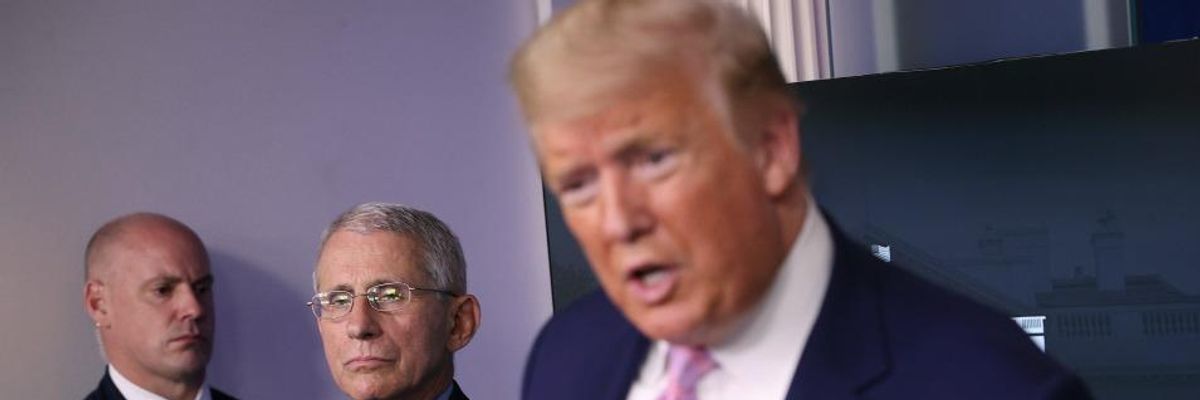
Dr. Anthony Fauci on Sunday told Margaret Brennan on "Face the Nation" that scientific evidence does not support President Donald Trump's repeated claim that hydroxychloroquine can prevent the coronavirus. (Photo: Alliance for Health Policy/Flickr/cc)
'This President Has Blood on His Hands': Trump Again Urges Public to Take Anti-Malaria Drug for Coronavirus, Despite Reports of Danger
"'What do you have to lose?'" Rep. Ilhan Omar (D-Minn.) asked. "They can lose their life, you imbecile."
The nation's top expert on infectious diseases was forced once again on Sunday to negate President Donald Trump's latest claim that an anti-malaria drug can treat coronavirus, which the president made at his Saturday evening press conference.
On CBS's "Face the Nation," National Institute of Allergy and Infectious Diseases (NIAID) director Dr. Anthony Fauci told host Margaret Brennan that "in terms of science, I don't think we could definitively say it works," regarding the use of hydroxychloroquine for the virus.
"As I've said many times, Margaret, the data are really just at best suggestive," Fauci said. "There have been cases that show there may be an effect and there are others to show there's no effect."
At his press briefing the previous evening, Trump said the federal government is adding millions of doses of hydroxychloroquine to the Strategic National Stockpile (SNS), which states have desperately been attempting to draw from in order to obtain supplies recommended by medical experts, including ventilators and personal protective equipment (PPE) for healthcare providers.
"What do you have to lose? Take it," Trump said of the drug. "I really think they should take it. But it's their choice. And it's their doctor's choice or the doctors in the hospital. But hydroxychloroquine. Try it, if you'd like."
As Common Dreams reported last month, three people in Nigeria were hospitalized after overdosing on the drug following Trump's earlier claims about hydroxychloroquine. A man in Arizona died after ingesting chloroquine phosphate, after his wife cited the president's televised briefings as evidence that it could prevent the coronavirus, officially called COVID-19.
"'What do you have to lose?'" Rep. Ilhan Omar (D-Minn.) tweeted after Trump's briefing. "They can lose their life, you imbecile."
Critics on social media warned others against heeding the president's advice.
Some laboratory studies of a small number of cases have suggested hydroxychloroquine could stop the coronavirus from invading cells, and according to the New York Times, "some researchers think its ability to dial back an overactive immune system--the reason it is used for autoimmune diseases--might help relieve the life-threatening inflammation that develops in some coronavirus patients."
But researchers say far more evidence is needed for the Food and Drug Administration (FDA) to approve the drug for anti-coronavirus use.
We are at a crossroads
This country and this world are at a monumental crossroads. US voters have an opportunity to beat back the forces of fascism and confront the billionaires who are rigging the economy, our media system, and our democracy, making it increasingly impossible for ordinary people to get by. We’re not just talking about the election. We’re talking about what must be done once these fascist elements are vanquished from power. We need a bolder set of solutions than what either major party has so far been willing to offer and a working-class movement ready to fight like hell for it. Trump didn't emerge from nowhere. The conditions that fueled MAGA authoritarianism were created by decades of radical neoliberal economic policies and a corrupt political system dominated by corporate interests. They slashed taxes on the super-rich, promising that the benefits would trickle down. They said giveaways to the corporate titans would make life more affordable for the rest of us. It was all bullshit. And when a bitter, betrayed populace searches for someone to blame, right-wing demagogues have little trouble finding scapegoats. People know when they're being lied to, but you won't hear any of this from the corporate media. Only independent journalism—powered and funded by people who believe in building a better world—can deliver truly trustworthy daily news. Our Fall Campaign is underway, and we need your help. To power our newsroom through the rest of the year, we need to raise $125,000 by midnight on October 31. So if you share our vision, please contribute whatever you can to sustain our work. |
The nation's top expert on infectious diseases was forced once again on Sunday to negate President Donald Trump's latest claim that an anti-malaria drug can treat coronavirus, which the president made at his Saturday evening press conference.
On CBS's "Face the Nation," National Institute of Allergy and Infectious Diseases (NIAID) director Dr. Anthony Fauci told host Margaret Brennan that "in terms of science, I don't think we could definitively say it works," regarding the use of hydroxychloroquine for the virus.
"As I've said many times, Margaret, the data are really just at best suggestive," Fauci said. "There have been cases that show there may be an effect and there are others to show there's no effect."
At his press briefing the previous evening, Trump said the federal government is adding millions of doses of hydroxychloroquine to the Strategic National Stockpile (SNS), which states have desperately been attempting to draw from in order to obtain supplies recommended by medical experts, including ventilators and personal protective equipment (PPE) for healthcare providers.
"What do you have to lose? Take it," Trump said of the drug. "I really think they should take it. But it's their choice. And it's their doctor's choice or the doctors in the hospital. But hydroxychloroquine. Try it, if you'd like."
As Common Dreams reported last month, three people in Nigeria were hospitalized after overdosing on the drug following Trump's earlier claims about hydroxychloroquine. A man in Arizona died after ingesting chloroquine phosphate, after his wife cited the president's televised briefings as evidence that it could prevent the coronavirus, officially called COVID-19.
"'What do you have to lose?'" Rep. Ilhan Omar (D-Minn.) tweeted after Trump's briefing. "They can lose their life, you imbecile."
Critics on social media warned others against heeding the president's advice.
Some laboratory studies of a small number of cases have suggested hydroxychloroquine could stop the coronavirus from invading cells, and according to the New York Times, "some researchers think its ability to dial back an overactive immune system--the reason it is used for autoimmune diseases--might help relieve the life-threatening inflammation that develops in some coronavirus patients."
But researchers say far more evidence is needed for the Food and Drug Administration (FDA) to approve the drug for anti-coronavirus use.