SUBSCRIBE TO OUR FREE NEWSLETTER
Daily news & progressive opinion—funded by the people, not the corporations—delivered straight to your inbox.
5
#000000
#FFFFFF
To donate by check, phone, or other method, see our More Ways to Give page.
Daily news & progressive opinion—funded by the people, not the corporations—delivered straight to your inbox.
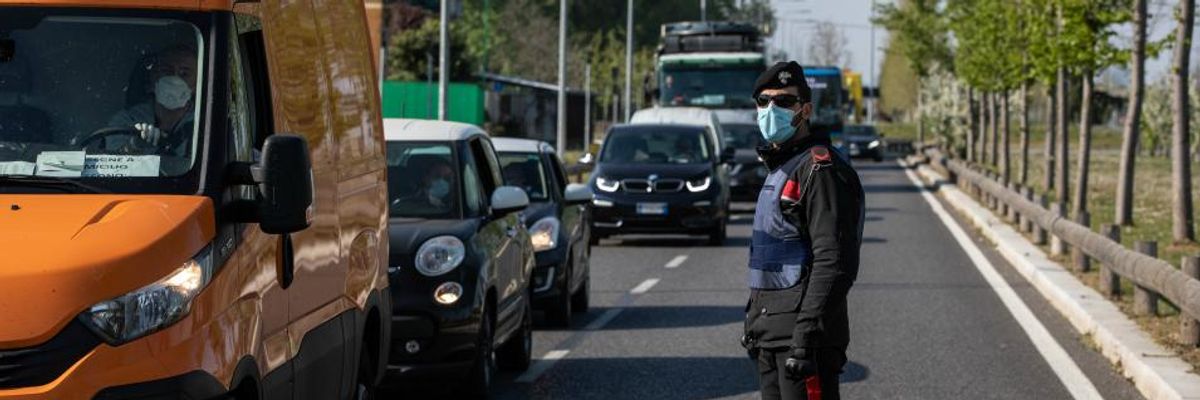
An Italian Carabinieri officer, wearing a respiratory mask, stands guard at a road block on April 10, 2020 in Milan, Italy. The Italian government further strengthened police controls nationwide in the effort to prevent people leaving the quarantine during Easter weekend.(Photo: Emanuele Cremaschi/Getty Images)
Climate activists from across the globe on Tuesday welcomed an ambitious new plan for Milan that will, according to the Guardian, transform 22 miles of street space currently reserved for cars "with a rapid, experimental citywide expansion of cycling and walking space to protect residents as COVID-19 restrictions are lifted."
"Turning 35km of Milan's streets over to cyclists and pedestrians shows how there are openings amidst the crisis to boldly and beneficially reimagine our lives, landscapes, and future on the other side."
--Julian Hoffman, writer
Greece-based author Julian Hoffman declared, "Turning 35km of Milan's streets over to cyclists and pedestrians shows how there are openings amidst the crisis to boldly and beneficially reimagine our lives, landscapes, and future on the other side."
The coronavirus pandemic has sparked calls for a global Green New Deal and just recovery that incorporates climate action--particularly a swift transition to 100% renewable energy and other initiatives to cut planet-heating emissions--into rebuilding the world's economy. The crisis has also elevated concerns about air quality, as studies have shown that high levels of pollution may be "one of the most important contributors" to deaths from COVID-19.
As the Guardian reported:
The northern Italian city and surrounding Lombardy region are among Europe's most polluted, and have also been especially hard hit by the COVID-19 outbreak.
Under the nationwide lockdown, motor traffic congestion has dropped by 30-75%, and air pollution with it. City officials hope to fend off a resurgence in car use as residents return to work looking to avoid busy public transport.
The Strade Aperte or "Open Streets" plan, which the Guardian called "one of Europe's most ambitious schemes reallocating street space from cars to cycling and walking," will be implemented this summer. Milan Deputy Mayor Marco Granelli said that "we worked for years to reduce car use. If everybody drives a car, there is no space for people, there is no space to move, there is no space for commercial activities outside the shops."
"Of course, we want to reopen the economy, but we think we should do it on a different basis from before," he said. "We think we have to reimagine Milan in the new situation. We have to get ready; that's why it's so important to defend even a part of the economy, to support bars, artisans, and restaurants. When it is over, the cities that still have this kind of economy will have an advantage, and Milan wants to be in that category."
Granelli's comments were applauded by Greenpeace U.K., which tweeted that he was "hitting the nail squarely on the head."
News of the plan was also welcomed on Twitter Tuesday by C40 Cities, Extinction Rebellion Camden, and Swedish teen climate leader Greta Thunberg, who founded the global Fridays for Future movement. Others celebrated the plan as an "excellent example of #BuildBackBetter" and called for crafting similar schemes for other major cities like New York, London, and beyond:
"As cities across Europe move out of lockdown, it's a superb opportunity to say goodbye to traffic-clogged streets," wrote Sylvia Thompson, a contributor to The Irish Times who covers health, nature, science, and environmental issues.
Janette Sadik-Khan--a former transportation commissioner for New York City who is working with cities including Milan and Bogota on their transport recovery programs--told the Guardian that Milan's scheme could serve as a model for the rest of the world.
"A lot of cities and even countries have been defined by how they've responded to historical forces, whether it's political, social, or physical reconstruction," said Sadik-Khan. "The Milan plan is so important is because it lays out a good playbook for how you can reset your cities now."
"It's a once-in-a-lifetime opportunity to take a fresh look at your streets and make sure that they are set to achieve the outcomes that we want to achieve: not just moving cars as fast as possible from point A to point B, but making it possible for everyone to get around safely," she added. "I know we'll be looking to Milan for guidance from New York City."
This country and this world are at a monumental crossroads. US voters have an opportunity to beat back the forces of fascism and confront the billionaires who are rigging the economy, our media system, and our democracy, making it increasingly impossible for ordinary people to get by. We’re not just talking about the election. We’re talking about what must be done once these fascist elements are vanquished from power. We need a bolder set of solutions than what either major party has so far been willing to offer and a working-class movement ready to fight like hell for it. Trump didn't emerge from nowhere. The conditions that fueled MAGA authoritarianism were created by decades of radical neoliberal economic policies and a corrupt political system dominated by corporate interests. They slashed taxes on the super-rich, promising that the benefits would trickle down. They said giveaways to the corporate titans would make life more affordable for the rest of us. It was all bullshit. And when a bitter, betrayed populace searches for someone to blame, right-wing demagogues have little trouble finding scapegoats. People know when they're being lied to, but you won't hear any of this from the corporate media. Only independent journalism—powered and funded by people who believe in building a better world—can deliver truly trustworthy daily news. If you share our vision, please contribute whatever you can to sustain our work. |
Climate activists from across the globe on Tuesday welcomed an ambitious new plan for Milan that will, according to the Guardian, transform 22 miles of street space currently reserved for cars "with a rapid, experimental citywide expansion of cycling and walking space to protect residents as COVID-19 restrictions are lifted."
"Turning 35km of Milan's streets over to cyclists and pedestrians shows how there are openings amidst the crisis to boldly and beneficially reimagine our lives, landscapes, and future on the other side."
--Julian Hoffman, writer
Greece-based author Julian Hoffman declared, "Turning 35km of Milan's streets over to cyclists and pedestrians shows how there are openings amidst the crisis to boldly and beneficially reimagine our lives, landscapes, and future on the other side."
The coronavirus pandemic has sparked calls for a global Green New Deal and just recovery that incorporates climate action--particularly a swift transition to 100% renewable energy and other initiatives to cut planet-heating emissions--into rebuilding the world's economy. The crisis has also elevated concerns about air quality, as studies have shown that high levels of pollution may be "one of the most important contributors" to deaths from COVID-19.
As the Guardian reported:
The northern Italian city and surrounding Lombardy region are among Europe's most polluted, and have also been especially hard hit by the COVID-19 outbreak.
Under the nationwide lockdown, motor traffic congestion has dropped by 30-75%, and air pollution with it. City officials hope to fend off a resurgence in car use as residents return to work looking to avoid busy public transport.
The Strade Aperte or "Open Streets" plan, which the Guardian called "one of Europe's most ambitious schemes reallocating street space from cars to cycling and walking," will be implemented this summer. Milan Deputy Mayor Marco Granelli said that "we worked for years to reduce car use. If everybody drives a car, there is no space for people, there is no space to move, there is no space for commercial activities outside the shops."
"Of course, we want to reopen the economy, but we think we should do it on a different basis from before," he said. "We think we have to reimagine Milan in the new situation. We have to get ready; that's why it's so important to defend even a part of the economy, to support bars, artisans, and restaurants. When it is over, the cities that still have this kind of economy will have an advantage, and Milan wants to be in that category."
Granelli's comments were applauded by Greenpeace U.K., which tweeted that he was "hitting the nail squarely on the head."
News of the plan was also welcomed on Twitter Tuesday by C40 Cities, Extinction Rebellion Camden, and Swedish teen climate leader Greta Thunberg, who founded the global Fridays for Future movement. Others celebrated the plan as an "excellent example of #BuildBackBetter" and called for crafting similar schemes for other major cities like New York, London, and beyond:
"As cities across Europe move out of lockdown, it's a superb opportunity to say goodbye to traffic-clogged streets," wrote Sylvia Thompson, a contributor to The Irish Times who covers health, nature, science, and environmental issues.
Janette Sadik-Khan--a former transportation commissioner for New York City who is working with cities including Milan and Bogota on their transport recovery programs--told the Guardian that Milan's scheme could serve as a model for the rest of the world.
"A lot of cities and even countries have been defined by how they've responded to historical forces, whether it's political, social, or physical reconstruction," said Sadik-Khan. "The Milan plan is so important is because it lays out a good playbook for how you can reset your cities now."
"It's a once-in-a-lifetime opportunity to take a fresh look at your streets and make sure that they are set to achieve the outcomes that we want to achieve: not just moving cars as fast as possible from point A to point B, but making it possible for everyone to get around safely," she added. "I know we'll be looking to Milan for guidance from New York City."