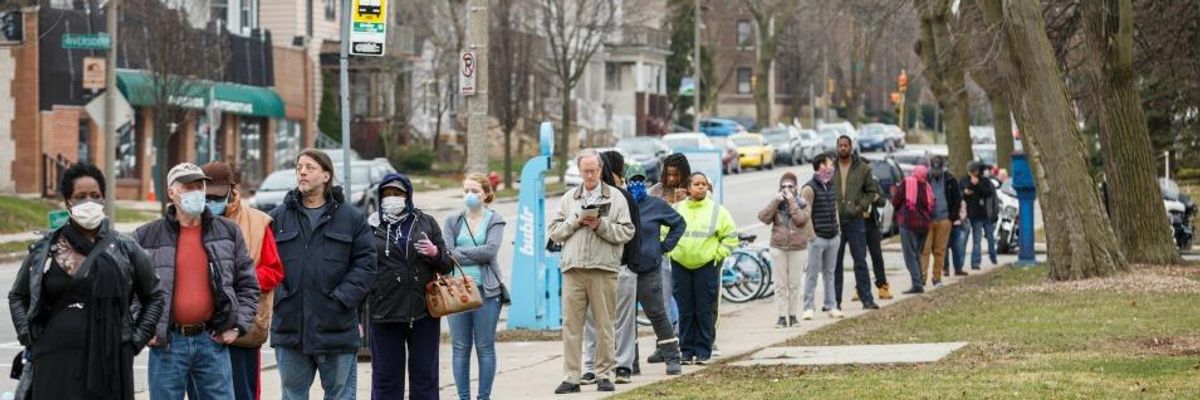
A line to vote in Wisconsin's spring primary election wraps around for blocks and blocks on Tuesday, April 7, 2020 at Riverside High School in Milwaukee, Wisc. (Photo: Sara Stathas for the Washington Post)
Bolstering Case for Nationwide Vote-by-Mail, New Study Shows Wisconsin In-Person Election Exploded New Covid-19 Infections
While counties with the most in-person polling places on April 7 saw large case spikes in the following weeks, counties that used widespread absentee balloting saw the opposite effect.
A new study published Monday showed a strong correlation between last month's in-person primary election in Wisconsin and an increase in coronavirus infections in the state, bolstering calls for a robust national vote-by-mail system for November.
Researchers at University of Wisconsin-Oshkosh and Ball State University found clear spikes in cases in counties that had the most in-person voting locations on April 7, and found that far fewer new cases were confirmed in counties with widespread absentee ballot voting.
Though public health experts had urged against holding the election due to the risks, the in-person voting was pushed forward by state Republicans, former Vice President Joe Biden, and a last-minute ruling by the U.S. Supreme Court.
The research proves, wrote journalist David Sirota, that the decision to move ahead with in-person voting "ended up spreading a deadly pandemic."
The economists examined the number of new cases in each of Wisconsin's 72 counties, and found that more cases were reported in the two to three weeks after the election--the incubation period for Covid-19--in counties with the highest numbers of in-person polling locations.
"When the average number of votes per voting location increases by 100 (a 0.10 unit change), the rate of positive tests in a county rises by roughly 0.034 to 0.035 (3.4 to 3.5 percentage points) two to three weeks after the election," the researchers wrote.
Meanwhile, the opposite effect was shown in counties that utilized absentee balloting.
"The estimates from absentee ballot voting suggest that every unit increase in absentee ballots (an additional 10,000 absentee ballots), lead to decreases in the positive rate of between 0.07 and 0.08 percentage points two to three weeks after the election," the study reads.
The research was released two days after a spokeswoman for the state Department of Health Services said that the agency's official count of Covid-19 cases linked to the election stood at 71.
Democratic Gov. Tony Evers called on the Republican-led state legislature to cancel the in-person election and allow voters to cast absentee ballots, but the GOP rejected the plan.
Hours before the election, the U.S. Supreme Court blocked the state from extending the deadline for absentee voting in what Justice Ruth Bader Ginsberg warned would "result in massive disenfranchisement" as Wisconsin voters were forced to choose between participating in the democratic process or risking their health.
The economists who authored the study urged election officials to consider the widespread use of absentee ballots to avoid new spikes in coronavirus cases after Americans vote in the 2020 elections in November.
"We find a consistent negative relationship between absentee voting and the rate of positive COVID-19 tests," reads the study. "Given these results, it may be prudent, to the extent possible, that policy makers and election clerks take steps to either expand the number of polling locations or encourage absentee voting for future elections held during the COVID-19 pandemic."
On social media, Harvard University epidemiologist Eric Feigl-Ding drew attention to the correlation between lower case numbers and more absentee voting.
Sirota noted that the study was released as President Donald Trump claims a vote-by-mail system would invite widespread "voter fraud."
Contrary to Trump's efforts to "manufacture concerns" about absentee balloting, Sirota wrote in his newsletter, "Vote by mail systems have not been plagued by fraud and they do not [prefer] one party over the other."
The study was published days after Wisconsin's conservative-led state Supreme Court struck down Evers' stay-at-home order, leading the governor to warn that the state will likely see major spikes in coronavirus cases and deaths in the coming weeks.
The state reported its largest single-day increase in cases on Saturday, with 502 new infections.
The decisions regarding reopening the state and moving ahead with last month's election--both made against the advise of experts--show that Wisconsin's Republican Party is putting "politics over public health," wrote Rep. Mark Pocan (D-Wisc.) on social media.
We are at a crossroads
This country and this world are at a monumental crossroads. US voters have an opportunity to beat back the forces of fascism and confront the billionaires who are rigging the economy, our media system, and our democracy, making it increasingly impossible for ordinary people to get by. We’re not just talking about the election. We’re talking about what must be done once these fascist elements are vanquished from power. We need a bolder set of solutions than what either major party has so far been willing to offer and a working-class movement ready to fight like hell for it. Trump didn't emerge from nowhere. The conditions that fueled MAGA authoritarianism were created by decades of radical neoliberal economic policies and a corrupt political system dominated by corporate interests. They slashed taxes on the super-rich, promising that the benefits would trickle down. They said giveaways to the corporate titans would make life more affordable for the rest of us. It was all bullshit. And when a bitter, betrayed populace searches for someone to blame, right-wing demagogues have little trouble finding scapegoats. People know when they're being lied to, but you won't hear any of this from the corporate media. Only independent journalism—powered and funded by people who believe in building a better world—can deliver truly trustworthy daily news. Our Fall Campaign is underway, and we need your help. To power our newsroom through the rest of the year, we need to raise $125,000 by midnight on October 31. So if you share our vision, please contribute whatever you can to sustain our work. |
A new study published Monday showed a strong correlation between last month's in-person primary election in Wisconsin and an increase in coronavirus infections in the state, bolstering calls for a robust national vote-by-mail system for November.
Researchers at University of Wisconsin-Oshkosh and Ball State University found clear spikes in cases in counties that had the most in-person voting locations on April 7, and found that far fewer new cases were confirmed in counties with widespread absentee ballot voting.
Though public health experts had urged against holding the election due to the risks, the in-person voting was pushed forward by state Republicans, former Vice President Joe Biden, and a last-minute ruling by the U.S. Supreme Court.
The research proves, wrote journalist David Sirota, that the decision to move ahead with in-person voting "ended up spreading a deadly pandemic."
The economists examined the number of new cases in each of Wisconsin's 72 counties, and found that more cases were reported in the two to three weeks after the election--the incubation period for Covid-19--in counties with the highest numbers of in-person polling locations.
"When the average number of votes per voting location increases by 100 (a 0.10 unit change), the rate of positive tests in a county rises by roughly 0.034 to 0.035 (3.4 to 3.5 percentage points) two to three weeks after the election," the researchers wrote.
Meanwhile, the opposite effect was shown in counties that utilized absentee balloting.
"The estimates from absentee ballot voting suggest that every unit increase in absentee ballots (an additional 10,000 absentee ballots), lead to decreases in the positive rate of between 0.07 and 0.08 percentage points two to three weeks after the election," the study reads.
The research was released two days after a spokeswoman for the state Department of Health Services said that the agency's official count of Covid-19 cases linked to the election stood at 71.
Democratic Gov. Tony Evers called on the Republican-led state legislature to cancel the in-person election and allow voters to cast absentee ballots, but the GOP rejected the plan.
Hours before the election, the U.S. Supreme Court blocked the state from extending the deadline for absentee voting in what Justice Ruth Bader Ginsberg warned would "result in massive disenfranchisement" as Wisconsin voters were forced to choose between participating in the democratic process or risking their health.
The economists who authored the study urged election officials to consider the widespread use of absentee ballots to avoid new spikes in coronavirus cases after Americans vote in the 2020 elections in November.
"We find a consistent negative relationship between absentee voting and the rate of positive COVID-19 tests," reads the study. "Given these results, it may be prudent, to the extent possible, that policy makers and election clerks take steps to either expand the number of polling locations or encourage absentee voting for future elections held during the COVID-19 pandemic."
On social media, Harvard University epidemiologist Eric Feigl-Ding drew attention to the correlation between lower case numbers and more absentee voting.
Sirota noted that the study was released as President Donald Trump claims a vote-by-mail system would invite widespread "voter fraud."
Contrary to Trump's efforts to "manufacture concerns" about absentee balloting, Sirota wrote in his newsletter, "Vote by mail systems have not been plagued by fraud and they do not [prefer] one party over the other."
The study was published days after Wisconsin's conservative-led state Supreme Court struck down Evers' stay-at-home order, leading the governor to warn that the state will likely see major spikes in coronavirus cases and deaths in the coming weeks.
The state reported its largest single-day increase in cases on Saturday, with 502 new infections.
The decisions regarding reopening the state and moving ahead with last month's election--both made against the advise of experts--show that Wisconsin's Republican Party is putting "politics over public health," wrote Rep. Mark Pocan (D-Wisc.) on social media.