
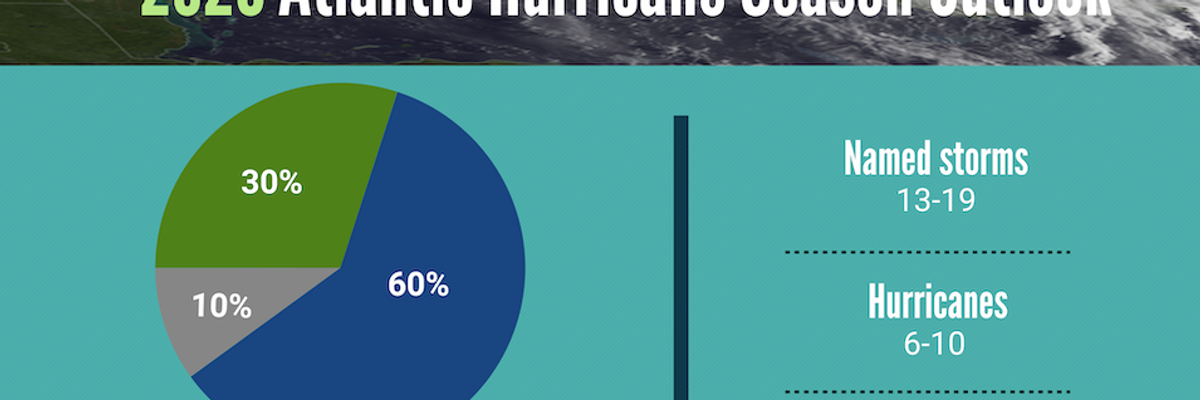
A summary infographic showing hurricane season probability and numbers of named storms predicted from NOAA's 2020 Atlantic Hurricane Season Outlook. (Image: NOAA)
With Covid-19 Raging, Warnings of Worse-Than-Usual Hurricane Season Point to Trouble Ahead
"Hurricane season is about to start and its risks will only grow and potentially compound any impacts from the pandemic."
Scientists are sounding the alarm that this year's hurricane season could be catastrophic, citing predictions of higher-than-usual activity expected this summer and fall in the midst of the ongoing coronavirus pandemic that has pushed public health systems and the economies to the brink around the world.
"While we cannot say what the situation of the pandemic will be in the coming months, we do know hurricane season is about to start and its risks will only grow and potentially compound any impacts from the pandemic," climate scientist Astrid Caldas wrote at the Union of Concerned Scientists blog on Thursday.
The National Oceanic and Atmospheric Administration (NOAA) released its annual hurricane forecast Thursday morning, predicting a likely stronger season from June 1 to November 1. A named storm already formed in the Atlantic--Arthur, which has now dissipated--making 2020 the record sixth year in a row where that has happened.
The climate crisis is widely understood by forecasters and scientists to be exacerbating the severity of the storm season and making the hurricanes slower, wetter, and more dangerous.
"The NOAA outlook mirrors the Colorado State University forecast released in April," wrote Caldas. "Both base their predictions mainly on the absence of an El Nino throughout the summer, in addition to above-average tropical and subtropical sea surface temperatures."
As the Washington Post reported:
The NOAA outlook calls for a 60% likelihood of an above-average season, with a 70% chance of 13 to 19 named storms, six to 10 of which will become hurricanes. Three to six of those could become major hurricanes of Category 3 intensity or higher, and there is a chance that the season will become "extremely active," the agency said.
"As far as we can tell it's going to be an extremely active hurricane season," Colorado State University researcher Jhordanne Jones told the Guardian.
The pandemic is increasing the prospect that should a major storm make landfall in the U.S. the consequences could be even more catastrophic than under normal circumstances. Shelters are already being prepared to handle the social distancing measures necessary to slow the spread of disease.
But, according to the Guardian, the chances for disaster are myriad:
The pandemic has thrown up a range of potential problems in a disaster situation. Volunteers who usually help with relief efforts may be sick or unwilling to be in close contact with people potentially infected, while it may be difficult to transfer medical expertise and supplies between states. The economic downturn triggered by the pandemic means many people may not even have the means to flee a storm before it hits.
Union of Concerned Scientists policy director and lead economist for Climate and Energy Rachel Cleetus on Thursday summed up the dangers of the storm and pandemic to disadvantaged and marginalized communities along the East and Gulf coasts and called on Congress to act and for FEMA to be ready to handle the damage.
"To mount an effective response, our solutions must be intersectional, centering the health and well-being of people--including those who have historically been marginalized and discriminated against," said Cleetus. "We must prepare well in advance, not simply respond when disasters strike."
An Urgent Message From Our Co-Founder
Dear Common Dreams reader, It’s been nearly 30 years since I co-founded Common Dreams with my late wife, Lina Newhouser. We had the radical notion that journalism should serve the public good, not corporate profits. It was clear to us from the outset what it would take to build such a project. No paid advertisements. No corporate sponsors. No millionaire publisher telling us what to think or do. Many people said we wouldn't last a year, but we proved those doubters wrong. Together with a tremendous team of journalists and dedicated staff, we built an independent media outlet free from the constraints of profits and corporate control. Our mission has always been simple: To inform. To inspire. To ignite change for the common good. Building Common Dreams was not easy. Our survival was never guaranteed. When you take on the most powerful forces—Wall Street greed, fossil fuel industry destruction, Big Tech lobbyists, and uber-rich oligarchs who have spent billions upon billions rigging the economy and democracy in their favor—the only bulwark you have is supporters who believe in your work. But here’s the urgent message from me today. It's never been this bad out there. And it's never been this hard to keep us going. At the very moment Common Dreams is most needed, the threats we face are intensifying. We need your support now more than ever. We don't accept corporate advertising and never will. We don't have a paywall because we don't think people should be blocked from critical news based on their ability to pay. Everything we do is funded by the donations of readers like you. When everyone does the little they can afford, we are strong. But if that support retreats or dries up, so do we. Will you donate now to make sure Common Dreams not only survives but thrives? —Craig Brown, Co-founder |
Scientists are sounding the alarm that this year's hurricane season could be catastrophic, citing predictions of higher-than-usual activity expected this summer and fall in the midst of the ongoing coronavirus pandemic that has pushed public health systems and the economies to the brink around the world.
"While we cannot say what the situation of the pandemic will be in the coming months, we do know hurricane season is about to start and its risks will only grow and potentially compound any impacts from the pandemic," climate scientist Astrid Caldas wrote at the Union of Concerned Scientists blog on Thursday.
The National Oceanic and Atmospheric Administration (NOAA) released its annual hurricane forecast Thursday morning, predicting a likely stronger season from June 1 to November 1. A named storm already formed in the Atlantic--Arthur, which has now dissipated--making 2020 the record sixth year in a row where that has happened.
The climate crisis is widely understood by forecasters and scientists to be exacerbating the severity of the storm season and making the hurricanes slower, wetter, and more dangerous.
"The NOAA outlook mirrors the Colorado State University forecast released in April," wrote Caldas. "Both base their predictions mainly on the absence of an El Nino throughout the summer, in addition to above-average tropical and subtropical sea surface temperatures."
As the Washington Post reported:
The NOAA outlook calls for a 60% likelihood of an above-average season, with a 70% chance of 13 to 19 named storms, six to 10 of which will become hurricanes. Three to six of those could become major hurricanes of Category 3 intensity or higher, and there is a chance that the season will become "extremely active," the agency said.
"As far as we can tell it's going to be an extremely active hurricane season," Colorado State University researcher Jhordanne Jones told the Guardian.
The pandemic is increasing the prospect that should a major storm make landfall in the U.S. the consequences could be even more catastrophic than under normal circumstances. Shelters are already being prepared to handle the social distancing measures necessary to slow the spread of disease.
But, according to the Guardian, the chances for disaster are myriad:
The pandemic has thrown up a range of potential problems in a disaster situation. Volunteers who usually help with relief efforts may be sick or unwilling to be in close contact with people potentially infected, while it may be difficult to transfer medical expertise and supplies between states. The economic downturn triggered by the pandemic means many people may not even have the means to flee a storm before it hits.
Union of Concerned Scientists policy director and lead economist for Climate and Energy Rachel Cleetus on Thursday summed up the dangers of the storm and pandemic to disadvantaged and marginalized communities along the East and Gulf coasts and called on Congress to act and for FEMA to be ready to handle the damage.
"To mount an effective response, our solutions must be intersectional, centering the health and well-being of people--including those who have historically been marginalized and discriminated against," said Cleetus. "We must prepare well in advance, not simply respond when disasters strike."
Scientists are sounding the alarm that this year's hurricane season could be catastrophic, citing predictions of higher-than-usual activity expected this summer and fall in the midst of the ongoing coronavirus pandemic that has pushed public health systems and the economies to the brink around the world.
"While we cannot say what the situation of the pandemic will be in the coming months, we do know hurricane season is about to start and its risks will only grow and potentially compound any impacts from the pandemic," climate scientist Astrid Caldas wrote at the Union of Concerned Scientists blog on Thursday.
The National Oceanic and Atmospheric Administration (NOAA) released its annual hurricane forecast Thursday morning, predicting a likely stronger season from June 1 to November 1. A named storm already formed in the Atlantic--Arthur, which has now dissipated--making 2020 the record sixth year in a row where that has happened.
The climate crisis is widely understood by forecasters and scientists to be exacerbating the severity of the storm season and making the hurricanes slower, wetter, and more dangerous.
"The NOAA outlook mirrors the Colorado State University forecast released in April," wrote Caldas. "Both base their predictions mainly on the absence of an El Nino throughout the summer, in addition to above-average tropical and subtropical sea surface temperatures."
As the Washington Post reported:
The NOAA outlook calls for a 60% likelihood of an above-average season, with a 70% chance of 13 to 19 named storms, six to 10 of which will become hurricanes. Three to six of those could become major hurricanes of Category 3 intensity or higher, and there is a chance that the season will become "extremely active," the agency said.
"As far as we can tell it's going to be an extremely active hurricane season," Colorado State University researcher Jhordanne Jones told the Guardian.
The pandemic is increasing the prospect that should a major storm make landfall in the U.S. the consequences could be even more catastrophic than under normal circumstances. Shelters are already being prepared to handle the social distancing measures necessary to slow the spread of disease.
But, according to the Guardian, the chances for disaster are myriad:
The pandemic has thrown up a range of potential problems in a disaster situation. Volunteers who usually help with relief efforts may be sick or unwilling to be in close contact with people potentially infected, while it may be difficult to transfer medical expertise and supplies between states. The economic downturn triggered by the pandemic means many people may not even have the means to flee a storm before it hits.
Union of Concerned Scientists policy director and lead economist for Climate and Energy Rachel Cleetus on Thursday summed up the dangers of the storm and pandemic to disadvantaged and marginalized communities along the East and Gulf coasts and called on Congress to act and for FEMA to be ready to handle the damage.
"To mount an effective response, our solutions must be intersectional, centering the health and well-being of people--including those who have historically been marginalized and discriminated against," said Cleetus. "We must prepare well in advance, not simply respond when disasters strike."