
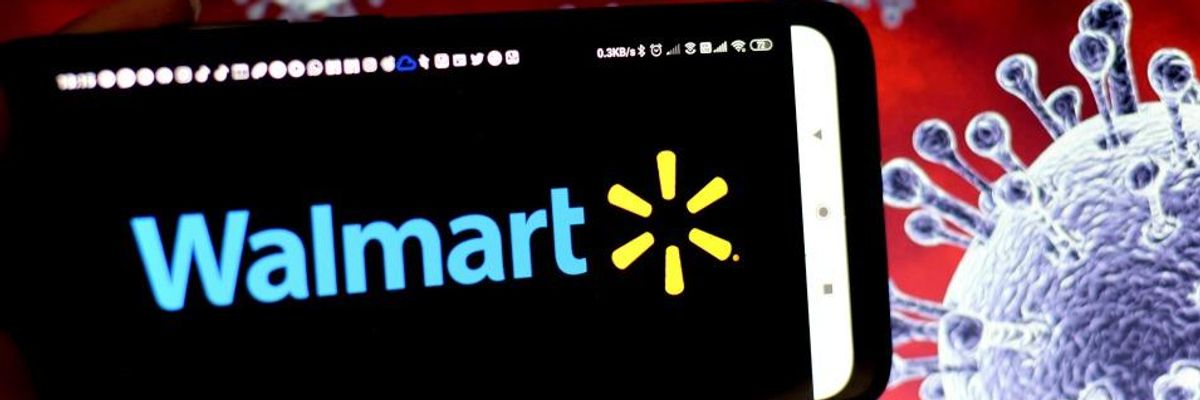
In this photo illustration a Walmart logo seen displayed on a smartphone with a COVID-19 coronavirus image in the background. (Photo: Avishek Das/SOPA Images/LightRocket via Getty Images)
Demanding Greater Say in Covid-19 Safety Policies, Just 9% of Walmart Workers Report Ability to Socially Distance at Work
Labor rights group United for Respect released new polling data regarding Covid-19 precautions as employees demanded to be able to serve on Walmart's board of directors.
The labor rights group United for Respect on Thursday released survey data showing that months after public health officials issued imperative safety guidance to companies across the U.S., employees at Walmart still do not feel safe at work from the threat of the coronavirus.
A survey of 1,500 associates at Walmart stores showed that just 9% say they are able to socially distance at work, even after the company implemented customer limits and other safety measures.
"The store is still far too crowded and social distancing isn't possible," one associate in Long Beach, California told United for Respect on May 5. "It's a free-for-all. There's no system or enforcement...Customers don't always wear masks or they take them off."
Two out of five workers surveyed said they don't trust Walmart to maintain a safe environment at work, and nearly half of company employees reported that they would come to work sick. A majority of those respondents said they would do so for fear of being penalized or reprimanded by managers if they were to stay home.
The survey was conducted this month--two months after Walmart said it was temporarily changing its attendance policy to allow workers to stay home and receive pay if they feel uncomfortable coming to work, and to provide paid sick leave for employees who contract the coronavirus. Many of the workers said their managers had not communicated with them about the Covid-19 emergency leave policy.
"Walmart is not protecting associates or customers. We're understaffed, our store is too crowded for distancing, there's not enough cleaning, and leave policies are confusing and unclear. There is a breakdown in delivering feedback up through middle and upper management," said Mary Pat Tifft, who has worked at Walmart for over three decades.
When United for Respect released the survey results on Thursday, at least 21 Walmart employees had died of Covid-19. Thousands more have contracted the disease.
Although the CDC has called on employers to inform workers when an employee contracts the coronavirus, Walmart workers say the company has not been transparent about cases in its more than 4,000 U.S. stores.
Last month, United for Respect launched an employee-driven Covid-19 tracker, allowing workers to report cases in their stores as well as provide details about precautions managers are taking--or not taking.
"There's a huge disconnect between upper management and what's happening in the stores," said Cynthia Murray, a Walmart associate of nearly 20 years. "What we say doesn't go back up the chain--middle managers don't want to hear it and don't pass on what we report."
The survey was released as Walmart employees, supported by United for Respect and shareholder advocacy group Majority Action, is calling on the company's board of directors to adopt a policy of considering hourly employees as nominees for board positions.
Doing so, employees say, would force Walmart to confront the realities of day-to-day operations at stores, particularly during the current public health crisis, and reconsider "misaligned executive compensation."
The organizations on Thursday pointed to a number of European companies on their boards, which pay higher dividends, respond well to economic downturns, and report greater or similar profitability compared with companies that have no employee board members.
"Board-level employee representation is a proven governance reform that will provide necessary insight into risks and promote long term shareholder value," said Eli Kasargod-Staub, executive director of Majority Action. "The current pandemic demonstrates clearly that workplace management is fundamental to effective governance, and that failure is a material risk. Involving workers in governance is a key part of the solution."
The board is scheduled to vote on the matter on June 3.
We are at a crossroads
This country and this world are at a monumental crossroads. US voters have an opportunity to beat back the forces of fascism and confront the billionaires who are rigging the economy, our media system, and our democracy, making it increasingly impossible for ordinary people to get by. We’re not just talking about the election. We’re talking about what must be done once these fascist elements are vanquished from power. We need a bolder set of solutions than what either major party has so far been willing to offer and a working-class movement ready to fight like hell for it. Trump didn't emerge from nowhere. The conditions that fueled MAGA authoritarianism were created by decades of radical neoliberal economic policies and a corrupt political system dominated by corporate interests. They slashed taxes on the super-rich, promising that the benefits would trickle down. They said giveaways to the corporate titans would make life more affordable for the rest of us. It was all bullshit. And when a bitter, betrayed populace searches for someone to blame, right-wing demagogues have little trouble finding scapegoats. People know when they're being lied to, but you won't hear any of this from the corporate media. Only independent journalism—powered and funded by people who believe in building a better world—can deliver truly trustworthy daily news. Our Fall Campaign is underway, and we need your help. To power our newsroom through the rest of the year, we need to raise $125,000 by midnight on October 31. So if you share our vision, please contribute whatever you can to sustain our work. |
The labor rights group United for Respect on Thursday released survey data showing that months after public health officials issued imperative safety guidance to companies across the U.S., employees at Walmart still do not feel safe at work from the threat of the coronavirus.
A survey of 1,500 associates at Walmart stores showed that just 9% say they are able to socially distance at work, even after the company implemented customer limits and other safety measures.
"The store is still far too crowded and social distancing isn't possible," one associate in Long Beach, California told United for Respect on May 5. "It's a free-for-all. There's no system or enforcement...Customers don't always wear masks or they take them off."
Two out of five workers surveyed said they don't trust Walmart to maintain a safe environment at work, and nearly half of company employees reported that they would come to work sick. A majority of those respondents said they would do so for fear of being penalized or reprimanded by managers if they were to stay home.
The survey was conducted this month--two months after Walmart said it was temporarily changing its attendance policy to allow workers to stay home and receive pay if they feel uncomfortable coming to work, and to provide paid sick leave for employees who contract the coronavirus. Many of the workers said their managers had not communicated with them about the Covid-19 emergency leave policy.
"Walmart is not protecting associates or customers. We're understaffed, our store is too crowded for distancing, there's not enough cleaning, and leave policies are confusing and unclear. There is a breakdown in delivering feedback up through middle and upper management," said Mary Pat Tifft, who has worked at Walmart for over three decades.
When United for Respect released the survey results on Thursday, at least 21 Walmart employees had died of Covid-19. Thousands more have contracted the disease.
Although the CDC has called on employers to inform workers when an employee contracts the coronavirus, Walmart workers say the company has not been transparent about cases in its more than 4,000 U.S. stores.
Last month, United for Respect launched an employee-driven Covid-19 tracker, allowing workers to report cases in their stores as well as provide details about precautions managers are taking--or not taking.
"There's a huge disconnect between upper management and what's happening in the stores," said Cynthia Murray, a Walmart associate of nearly 20 years. "What we say doesn't go back up the chain--middle managers don't want to hear it and don't pass on what we report."
The survey was released as Walmart employees, supported by United for Respect and shareholder advocacy group Majority Action, is calling on the company's board of directors to adopt a policy of considering hourly employees as nominees for board positions.
Doing so, employees say, would force Walmart to confront the realities of day-to-day operations at stores, particularly during the current public health crisis, and reconsider "misaligned executive compensation."
The organizations on Thursday pointed to a number of European companies on their boards, which pay higher dividends, respond well to economic downturns, and report greater or similar profitability compared with companies that have no employee board members.
"Board-level employee representation is a proven governance reform that will provide necessary insight into risks and promote long term shareholder value," said Eli Kasargod-Staub, executive director of Majority Action. "The current pandemic demonstrates clearly that workplace management is fundamental to effective governance, and that failure is a material risk. Involving workers in governance is a key part of the solution."
The board is scheduled to vote on the matter on June 3.