SUBSCRIBE TO OUR FREE NEWSLETTER
Daily news & progressive opinion—funded by the people, not the corporations—delivered straight to your inbox.
5
#000000
#FFFFFF
To donate by check, phone, or other method, see our More Ways to Give page.
Daily news & progressive opinion—funded by the people, not the corporations—delivered straight to your inbox.
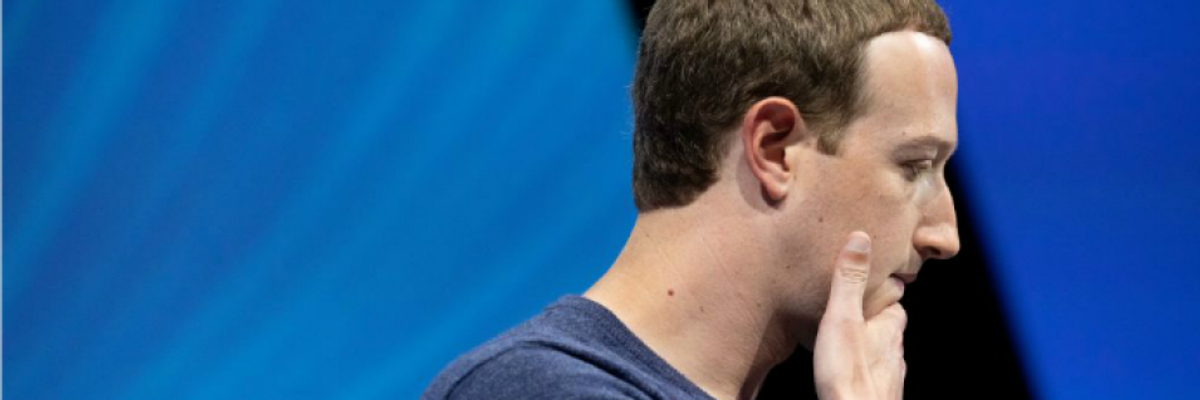
Mark Zuckerberg, chief executive officer and founder of Facebook, attends the Viva Tech start-up and technology gathering at Parc des Expositions Porte de Versailles on May 24, 2018 in Paris, France. (Photo: Christophe Morin/IP3/Getty Images)
Despite internal research that Facebook's platform was exploiting and exacerbating divisiveness among its users, top executives ignored the findings that the algorithms were doing the exact opposite of the company's stated public mission to bring people together.
That's according to new reporting Tuesday from the Wall Street Journal which in a comprehensive dive into the company's treatment of its platform's capabilities to divide users found that executives knew in 2018 what the site was doing to users but declined to take action.
"The most persistent myth about Facebook is that it naively bumbles its way into trouble," tweeted New York Times tech columnist Kevin Roose. "It has always known what it is, and what it's doing to society."
"Our algorithms exploit the human brain's attraction to divisiveness," a presentation to the company's leaders in 2018 declared. The research further warned that if the problem was "left unchecked," the platform's system would feed users "more and more divisive content in an effort to gain user attention & increase time on the platform."
As the Daily Beast explained:
The social-media giant, which boasts its mission is to "connect the world," reportedly launched a research project in 2017 led by Facebook's former Chief Product Officer Chris Cox to study how its algorithms aggravate divisive and harmful content. The task force named "Common Ground" assigned employees into "Integrity Teams" throughout the company. The team reportedly found that while some groups united people from various backgrounds, others only accelerated conflict and misinformation.
Despite the evidence laid out in Cox's team's presentation, however, the company's board--particularly vice president of global public policy Joel Kaplan--rejected taking action to change the platform's algorithm and incentives.
According to the Journal, Kaplan has outsized power at Facebook when it comes to determining the direction of the company:
A former deputy chief of staff to George W. Bush, Mr. Kaplan became more involved in content-ranking decisions after 2016 allegations Facebook had suppressed trending news stories from conservative outlets. An internal review didn't substantiate the claims of bias, Facebook's then-general counsel Colin Stretch told Congress, but the damage to Facebook's reputation among conservatives had been done.
[...]
Disapproval from Mr. Kaplan's team or Facebook's communications department could scuttle a project, said people familiar with the effort. Negative policy-team reviews killed efforts to build a classification system for hyperpolarized content.
Journalists took to Twitter to note the timeline of the meeting and their requests for information on the platform's incentives.
"I visited Facebook HQ around this time to ask about the growing instances of mass violence linked the platform," tweeted New York Times reporter Max Fisher. "One executive after another looked me in the eye and said they had no reason to believe the platform itself drove bad behavior."
The reporting, said tech accountability advocacy group Freedom From Google and Facebook, "proves what we've been saying all along: Facebook knows what it's doing, intentionally continues to cause harm to increase engagement and profit, and will never fix these problems themselves."
"Until Congress, state attorneys general, the FTC, or DOJ breaks up Facebook's monopoly and further regulates them," the group added, "nothing is going to change."
Dear Common Dreams reader, It’s been nearly 30 years since I co-founded Common Dreams with my late wife, Lina Newhouser. We had the radical notion that journalism should serve the public good, not corporate profits. It was clear to us from the outset what it would take to build such a project. No paid advertisements. No corporate sponsors. No millionaire publisher telling us what to think or do. Many people said we wouldn't last a year, but we proved those doubters wrong. Together with a tremendous team of journalists and dedicated staff, we built an independent media outlet free from the constraints of profits and corporate control. Our mission has always been simple: To inform. To inspire. To ignite change for the common good. Building Common Dreams was not easy. Our survival was never guaranteed. When you take on the most powerful forces—Wall Street greed, fossil fuel industry destruction, Big Tech lobbyists, and uber-rich oligarchs who have spent billions upon billions rigging the economy and democracy in their favor—the only bulwark you have is supporters who believe in your work. But here’s the urgent message from me today. It's never been this bad out there. And it's never been this hard to keep us going. At the very moment Common Dreams is most needed, the threats we face are intensifying. We need your support now more than ever. We don't accept corporate advertising and never will. We don't have a paywall because we don't think people should be blocked from critical news based on their ability to pay. Everything we do is funded by the donations of readers like you. When everyone does the little they can afford, we are strong. But if that support retreats or dries up, so do we. Will you donate now to make sure Common Dreams not only survives but thrives? —Craig Brown, Co-founder |
Despite internal research that Facebook's platform was exploiting and exacerbating divisiveness among its users, top executives ignored the findings that the algorithms were doing the exact opposite of the company's stated public mission to bring people together.
That's according to new reporting Tuesday from the Wall Street Journal which in a comprehensive dive into the company's treatment of its platform's capabilities to divide users found that executives knew in 2018 what the site was doing to users but declined to take action.
"The most persistent myth about Facebook is that it naively bumbles its way into trouble," tweeted New York Times tech columnist Kevin Roose. "It has always known what it is, and what it's doing to society."
"Our algorithms exploit the human brain's attraction to divisiveness," a presentation to the company's leaders in 2018 declared. The research further warned that if the problem was "left unchecked," the platform's system would feed users "more and more divisive content in an effort to gain user attention & increase time on the platform."
As the Daily Beast explained:
The social-media giant, which boasts its mission is to "connect the world," reportedly launched a research project in 2017 led by Facebook's former Chief Product Officer Chris Cox to study how its algorithms aggravate divisive and harmful content. The task force named "Common Ground" assigned employees into "Integrity Teams" throughout the company. The team reportedly found that while some groups united people from various backgrounds, others only accelerated conflict and misinformation.
Despite the evidence laid out in Cox's team's presentation, however, the company's board--particularly vice president of global public policy Joel Kaplan--rejected taking action to change the platform's algorithm and incentives.
According to the Journal, Kaplan has outsized power at Facebook when it comes to determining the direction of the company:
A former deputy chief of staff to George W. Bush, Mr. Kaplan became more involved in content-ranking decisions after 2016 allegations Facebook had suppressed trending news stories from conservative outlets. An internal review didn't substantiate the claims of bias, Facebook's then-general counsel Colin Stretch told Congress, but the damage to Facebook's reputation among conservatives had been done.
[...]
Disapproval from Mr. Kaplan's team or Facebook's communications department could scuttle a project, said people familiar with the effort. Negative policy-team reviews killed efforts to build a classification system for hyperpolarized content.
Journalists took to Twitter to note the timeline of the meeting and their requests for information on the platform's incentives.
"I visited Facebook HQ around this time to ask about the growing instances of mass violence linked the platform," tweeted New York Times reporter Max Fisher. "One executive after another looked me in the eye and said they had no reason to believe the platform itself drove bad behavior."
The reporting, said tech accountability advocacy group Freedom From Google and Facebook, "proves what we've been saying all along: Facebook knows what it's doing, intentionally continues to cause harm to increase engagement and profit, and will never fix these problems themselves."
"Until Congress, state attorneys general, the FTC, or DOJ breaks up Facebook's monopoly and further regulates them," the group added, "nothing is going to change."
Despite internal research that Facebook's platform was exploiting and exacerbating divisiveness among its users, top executives ignored the findings that the algorithms were doing the exact opposite of the company's stated public mission to bring people together.
That's according to new reporting Tuesday from the Wall Street Journal which in a comprehensive dive into the company's treatment of its platform's capabilities to divide users found that executives knew in 2018 what the site was doing to users but declined to take action.
"The most persistent myth about Facebook is that it naively bumbles its way into trouble," tweeted New York Times tech columnist Kevin Roose. "It has always known what it is, and what it's doing to society."
"Our algorithms exploit the human brain's attraction to divisiveness," a presentation to the company's leaders in 2018 declared. The research further warned that if the problem was "left unchecked," the platform's system would feed users "more and more divisive content in an effort to gain user attention & increase time on the platform."
As the Daily Beast explained:
The social-media giant, which boasts its mission is to "connect the world," reportedly launched a research project in 2017 led by Facebook's former Chief Product Officer Chris Cox to study how its algorithms aggravate divisive and harmful content. The task force named "Common Ground" assigned employees into "Integrity Teams" throughout the company. The team reportedly found that while some groups united people from various backgrounds, others only accelerated conflict and misinformation.
Despite the evidence laid out in Cox's team's presentation, however, the company's board--particularly vice president of global public policy Joel Kaplan--rejected taking action to change the platform's algorithm and incentives.
According to the Journal, Kaplan has outsized power at Facebook when it comes to determining the direction of the company:
A former deputy chief of staff to George W. Bush, Mr. Kaplan became more involved in content-ranking decisions after 2016 allegations Facebook had suppressed trending news stories from conservative outlets. An internal review didn't substantiate the claims of bias, Facebook's then-general counsel Colin Stretch told Congress, but the damage to Facebook's reputation among conservatives had been done.
[...]
Disapproval from Mr. Kaplan's team or Facebook's communications department could scuttle a project, said people familiar with the effort. Negative policy-team reviews killed efforts to build a classification system for hyperpolarized content.
Journalists took to Twitter to note the timeline of the meeting and their requests for information on the platform's incentives.
"I visited Facebook HQ around this time to ask about the growing instances of mass violence linked the platform," tweeted New York Times reporter Max Fisher. "One executive after another looked me in the eye and said they had no reason to believe the platform itself drove bad behavior."
The reporting, said tech accountability advocacy group Freedom From Google and Facebook, "proves what we've been saying all along: Facebook knows what it's doing, intentionally continues to cause harm to increase engagement and profit, and will never fix these problems themselves."
"Until Congress, state attorneys general, the FTC, or DOJ breaks up Facebook's monopoly and further regulates them," the group added, "nothing is going to change."