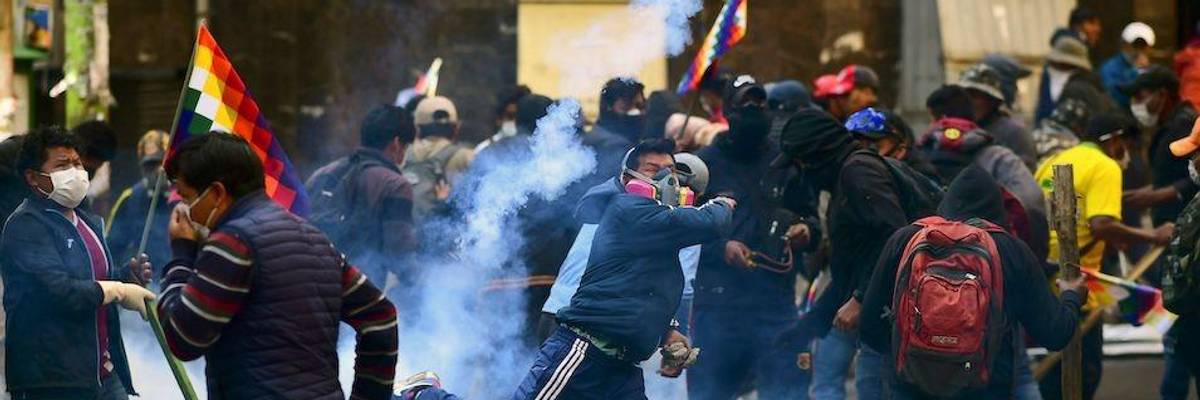
Supporters of Bolivian ex-president Evo Morales clash with riot police during a protest against the interim government in La Paz on November 15, 2019. (Photo: Ronaldo Schemidt/AFP/Getty Images)
'It Was--Then as Now--Clearly a Coup': NYT Finally Gets Around to Reporting OAS Fraud Election Claims in Bolivia Were Bogus
"For those paying close attention to the 2019 election, there was never any doubt that the OAS' claims of fraud were bogus."
More than seven months after claims of fraudulent elections sparked an undemocratic coup that led to the ouster of Bolivian President Evo Morales, the New York Times late Sunday reported on new research showing the U.S.-led Organization of American States used flawed data and analysis to support its widely cited contention the voting was rigged.
"It was clear from the start, but now even the NYT is admitting: what happened in Bolivia was nothing short of a coup by the U.S. and its OAS puppet, deposing one of the most successful democratically elected leaders in modern Latin American history," tweeted journalist Glenn Greenwald in response to the tTimes reportin.
As Common Dreams reported in November, U.S. officials cited the OAS report on the election as a justification for backing the coup that deposed Morales, the left-wing Indigenous former president.
Despite reporting from the Center for Economic and Policy Research (CEPR) casting doubt on those claims within 24 hours of the OAS making them, the Times only covered the problems with the U.S.-dominated organization's analysis after a study (pdf) from three independent researchers found the same results.
As the Times reported Monday:
The authors of the new study said they were unable to replicate the O.A.S.'s findings using its likely techniques. They said a sudden change in the trend appeared only when they excluded results from the manually processed, late-reporting polling booths.
This suggests that the organization used an incorrect data set to reach its conclusion, the researchers said. The difference is significant: the 1,500 excluded late-reporting booths account for the bulk of the final votes that the O.A.S. statistical analysis claims are suspicious.
In a statement, CEPR research associate Jake Johnston said that the OAS "continued to repeat its false assertions for many months with little to no pushback or accountability" despite his organization's finding to the contrary.
"For those paying close attention to the 2019 election, there was never any doubt that the OAS' claims of fraud were bogus," said Johnston.
Since the coup, the human rights situation in the Latin American country has gone from bad to worse as the government of far-right interim president Jeanine Anez has rolled back reforms put in place by Morales, opened the country's resources to private exploitation, and delayed scheduled elections under the pretext of public health due to the coronavirus outbreak.
"The OAS bears responsibility for the significant deterioration of the human rights situation in Bolivia since Morales' ouster," said CEPR co-director Mark Weisbrot.
Weisbrot warned that if the OAS and its leadership is "allowed to get away with such politically driven falsification of their electoral observation results again, this threatens not only Bolivian democracy but the democracy of any country where the OAS may be involved in elections in the future."
We are at a crossroads
This country and this world are at a monumental crossroads. In a few short weeks, US voters will have an opportunity to beat back the forces of fascism and confront the billionaires who are rigging the economy, our media system, and our democracy, making it increasingly impossible for ordinary people to get by. We’re not just talking about the election. We’re talking about what must be done once these fascist elements are vanquished from power. We need a bolder set of solutions than what either major party has so far been willing to offer and a working-class movement ready to fight like hell for it. Trump didn't emerge from nowhere. The conditions that fueled MAGA authoritarianism were created by decades of radical neoliberal economic policies and a corrupt political system dominated by corporate interests. They slashed taxes on the super-rich, promising that the benefits would trickle down. They said giveaways to the corporate titans would make life more affordable for the rest of us. It was all bullshit. And when a bitter, betrayed populace searches for someone to blame, right-wing demagogues have little trouble finding scapegoats. People know when they're being lied to, but you won't hear any of this from the corporate media. Only independent journalism—powered and funded by people who believe in building a better world—can deliver truly trustworthy daily news. Our Fall Campaign is underway, and we need your help. To power our newsroom through the rest of the year, we need to raise $125,000 by midnight on October 31. So if you share our vision, please contribute whatever you can to sustain our work. |
More than seven months after claims of fraudulent elections sparked an undemocratic coup that led to the ouster of Bolivian President Evo Morales, the New York Times late Sunday reported on new research showing the U.S.-led Organization of American States used flawed data and analysis to support its widely cited contention the voting was rigged.
"It was clear from the start, but now even the NYT is admitting: what happened in Bolivia was nothing short of a coup by the U.S. and its OAS puppet, deposing one of the most successful democratically elected leaders in modern Latin American history," tweeted journalist Glenn Greenwald in response to the tTimes reportin.
As Common Dreams reported in November, U.S. officials cited the OAS report on the election as a justification for backing the coup that deposed Morales, the left-wing Indigenous former president.
Despite reporting from the Center for Economic and Policy Research (CEPR) casting doubt on those claims within 24 hours of the OAS making them, the Times only covered the problems with the U.S.-dominated organization's analysis after a study (pdf) from three independent researchers found the same results.
As the Times reported Monday:
The authors of the new study said they were unable to replicate the O.A.S.'s findings using its likely techniques. They said a sudden change in the trend appeared only when they excluded results from the manually processed, late-reporting polling booths.
This suggests that the organization used an incorrect data set to reach its conclusion, the researchers said. The difference is significant: the 1,500 excluded late-reporting booths account for the bulk of the final votes that the O.A.S. statistical analysis claims are suspicious.
In a statement, CEPR research associate Jake Johnston said that the OAS "continued to repeat its false assertions for many months with little to no pushback or accountability" despite his organization's finding to the contrary.
"For those paying close attention to the 2019 election, there was never any doubt that the OAS' claims of fraud were bogus," said Johnston.
Since the coup, the human rights situation in the Latin American country has gone from bad to worse as the government of far-right interim president Jeanine Anez has rolled back reforms put in place by Morales, opened the country's resources to private exploitation, and delayed scheduled elections under the pretext of public health due to the coronavirus outbreak.
"The OAS bears responsibility for the significant deterioration of the human rights situation in Bolivia since Morales' ouster," said CEPR co-director Mark Weisbrot.
Weisbrot warned that if the OAS and its leadership is "allowed to get away with such politically driven falsification of their electoral observation results again, this threatens not only Bolivian democracy but the democracy of any country where the OAS may be involved in elections in the future."