
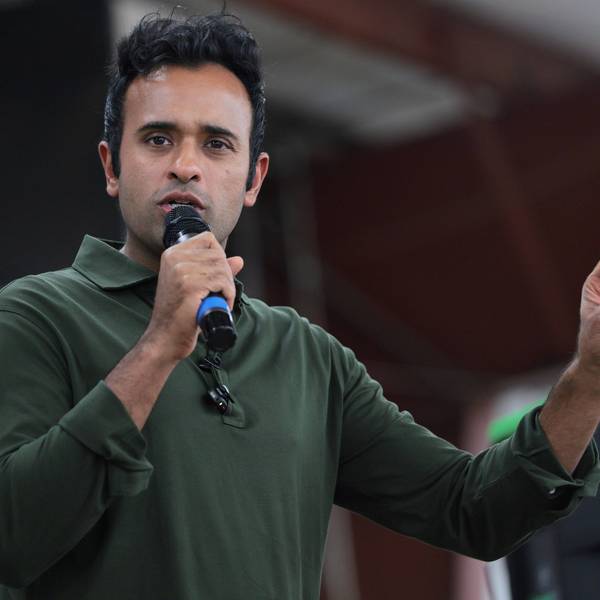

Education Secretary Betsy DeVos at the Conservative Political Action Conference (CPAC) in 2017. (Photo: Gage Skidmore/Flickr/cc)
'This Is Cruel': DeVos Bars Certain Students, Including DACA Recipients, From Covid-19 Relief Funds
"These extreme eligibility requirements will not only harm students, but they are also contrary to congressional intent," said Sen. Patty Murray.
Education Secretary Betsy DeVos sparked outrage Thursday by doubling down on an April guidance that bars U.S. higher education institutions from giving any federal coronavirus relief funds to foreign, undocumented, and certain other students.
"As students across the country are struggling to make ends meet in the face of unprecedented financial challenges, Secretary DeVos' efforts to deny some much-needed aid is cruel."
--Sen. Patty Murray
"Secretary Betsy DeVos' rule makes clear that even though Covid-19 doesn't discriminate, this administration does," declared Randi Weingarten, president of the American Federation of Teachers (AFT), the nation's second-largest educators union.
"Our country is facing three major crises--a public health crisis, an economic crisis, and a racial justice crisis--all of which exacerbate the inequalities in our communities and require more help from our federal government, not less," she said. "Yet in our moment of greatest need, this administration doubles down on its bigoted, anti-immigrant stance, and DeVos does the dirty work by cutting off any aid that could help our undocumented students."
The announcement came after Eloy Ortiz Oakley, chancellor of California Community Colleges, and Washington state Attorney General Bob Ferguson brought legal challenges against the April guidance in May--the same month the Department of Education claimed (pdf) the guidance was "preliminary" and would not be enforced.
However, the new interim final rule (pdf)--which reiterates the guidance's eligibility requirements--will carry the force of law. According to the DOE, the rule will be published in the Federal Register Monday and take effect after a 30-day public comment period.
The rule pertains to the Higher Education Emergency Relief Fund (HEERF) established under the Coronavirus Aid, Relief, and Economic Security (CARES) Act that President Donald Trump signed in late March. The fund enables colleges and universities to provide about $6 billion in cash grants to students whose lives and studies have been disrupted by the pandemic to spend on necessities such as course materials, food, healthcare, and childcare.
Students protected by Deferred Action for Childhood Arrivals (DACA)--an Obama-era program that allows some immigrants brought to the country as children but not legally in the United States to temporarily live, work, and study in the country--would be excluded from receiving relief funds. Trump has repeatedly attacked DACA and its recipients. The U.S. Supreme Court is expected to weigh in on the program's future soon.
"This is cruel," the Leadership Conference on Civil and Human Rights tweeted Thursday of DOE's attack on DACA recipients, who are often called Dreamers due to some related legislative proposals. The group's president Vanita Gupta previously condemned the April guidance as "cruel and outrageous."
"Undocumented immigrants have been working on the frontlines of this pandemic and are the backbone of this country, but in return for their service, they're being told they're ineligible for most of the pandemic aid available," said AFT's Weingarten. "From stimulus checks to unemployment, undocumented immigrants have been left out and left behind, and now DeVos wants to extend that attack to immigrant students as well."
DACA recipients aren't the only students targeted by the rule. New York Times education reporter Erica L. Green tweeted a list of some other groups who will be excluded from receiving emergency relief under the rule:
As the DOE statement explained:
By aligning student eligibility requirements for emergency financial aid grants under the CARES Act with Title IV eligibility, which dictates which students can receive taxpayer-subsidized student loans or grants, foreign nationals and most other noncitizens would not be eligible, as well as those who: (1) are dual-enrolled in secondary school; (2) do not meet academic progress standards; (3) are in default on a federal student loan or owe any refund relating to a federal student grant; (4) are without a high school diploma, GED certification, or recognized equivalent or exception; or (5) are in programs that are not Title IV-eligible programs.
DeVos said Thursday that the rule "helps erase any uncertainty some institutions have expressed and helps make sure we can support America's students facing the greatest needs. We have a responsibility to taxpayers to administer the CARES Act faithfully, and that's exactly what we're doing."
However, Sen. Patty Murray (D-Wash.)--ranking member of the Senate Health, Education, Labor, and Pensions (HELP) Committee--pushed back against that claim in a statement, echoing previous arguments from Democratic lawmakers and higher education experts that the DOE's position does not align with the March legislation.
"As students across the country are struggling to make ends meet in the face of unprecedented financial challenges, Secretary DeVos' efforts to deny some much-needed aid is cruel," Murray said. "These extreme eligibility requirements will not only harm students, but they are also contrary to congressional intent. I'll keep fighting to ensure that students get the relief they need--and that Secretary DeVos implements the law as Congress intended."
We are at a crossroads
This country and this world are at a monumental crossroads. In a few short weeks, US voters will have an opportunity to beat back the forces of fascism and confront the billionaires who are rigging the economy, our media system, and our democracy, making it increasingly impossible for ordinary people to get by. We’re not just talking about the election. We’re talking about what must be done once these fascist elements are vanquished from power. We need a bolder set of solutions than what either major party has so far been willing to offer and a working-class movement ready to fight like hell for it. Trump didn't emerge from nowhere. The conditions that fueled MAGA authoritarianism were created by decades of radical neoliberal economic policies and a corrupt political system dominated by corporate interests. They slashed taxes on the super-rich, promising that the benefits would trickle down. They said giveaways to the corporate titans would make life more affordable for the rest of us. It was all bullshit. And when a bitter, betrayed populace searches for someone to blame, right-wing demagogues have little trouble finding scapegoats. People know when they're being lied to, but you won't hear any of this from the corporate media. Only independent journalism—powered and funded by people who believe in building a better world—can deliver truly trustworthy daily news. Our Fall Campaign is underway, and we need your help. To power our newsroom through the rest of the year, we need to raise $125,000 by midnight on October 31. So if you share our vision, please contribute whatever you can to sustain our work. |
Education Secretary Betsy DeVos sparked outrage Thursday by doubling down on an April guidance that bars U.S. higher education institutions from giving any federal coronavirus relief funds to foreign, undocumented, and certain other students.
"As students across the country are struggling to make ends meet in the face of unprecedented financial challenges, Secretary DeVos' efforts to deny some much-needed aid is cruel."
--Sen. Patty Murray
"Secretary Betsy DeVos' rule makes clear that even though Covid-19 doesn't discriminate, this administration does," declared Randi Weingarten, president of the American Federation of Teachers (AFT), the nation's second-largest educators union.
"Our country is facing three major crises--a public health crisis, an economic crisis, and a racial justice crisis--all of which exacerbate the inequalities in our communities and require more help from our federal government, not less," she said. "Yet in our moment of greatest need, this administration doubles down on its bigoted, anti-immigrant stance, and DeVos does the dirty work by cutting off any aid that could help our undocumented students."
The announcement came after Eloy Ortiz Oakley, chancellor of California Community Colleges, and Washington state Attorney General Bob Ferguson brought legal challenges against the April guidance in May--the same month the Department of Education claimed (pdf) the guidance was "preliminary" and would not be enforced.
However, the new interim final rule (pdf)--which reiterates the guidance's eligibility requirements--will carry the force of law. According to the DOE, the rule will be published in the Federal Register Monday and take effect after a 30-day public comment period.
The rule pertains to the Higher Education Emergency Relief Fund (HEERF) established under the Coronavirus Aid, Relief, and Economic Security (CARES) Act that President Donald Trump signed in late March. The fund enables colleges and universities to provide about $6 billion in cash grants to students whose lives and studies have been disrupted by the pandemic to spend on necessities such as course materials, food, healthcare, and childcare.
Students protected by Deferred Action for Childhood Arrivals (DACA)--an Obama-era program that allows some immigrants brought to the country as children but not legally in the United States to temporarily live, work, and study in the country--would be excluded from receiving relief funds. Trump has repeatedly attacked DACA and its recipients. The U.S. Supreme Court is expected to weigh in on the program's future soon.
"This is cruel," the Leadership Conference on Civil and Human Rights tweeted Thursday of DOE's attack on DACA recipients, who are often called Dreamers due to some related legislative proposals. The group's president Vanita Gupta previously condemned the April guidance as "cruel and outrageous."
"Undocumented immigrants have been working on the frontlines of this pandemic and are the backbone of this country, but in return for their service, they're being told they're ineligible for most of the pandemic aid available," said AFT's Weingarten. "From stimulus checks to unemployment, undocumented immigrants have been left out and left behind, and now DeVos wants to extend that attack to immigrant students as well."
DACA recipients aren't the only students targeted by the rule. New York Times education reporter Erica L. Green tweeted a list of some other groups who will be excluded from receiving emergency relief under the rule:
As the DOE statement explained:
By aligning student eligibility requirements for emergency financial aid grants under the CARES Act with Title IV eligibility, which dictates which students can receive taxpayer-subsidized student loans or grants, foreign nationals and most other noncitizens would not be eligible, as well as those who: (1) are dual-enrolled in secondary school; (2) do not meet academic progress standards; (3) are in default on a federal student loan or owe any refund relating to a federal student grant; (4) are without a high school diploma, GED certification, or recognized equivalent or exception; or (5) are in programs that are not Title IV-eligible programs.
DeVos said Thursday that the rule "helps erase any uncertainty some institutions have expressed and helps make sure we can support America's students facing the greatest needs. We have a responsibility to taxpayers to administer the CARES Act faithfully, and that's exactly what we're doing."
However, Sen. Patty Murray (D-Wash.)--ranking member of the Senate Health, Education, Labor, and Pensions (HELP) Committee--pushed back against that claim in a statement, echoing previous arguments from Democratic lawmakers and higher education experts that the DOE's position does not align with the March legislation.
"As students across the country are struggling to make ends meet in the face of unprecedented financial challenges, Secretary DeVos' efforts to deny some much-needed aid is cruel," Murray said. "These extreme eligibility requirements will not only harm students, but they are also contrary to congressional intent. I'll keep fighting to ensure that students get the relief they need--and that Secretary DeVos implements the law as Congress intended."