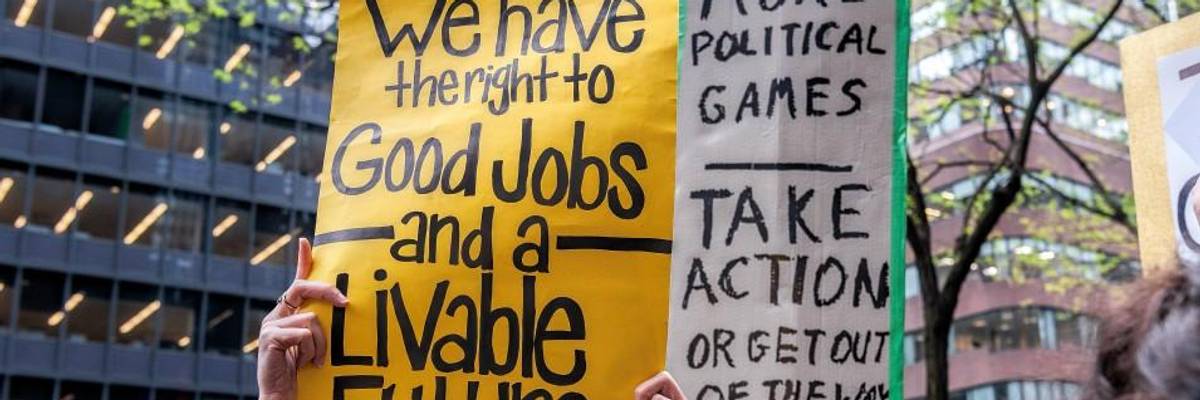
Sunrise NYC, a climate activist group, rallies in front of Senate Minority Leader Chuck Schumer's office in Midtown Manhattan demanding that he support the Green New Deal. (Photo: Gabriele Holtermann-Gorden/Pacific Press/LightRocket via Getty Images)
Research Shows 'Linking Climate Policy to Social and Economic Justice Makes It More Popular'
"The public wants a Green New Deal. The public wants green stimulus. The public wants to address inequality."
Amid persistent calls for a green and just recovery from the ongoing coronavirus pandemic and nationwide protests against systemic racism and injustice, researchers on Friday detailed recent studies showing "policy packages that address the climate crisis alongside income inequality, racial injustice, and the economic crisis are more popular among voters."
The protests sparked by Minneapolis police killing George Floyd have renewed pressure on all levels of government to pursue racial justice--and not just in terms of police violence against historically marginalized groups, particularly black Americans, but also when it comes to economic and environmental injustice.
In their piece for the Washington Post, the three researchers acknowledge the current slate of urgent crises facing the country and how these crises are linked to racial inequality before detailing the results of two nationally representative public opinion studies they conducted over the past year. "The take-home message is clear," the researchers write. "Linking climate policy with social and economic reforms makes climate action more popular with the public."
One example of this policymaking approach that the researchers highlight is the Green New Deal resolution introduced in February 2019 by Rep. Alexandria Ocasio-Cortez (D-N.Y.) and Sen. Ed Markey (D-Mass.). The resolution calls for tackling "the existential threat posed by climate change" through a 10-year shift to 100% clean energy that ensures a just transition for workers and frontline communities, in part by creating millions of new, well-paying jobs.
The researchers behind the studies and Post piece are Parrish Bergquist--a postdoctoral researcher at the Yale Program on Climate Change Communication and an incoming assistant professor of public policy at Georgetown University--along with Matto Mildenberger and Leah Stokes, who are both assistant professors of political science at the University of California at Santa Barbara and have each published books on climate policymaking.
In a tweet about the Post piece Friday, Stokes reiterated their finding that "linking climate policy to social and economic justice makes it more popular" and drew attention to the resolution from Ocasio-Cortez and Markey, writing that it turns out they "had a really popular idea when they proposed the Green New Deal."
The first study--detailed in a peer-reviewed, open access paper published last month in Environmental Research Letters--surveyed 2,476 Americans online last summer. Some respondents reviewed climate packages that included social or economic programs while others reviewed packages with only climate policies.
"We found unambiguous evidence that Americans support the key idea behind the Green New Deal: addressing climate change alongside economic and social problems," the researchers write in the Post. As they explain:
Compared with a policy package with only climate reforms, including economic policies such as a jobs guarantee, unionized clean energy jobs, and retraining for fossil fuel workers increased support for the package by an average of 12 percentage points. While Democrats in our survey viewed these policies more favorably, including economic measures in a climate package does not drive Republicans away.
We found similar results when we added some social policy planks, such as affordable housing and a $15 minimum wage. The social policies we tested increased support for a climate policy package by an average of 11 percentage points. That said, some social policies--such as universal, government-run health insurance and free college--increased the package's overall popularity but decreased Republican support.
The second study, conducted last month, surveyed 1,049 Americans to determine the popularity of including climate policies in the stimulus packages necessitated by the ongoing pandemic. Similar to the first study, the researchers found "packages that invest in clean energy and transportation are more popular than coronavirus spending that ignores the climate crisis."
"In our survey, including investments in wind and solar increases support by 8.5 percentage points, making it one of the most popular policy planks that we tested. While clean energy investments are mostly popular among Democrats, including them does not decrease Republican support," they write. "Yet, so far, Congress has not focused on green stimulus."
The researches note that "the climate crisis will not take a break during the pandemic" and "climate impacts will fall disproportionately on communities of color, including black Americans--the same groups who are already hit hardest by the Covid-19 crisis, unemployment, and police brutality."
Given the popularity of pairing urgently needed climate action with policies that address inequality, racial injustice, and the economic crisis, the researchers conclude that "in the future, we might find Congress taking this approach."
The piece comes about a week after the DNC Council on the Environment and Climate Crisis put out a Democratic Party platform recommendation--directed at presumptive presidential nominee Joe Biden--calling for a national plan through 2050 that is "informed by the vision and aspirations of the Green New Deal."
We are at a crossroads
This country and this world are at a monumental crossroads. US voters have an opportunity to beat back the forces of fascism and confront the billionaires who are rigging the economy, our media system, and our democracy, making it increasingly impossible for ordinary people to get by. We’re not just talking about the election. We’re talking about what must be done once these fascist elements are vanquished from power. We need a bolder set of solutions than what either major party has so far been willing to offer and a working-class movement ready to fight like hell for it. Trump didn't emerge from nowhere. The conditions that fueled MAGA authoritarianism were created by decades of radical neoliberal economic policies and a corrupt political system dominated by corporate interests. They slashed taxes on the super-rich, promising that the benefits would trickle down. They said giveaways to the corporate titans would make life more affordable for the rest of us. It was all bullshit. And when a bitter, betrayed populace searches for someone to blame, right-wing demagogues have little trouble finding scapegoats. People know when they're being lied to, but you won't hear any of this from the corporate media. Only independent journalism—powered and funded by people who believe in building a better world—can deliver truly trustworthy daily news. Our Fall Campaign is underway, and we need your help. To power our newsroom through the rest of the year, we need to raise $125,000 by midnight on October 31. So if you share our vision, please contribute whatever you can to sustain our work. |
Amid persistent calls for a green and just recovery from the ongoing coronavirus pandemic and nationwide protests against systemic racism and injustice, researchers on Friday detailed recent studies showing "policy packages that address the climate crisis alongside income inequality, racial injustice, and the economic crisis are more popular among voters."
The protests sparked by Minneapolis police killing George Floyd have renewed pressure on all levels of government to pursue racial justice--and not just in terms of police violence against historically marginalized groups, particularly black Americans, but also when it comes to economic and environmental injustice.
In their piece for the Washington Post, the three researchers acknowledge the current slate of urgent crises facing the country and how these crises are linked to racial inequality before detailing the results of two nationally representative public opinion studies they conducted over the past year. "The take-home message is clear," the researchers write. "Linking climate policy with social and economic reforms makes climate action more popular with the public."
One example of this policymaking approach that the researchers highlight is the Green New Deal resolution introduced in February 2019 by Rep. Alexandria Ocasio-Cortez (D-N.Y.) and Sen. Ed Markey (D-Mass.). The resolution calls for tackling "the existential threat posed by climate change" through a 10-year shift to 100% clean energy that ensures a just transition for workers and frontline communities, in part by creating millions of new, well-paying jobs.
The researchers behind the studies and Post piece are Parrish Bergquist--a postdoctoral researcher at the Yale Program on Climate Change Communication and an incoming assistant professor of public policy at Georgetown University--along with Matto Mildenberger and Leah Stokes, who are both assistant professors of political science at the University of California at Santa Barbara and have each published books on climate policymaking.
In a tweet about the Post piece Friday, Stokes reiterated their finding that "linking climate policy to social and economic justice makes it more popular" and drew attention to the resolution from Ocasio-Cortez and Markey, writing that it turns out they "had a really popular idea when they proposed the Green New Deal."
The first study--detailed in a peer-reviewed, open access paper published last month in Environmental Research Letters--surveyed 2,476 Americans online last summer. Some respondents reviewed climate packages that included social or economic programs while others reviewed packages with only climate policies.
"We found unambiguous evidence that Americans support the key idea behind the Green New Deal: addressing climate change alongside economic and social problems," the researchers write in the Post. As they explain:
Compared with a policy package with only climate reforms, including economic policies such as a jobs guarantee, unionized clean energy jobs, and retraining for fossil fuel workers increased support for the package by an average of 12 percentage points. While Democrats in our survey viewed these policies more favorably, including economic measures in a climate package does not drive Republicans away.
We found similar results when we added some social policy planks, such as affordable housing and a $15 minimum wage. The social policies we tested increased support for a climate policy package by an average of 11 percentage points. That said, some social policies--such as universal, government-run health insurance and free college--increased the package's overall popularity but decreased Republican support.
The second study, conducted last month, surveyed 1,049 Americans to determine the popularity of including climate policies in the stimulus packages necessitated by the ongoing pandemic. Similar to the first study, the researchers found "packages that invest in clean energy and transportation are more popular than coronavirus spending that ignores the climate crisis."
"In our survey, including investments in wind and solar increases support by 8.5 percentage points, making it one of the most popular policy planks that we tested. While clean energy investments are mostly popular among Democrats, including them does not decrease Republican support," they write. "Yet, so far, Congress has not focused on green stimulus."
The researches note that "the climate crisis will not take a break during the pandemic" and "climate impacts will fall disproportionately on communities of color, including black Americans--the same groups who are already hit hardest by the Covid-19 crisis, unemployment, and police brutality."
Given the popularity of pairing urgently needed climate action with policies that address inequality, racial injustice, and the economic crisis, the researchers conclude that "in the future, we might find Congress taking this approach."
The piece comes about a week after the DNC Council on the Environment and Climate Crisis put out a Democratic Party platform recommendation--directed at presumptive presidential nominee Joe Biden--calling for a national plan through 2050 that is "informed by the vision and aspirations of the Green New Deal."