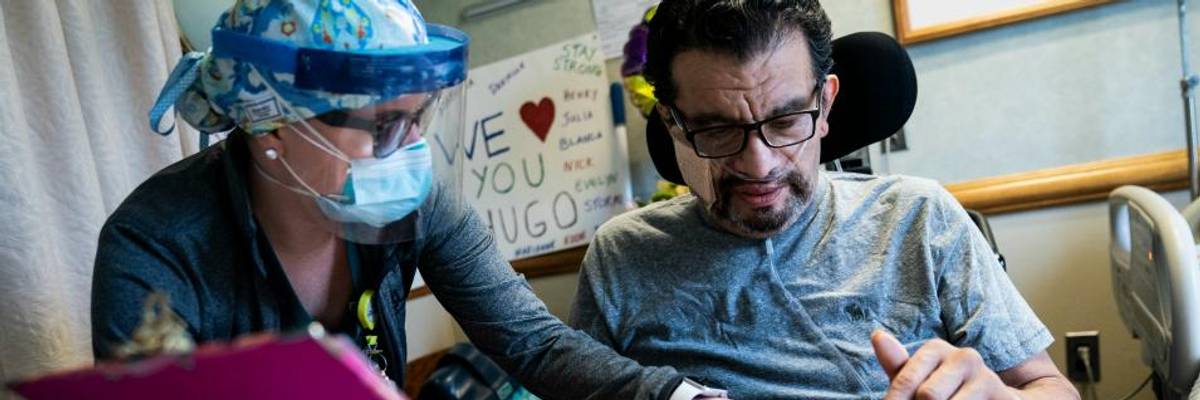
New York City firefighter EMS captain Hugo Sosa, who survived Covid-19, works on his recovery during a speech therapy session at Burke Rehabilitation Hospital on Thursday, May 28, 2020 in White Plains, New York. (Photo: Jabin Botsford/The Washington Post via Getty Images)
Nearly 9 in 10 Americans Fear Big Pharma Will Exploit Pandemic to Raise Drug Prices: Poll
Large majorities of those surveyed also said they are concerned about both insurance premiums and the general cost of healthcare rising.
An overwhelming majority of Americans are worried that the coronavirus crisis will drive up healthcare costs and nearly nine in 10 are concerned that "the pharmaceutical industry will take advantage of the current Covid-19 pandemic to increase drug prices," according to new Gallup and and West Health polling out Thursday.
"Concerns loom large that when the pandemic is all over, Big Pharma and insurance companies will revert to old patterns and behaviors and continue to squeeze Americans with ever-higher drug prices and insurance premiums."
--Tim Lash, West Health.
"Americans are clearly worried about the impact of the coronavirus pandemic well beyond being exposed to or spreading the disease," Gallup senior researcher Dan Witters said in a statement announcing the poll results.
Among the 1,016 U.S. adults surveyed in mid-May, 55% were "very" concerned Big Pharma will use the crisis to raise prices and 33% were "somewhat" concerned. The level of concern was consistent across most demographics except political affiliation, with Democrats more worried than Independents and Republicans.
However, U.S. adults across political parties largely agreed on another matter: 91% of Democrats, 87% of Independents, and 89% of Republicans said they believe that if an effective treatment for Covid-19 is approved by the Food and Drug Administration, "the federal government should be able to negotiate the price of the treatment with the drug manufacturer."
The survey also found that "79% are very or somewhat concerned about their health insurance premiums rising and 84% are very or somewhat concerned about the cost of care generally rising, with 41% very concerned about each." For both of those questions, Democrats were again the most worried respondents.
"Concerns loom large that when the pandemic is all over, Big Pharma and insurance companies will revert to old patterns and behaviors and continue to squeeze Americans with ever-higher drug prices and insurance premiums," said Tim Lash, chief strategy officer for the nonprofit West Health.
"If history is any guide, these concerns are well-founded, which is why promises to rein in prices are not enough," Lash added. "We need to retool our healthcare system and enact smart legislation now."
The poll shows that Americans are divided in terms of how well they feel the U.S. government has handled the pandemic relative to healthcare expenditures; Democrats and those with higher educations were less pleased with the response than Republicans and those with a high school education or less.
"When asked to rate the national response to Covid-19 relative to how much the U.S. spends on healthcare, 9% of respondents rate the U.S. response as excellent and another 14% as very good," Gallup explained. "In contrast, 34% rate the response as poor and 23% as fair."
The new polling results come as the U.S. has over 2,173,800 confirmed Covid-19 cases and more than 118,000 deaths. As CNN reported Wednesday, some states working to reopen and relax restrictions--such as Arizona, Florida, and Texas--are seeing record highs in their daily infection rates.
Overall, CNN found that 21 states are seeing a upward trend in new cases, 21 states are seeing a downward trend, and eight states are seeing steady numbers.
"A mix of early reopenings and disregard for personal safety measures have prompted researchers to increase their projections of Covid-19 deaths this summer," CNN noted. "One model cited by the White House now predicts 200,000 U.S. deaths from coronavirus by October 1."
In response to that model from the Institute for Health Metrics and Evaluation at the University of Washington, CNN chief medical correspondent Dr. Sanjay Gupta said, "Sadly, I think this 200,000 number may be a under prediction based on what we're starting to see in several states across the country."
We are at a crossroads
This country and this world are at a monumental crossroads. US voters have an opportunity to beat back the forces of fascism and confront the billionaires who are rigging the economy, our media system, and our democracy, making it increasingly impossible for ordinary people to get by. We’re not just talking about the election. We’re talking about what must be done once these fascist elements are vanquished from power. We need a bolder set of solutions than what either major party has so far been willing to offer and a working-class movement ready to fight like hell for it. Trump didn't emerge from nowhere. The conditions that fueled MAGA authoritarianism were created by decades of radical neoliberal economic policies and a corrupt political system dominated by corporate interests. They slashed taxes on the super-rich, promising that the benefits would trickle down. They said giveaways to the corporate titans would make life more affordable for the rest of us. It was all bullshit. And when a bitter, betrayed populace searches for someone to blame, right-wing demagogues have little trouble finding scapegoats. People know when they're being lied to, but you won't hear any of this from the corporate media. Only independent journalism—powered and funded by people who believe in building a better world—can deliver truly trustworthy daily news. Our Fall Campaign is underway, and we need your help. To power our newsroom through the rest of the year, we need to raise $125,000 by midnight on October 31. So if you share our vision, please contribute whatever you can to sustain our work. |
An overwhelming majority of Americans are worried that the coronavirus crisis will drive up healthcare costs and nearly nine in 10 are concerned that "the pharmaceutical industry will take advantage of the current Covid-19 pandemic to increase drug prices," according to new Gallup and and West Health polling out Thursday.
"Concerns loom large that when the pandemic is all over, Big Pharma and insurance companies will revert to old patterns and behaviors and continue to squeeze Americans with ever-higher drug prices and insurance premiums."
--Tim Lash, West Health.
"Americans are clearly worried about the impact of the coronavirus pandemic well beyond being exposed to or spreading the disease," Gallup senior researcher Dan Witters said in a statement announcing the poll results.
Among the 1,016 U.S. adults surveyed in mid-May, 55% were "very" concerned Big Pharma will use the crisis to raise prices and 33% were "somewhat" concerned. The level of concern was consistent across most demographics except political affiliation, with Democrats more worried than Independents and Republicans.
However, U.S. adults across political parties largely agreed on another matter: 91% of Democrats, 87% of Independents, and 89% of Republicans said they believe that if an effective treatment for Covid-19 is approved by the Food and Drug Administration, "the federal government should be able to negotiate the price of the treatment with the drug manufacturer."
The survey also found that "79% are very or somewhat concerned about their health insurance premiums rising and 84% are very or somewhat concerned about the cost of care generally rising, with 41% very concerned about each." For both of those questions, Democrats were again the most worried respondents.
"Concerns loom large that when the pandemic is all over, Big Pharma and insurance companies will revert to old patterns and behaviors and continue to squeeze Americans with ever-higher drug prices and insurance premiums," said Tim Lash, chief strategy officer for the nonprofit West Health.
"If history is any guide, these concerns are well-founded, which is why promises to rein in prices are not enough," Lash added. "We need to retool our healthcare system and enact smart legislation now."
The poll shows that Americans are divided in terms of how well they feel the U.S. government has handled the pandemic relative to healthcare expenditures; Democrats and those with higher educations were less pleased with the response than Republicans and those with a high school education or less.
"When asked to rate the national response to Covid-19 relative to how much the U.S. spends on healthcare, 9% of respondents rate the U.S. response as excellent and another 14% as very good," Gallup explained. "In contrast, 34% rate the response as poor and 23% as fair."
The new polling results come as the U.S. has over 2,173,800 confirmed Covid-19 cases and more than 118,000 deaths. As CNN reported Wednesday, some states working to reopen and relax restrictions--such as Arizona, Florida, and Texas--are seeing record highs in their daily infection rates.
Overall, CNN found that 21 states are seeing a upward trend in new cases, 21 states are seeing a downward trend, and eight states are seeing steady numbers.
"A mix of early reopenings and disregard for personal safety measures have prompted researchers to increase their projections of Covid-19 deaths this summer," CNN noted. "One model cited by the White House now predicts 200,000 U.S. deaths from coronavirus by October 1."
In response to that model from the Institute for Health Metrics and Evaluation at the University of Washington, CNN chief medical correspondent Dr. Sanjay Gupta said, "Sadly, I think this 200,000 number may be a under prediction based on what we're starting to see in several states across the country."