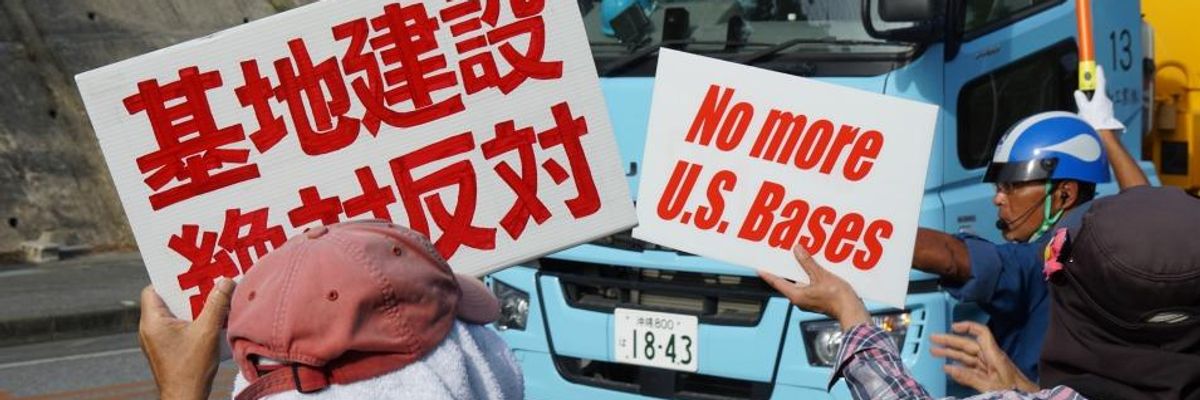
Protesters hold placards in front of a construction truck outside a U.S. Military construction site during a demonstration in 2019. Protesters demanded reduced U.S. military base burden in Okinawa as the prefecture marked 47 years since reversion to Japan this year. (Photo: Jinhee Lee/SOPA Images/LightRocket via Getty Images)
Okinawa Residents Warned of Chlorine Gas Exposure After Fire Erupts at US Military Hazmat Facility
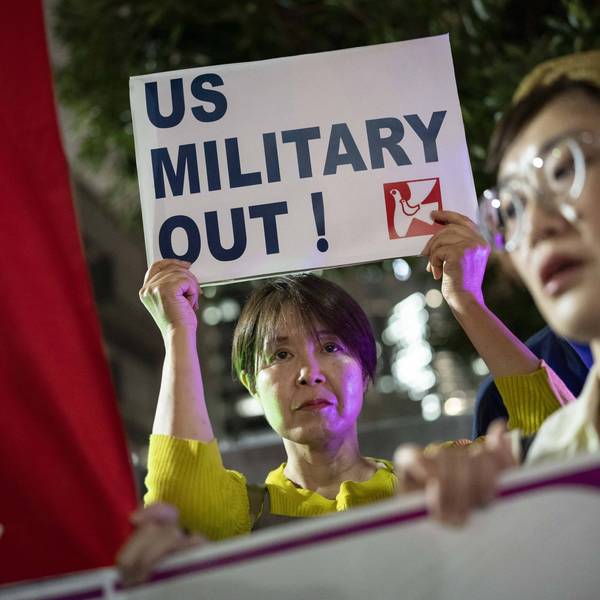
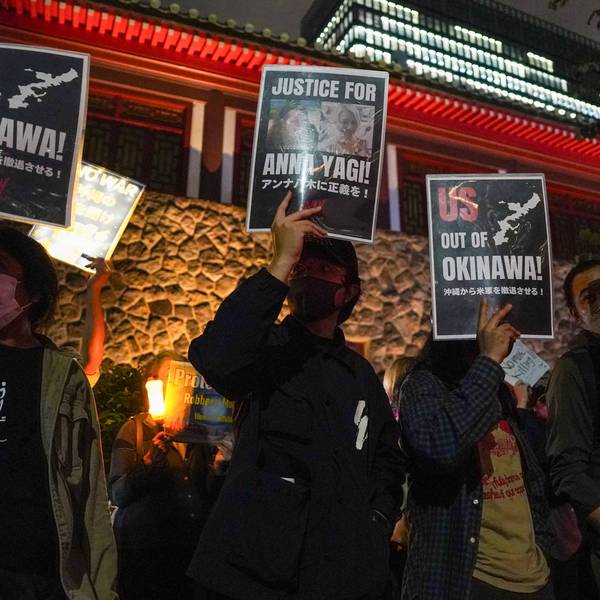
Locals have long protested U.S. military presence in Okinawa.
Residents of Okinawa learned Monday morning that they should seek treatment if they experience signs of chlorine gas or smoke exposure after a fire broke out inside a hazardous materials facility at the U.S, air base located on the Japanese island.
Emergency workers eventually put out the fire, which burned for several hours in the morning at the 18th Wing Hazardous Materials Pharmacy. The base was evacuated and 45 workers were treated for "mild symptoms" of exposure to smoke and gas, which can cause eye irritation, vision problems, a runny nose, throat irritation, and trouble breathing.
"Bioenvironmental personnel and emergency responders remain on the scene to monitor the situation and ensure there's no safety risk to the community," air base officials said in a press release.
More than 13,000 people live in the town of Kadena, which hosts the Kadena Air Base, the largest U.S. military base in Japan where more than half of the 50,000 U.S. troops in the country are stationed.
Residents of Okinawa have long protested the U.S. military presence there, demanding an end to environmental hazards and noise pollution at the base as well as crimes linked to U.S. personnel. In April, more than 140 tons of toxic fire-fighting foam leaked out of Marine Air Station Futenma, also located in Okinawa in the city of Ginowan.
Ginowan Mayor Masanori Matsukawa said at the time he would "demand the cause of the spill and discuss the environmental impact" at a meeting with base officials.
Last week, officials at Kadena Air Base criticized Okinawa media outlets for reporting on a U.S. soldier and an American civilian working at the base who are accused of robbing a nearby currency exchange store. Local journalists, the authorities claimed, had portrayed the U.S. military in a "negative light."
A prefectural spokesman did not defend the news outlets, but denied that Okinawa officials encouraged negative coverage of the alleged robbery. The Japanese government is supportive of U.S. military bases remaining in Okinawa under a bilateral security agreement.
In 2016, Okinawa residents held their largest anti-U.S. military protest in decades, with tens of thousands rallying after an American civilian contractor at Kadena Air Base was accused of raping and murdering a local woman.
"I hereby express my unflagging resolve to push for drastic review of the Japan-U.S. Status of Forces Agreement and withdrawal of Marines [from Okinawa]," then-Okinawa Gov. Takeshi Onaga, a vocal critic of the U.S., told protesters at the time.
Demonstrators at the historic protest carried signs reading, "Marines, Withdraw" and "Our anger has reached the limit."
We are at a crossroads
This country and this world are at a monumental crossroads. US voters have an opportunity to beat back the forces of fascism and confront the billionaires who are rigging the economy, our media system, and our democracy, making it increasingly impossible for ordinary people to get by. We’re not just talking about the election. We’re talking about what must be done once these fascist elements are vanquished from power. We need a bolder set of solutions than what either major party has so far been willing to offer and a working-class movement ready to fight like hell for it. Trump didn't emerge from nowhere. The conditions that fueled MAGA authoritarianism were created by decades of radical neoliberal economic policies and a corrupt political system dominated by corporate interests. They slashed taxes on the super-rich, promising that the benefits would trickle down. They said giveaways to the corporate titans would make life more affordable for the rest of us. It was all bullshit. And when a bitter, betrayed populace searches for someone to blame, right-wing demagogues have little trouble finding scapegoats. People know when they're being lied to, but you won't hear any of this from the corporate media. Only independent journalism—powered and funded by people who believe in building a better world—can deliver truly trustworthy daily news. Our Fall Campaign is underway, and we need your help. To power our newsroom through the rest of the year, we need to raise $125,000 by midnight on October 31. So if you share our vision, please contribute whatever you can to sustain our work. |
Residents of Okinawa learned Monday morning that they should seek treatment if they experience signs of chlorine gas or smoke exposure after a fire broke out inside a hazardous materials facility at the U.S, air base located on the Japanese island.
Emergency workers eventually put out the fire, which burned for several hours in the morning at the 18th Wing Hazardous Materials Pharmacy. The base was evacuated and 45 workers were treated for "mild symptoms" of exposure to smoke and gas, which can cause eye irritation, vision problems, a runny nose, throat irritation, and trouble breathing.
"Bioenvironmental personnel and emergency responders remain on the scene to monitor the situation and ensure there's no safety risk to the community," air base officials said in a press release.
More than 13,000 people live in the town of Kadena, which hosts the Kadena Air Base, the largest U.S. military base in Japan where more than half of the 50,000 U.S. troops in the country are stationed.
Residents of Okinawa have long protested the U.S. military presence there, demanding an end to environmental hazards and noise pollution at the base as well as crimes linked to U.S. personnel. In April, more than 140 tons of toxic fire-fighting foam leaked out of Marine Air Station Futenma, also located in Okinawa in the city of Ginowan.
Ginowan Mayor Masanori Matsukawa said at the time he would "demand the cause of the spill and discuss the environmental impact" at a meeting with base officials.
Last week, officials at Kadena Air Base criticized Okinawa media outlets for reporting on a U.S. soldier and an American civilian working at the base who are accused of robbing a nearby currency exchange store. Local journalists, the authorities claimed, had portrayed the U.S. military in a "negative light."
A prefectural spokesman did not defend the news outlets, but denied that Okinawa officials encouraged negative coverage of the alleged robbery. The Japanese government is supportive of U.S. military bases remaining in Okinawa under a bilateral security agreement.
In 2016, Okinawa residents held their largest anti-U.S. military protest in decades, with tens of thousands rallying after an American civilian contractor at Kadena Air Base was accused of raping and murdering a local woman.
"I hereby express my unflagging resolve to push for drastic review of the Japan-U.S. Status of Forces Agreement and withdrawal of Marines [from Okinawa]," then-Okinawa Gov. Takeshi Onaga, a vocal critic of the U.S., told protesters at the time.
Demonstrators at the historic protest carried signs reading, "Marines, Withdraw" and "Our anger has reached the limit."