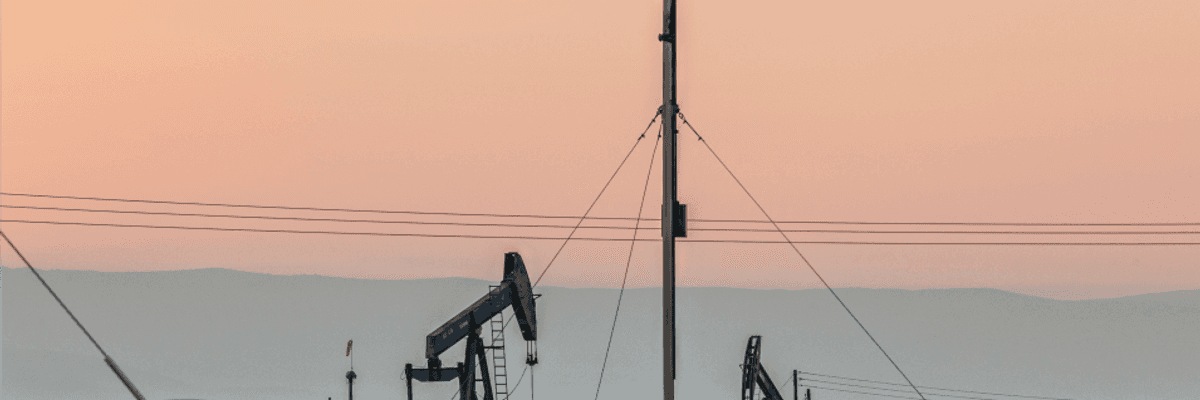
Flares burning off gas at Belridge Oil Field and hydraulic fracking site, which is the fourth largest oil field in California. (Photo: Citizens of the Planet/Education Images/Universal Images Group via Getty Images)
'The Poster Company for US Fracking Has Fallen': Chesapeake Energy Files for Bankruptcy
"Meanwhile the Trump administration continues to try and bail out this garbage fire industry with our tax dollars."
Climate advocates pointed to news Sunday that fracking giant Chesapeake Energy was filing for bankruptcy as further evidence that the fossil fuel industry's collapse is being hastened by the coronavirus pandemic and called for the government to stop propping up businesses in the field.
"Fracking giant Chesapeake Energy just declared bankruptcy thanks to its massive $9 billion debt," tweeted Friends of the Earth. "Meanwhile the Trump administration continues to try and bail out this garbage fire industry with our tax dollars--despite clear risks."
The company, which at its peak in 2008 was valued at $37 billion, had a market capitalization of just $115 million on Friday.
"The debt bubble made it unable for Chesapeake to maneuver when the pandemic ruined demand for energy," David Dayen wrote of the bankruptcy for The American Prospect.
News reports put most of the blame for the bankruptcy on former CEO Aubrey McClendon, who bought up leases and rights around the country as the fracking industry boomed.
As Forbes reported, a number of bad business decisions and moves left Chesapeake in bad condition even before gas prices collapsed due to the slowed demand from the pandemic.
According to Forbes:
As natural gas prices collapsed in the late 2000s, McClendon next turned to sales of his own company's assets or portions of working interests in big play areas as a means of continuing to finance and pay down that debt. He sold shares of the company's working interests in the Barnett, the Eagle Ford, the Marcellus and the Haynesville to various other players, like BP and CNOOC, but every sale also meant less and less cash flow coming into the company itself. Many in the business during that time joked about it being a sort of a pyramid scheme in which the debts would ultimately end up outstripping the company's income and ability to pay.
McClendon also made the decision in 2010-11 to shift Chesapeake's gas-heavy asset mix to one more heavy in liquids. That strategic decision certainly helped during a time of $100 oil prices, but the bust of 2015-16 and the current COVID-19-related price collapse ultimately proved to heavy a burden for current CEO Doug Lawler--who was brought on board in 2013--and his management team to navigate. A company that once had a market cap of over $37 billion at one point in May saw its market cap drop as low as $200 million. A company that once employed over 8,000 individuals today employs around 2,300.
John Thieroff, a senior analyst at Moody's Investors Service, told the Financial Times Sunday he expected other companies to follow suit.
"There will no doubt be others to file for bankruptcy in the near term as the sector looks to get out from under the copious amount of debt it took on during the boom," said Thieroff.
President Donald Trump has weighed bailing out the fossil fuel industry as part of a coronavirus pandemic recovery plan. The plans have been met with stiff resistance from environmental groups like Western Values Project, which said in May that the move was an example of the White House "using a public health crisis as an excuse to bail out the president's corporate cronies while leaving everyone else to fend for themselves."
We are at a crossroads
This country and this world are at a monumental crossroads. US voters have an opportunity to beat back the forces of fascism and confront the billionaires who are rigging the economy, our media system, and our democracy, making it increasingly impossible for ordinary people to get by. We’re not just talking about the election. We’re talking about what must be done once these fascist elements are vanquished from power. We need a bolder set of solutions than what either major party has so far been willing to offer and a working-class movement ready to fight like hell for it. Trump didn't emerge from nowhere. The conditions that fueled MAGA authoritarianism were created by decades of radical neoliberal economic policies and a corrupt political system dominated by corporate interests. They slashed taxes on the super-rich, promising that the benefits would trickle down. They said giveaways to the corporate titans would make life more affordable for the rest of us. It was all bullshit. And when a bitter, betrayed populace searches for someone to blame, right-wing demagogues have little trouble finding scapegoats. People know when they're being lied to, but you won't hear any of this from the corporate media. Only independent journalism—powered and funded by people who believe in building a better world—can deliver truly trustworthy daily news. Our Fall Campaign is underway, and we need your help. To power our newsroom through the rest of the year, we need to raise $125,000 by midnight on October 31. So if you share our vision, please contribute whatever you can to sustain our work. |
Climate advocates pointed to news Sunday that fracking giant Chesapeake Energy was filing for bankruptcy as further evidence that the fossil fuel industry's collapse is being hastened by the coronavirus pandemic and called for the government to stop propping up businesses in the field.
"Fracking giant Chesapeake Energy just declared bankruptcy thanks to its massive $9 billion debt," tweeted Friends of the Earth. "Meanwhile the Trump administration continues to try and bail out this garbage fire industry with our tax dollars--despite clear risks."
The company, which at its peak in 2008 was valued at $37 billion, had a market capitalization of just $115 million on Friday.
"The debt bubble made it unable for Chesapeake to maneuver when the pandemic ruined demand for energy," David Dayen wrote of the bankruptcy for The American Prospect.
News reports put most of the blame for the bankruptcy on former CEO Aubrey McClendon, who bought up leases and rights around the country as the fracking industry boomed.
As Forbes reported, a number of bad business decisions and moves left Chesapeake in bad condition even before gas prices collapsed due to the slowed demand from the pandemic.
According to Forbes:
As natural gas prices collapsed in the late 2000s, McClendon next turned to sales of his own company's assets or portions of working interests in big play areas as a means of continuing to finance and pay down that debt. He sold shares of the company's working interests in the Barnett, the Eagle Ford, the Marcellus and the Haynesville to various other players, like BP and CNOOC, but every sale also meant less and less cash flow coming into the company itself. Many in the business during that time joked about it being a sort of a pyramid scheme in which the debts would ultimately end up outstripping the company's income and ability to pay.
McClendon also made the decision in 2010-11 to shift Chesapeake's gas-heavy asset mix to one more heavy in liquids. That strategic decision certainly helped during a time of $100 oil prices, but the bust of 2015-16 and the current COVID-19-related price collapse ultimately proved to heavy a burden for current CEO Doug Lawler--who was brought on board in 2013--and his management team to navigate. A company that once had a market cap of over $37 billion at one point in May saw its market cap drop as low as $200 million. A company that once employed over 8,000 individuals today employs around 2,300.
John Thieroff, a senior analyst at Moody's Investors Service, told the Financial Times Sunday he expected other companies to follow suit.
"There will no doubt be others to file for bankruptcy in the near term as the sector looks to get out from under the copious amount of debt it took on during the boom," said Thieroff.
President Donald Trump has weighed bailing out the fossil fuel industry as part of a coronavirus pandemic recovery plan. The plans have been met with stiff resistance from environmental groups like Western Values Project, which said in May that the move was an example of the White House "using a public health crisis as an excuse to bail out the president's corporate cronies while leaving everyone else to fend for themselves."