

SUBSCRIBE TO OUR FREE NEWSLETTER
Daily news & progressive opinion—funded by the people, not the corporations—delivered straight to your inbox.
5
#000000
#FFFFFF
To donate by check, phone, or other method, see our More Ways to Give page.
Daily news & progressive opinion—funded by the people, not the corporations—delivered straight to your inbox.
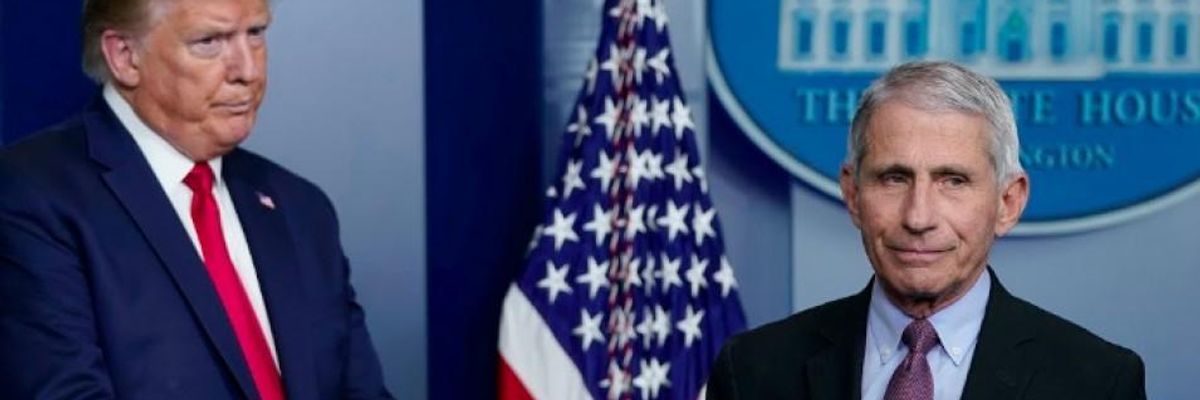
Dr. Anthony Fauci (R), director of the National Institute of Allergy and Infectious Diseases, and U.S. President Donald Trump participate in the daily coronavirus task force briefing at the White House on April 22, 2020 in Washington, D.C. (Photo: Drew Angerer/Getty Images)
Amid reporting that President Donald Trump and Dr. Anthony Fauci are now barely on speaking terms, the top health official admitted in an interview published Friday that his reputation for truth-telling and fact-based warnings about the coronavirus outbreak is likely why the American people have not seen him very much on television recently.
"I have a reputation, as you probably have figured out, of speaking the truth at all times and not sugar-coating things. And that may be one of the reasons why I haven't been on television very much lately," said Fauci, director of the National Institute of Allergy and Infectious Diseases, in an interview (paywall) with the Financial Times.
Trump this week has openly criticized Fauci as having made "a lot of mistakes" when it comes to the Covid-19 pandemic, a classic example of the president deflecting criticisms that he receives onto others--even members of his own administration.
According to CNN, things are potentially even worse than they appear:
With coronavirus raging, Trump and Fauci are no longer speaking. The President has taken to openly criticizing him on television. Fauci is expressing puzzlement at some of Trump's claims.
When the coronavirus task force convened at the Department of Education this week, Fauci was told to beam in over the phone instead of attending in person.
While he's conducted a flurry of newspaper and radio interviews, he has stopped appearing on major American television networks.
As infections cases in the U.S. continue to surge, Fauci on Tuesday said the country is "still knee deep in the first wave" of the pandemic, but Trump later that day publicly contradicted the assessment. "I disagree with him," Trump told journalist Greta Van Susteren on her show Full Court Press. "I think we are in a good place."
On Sunday of this week, "Face the Nation" went public with the fact they have been unable to get the White House to book Fauci, or officials from the CDC, for the last three months. Writing for the Washington Post, digital opinions editor James Downie says the absence of top officials and experts from the weekend shows and other prominent outlets has a certain logic to it "when you realize that even in the midst of this deadly pandemic, the administration's top priority is the president's image."
"With new coronavirus cases at 50,000 for four straight days, a normal administration would be flooding news programs with medical experts to tell Americans to wear masks, practice social distancing and otherwise fight the virus's spread," writes Downie. "But the Trump White House is doing the opposite."
While it might seem to many the definition of insanity to keep one of the most highly-trusted and expert officials in the administration out of public view when the public health risks are so high and the public hunger for guidance is a given, Downie argues that sidelining Fauci is reasonable if the White House goal is "not public safety but to avoid making the president look bad--no matter the cost."
This country and this world are at a monumental crossroads. US voters have an opportunity to beat back the forces of fascism and confront the billionaires who are rigging the economy, our media system, and our democracy, making it increasingly impossible for ordinary people to get by. We’re not just talking about the election. We’re talking about what must be done once these fascist elements are vanquished from power. We need a bolder set of solutions than what either major party has so far been willing to offer and a working-class movement ready to fight like hell for it. Trump didn't emerge from nowhere. The conditions that fueled MAGA authoritarianism were created by decades of radical neoliberal economic policies and a corrupt political system dominated by corporate interests. They slashed taxes on the super-rich, promising that the benefits would trickle down. They said giveaways to the corporate titans would make life more affordable for the rest of us. It was all bullshit. And when a bitter, betrayed populace searches for someone to blame, right-wing demagogues have little trouble finding scapegoats. People know when they're being lied to, but you won't hear any of this from the corporate media. Only independent journalism—powered and funded by people who believe in building a better world—can deliver truly trustworthy daily news. If you share our vision, please contribute whatever you can to sustain our work. |
Amid reporting that President Donald Trump and Dr. Anthony Fauci are now barely on speaking terms, the top health official admitted in an interview published Friday that his reputation for truth-telling and fact-based warnings about the coronavirus outbreak is likely why the American people have not seen him very much on television recently.
"I have a reputation, as you probably have figured out, of speaking the truth at all times and not sugar-coating things. And that may be one of the reasons why I haven't been on television very much lately," said Fauci, director of the National Institute of Allergy and Infectious Diseases, in an interview (paywall) with the Financial Times.
Trump this week has openly criticized Fauci as having made "a lot of mistakes" when it comes to the Covid-19 pandemic, a classic example of the president deflecting criticisms that he receives onto others--even members of his own administration.
According to CNN, things are potentially even worse than they appear:
With coronavirus raging, Trump and Fauci are no longer speaking. The President has taken to openly criticizing him on television. Fauci is expressing puzzlement at some of Trump's claims.
When the coronavirus task force convened at the Department of Education this week, Fauci was told to beam in over the phone instead of attending in person.
While he's conducted a flurry of newspaper and radio interviews, he has stopped appearing on major American television networks.
As infections cases in the U.S. continue to surge, Fauci on Tuesday said the country is "still knee deep in the first wave" of the pandemic, but Trump later that day publicly contradicted the assessment. "I disagree with him," Trump told journalist Greta Van Susteren on her show Full Court Press. "I think we are in a good place."
On Sunday of this week, "Face the Nation" went public with the fact they have been unable to get the White House to book Fauci, or officials from the CDC, for the last three months. Writing for the Washington Post, digital opinions editor James Downie says the absence of top officials and experts from the weekend shows and other prominent outlets has a certain logic to it "when you realize that even in the midst of this deadly pandemic, the administration's top priority is the president's image."
"With new coronavirus cases at 50,000 for four straight days, a normal administration would be flooding news programs with medical experts to tell Americans to wear masks, practice social distancing and otherwise fight the virus's spread," writes Downie. "But the Trump White House is doing the opposite."
While it might seem to many the definition of insanity to keep one of the most highly-trusted and expert officials in the administration out of public view when the public health risks are so high and the public hunger for guidance is a given, Downie argues that sidelining Fauci is reasonable if the White House goal is "not public safety but to avoid making the president look bad--no matter the cost."

