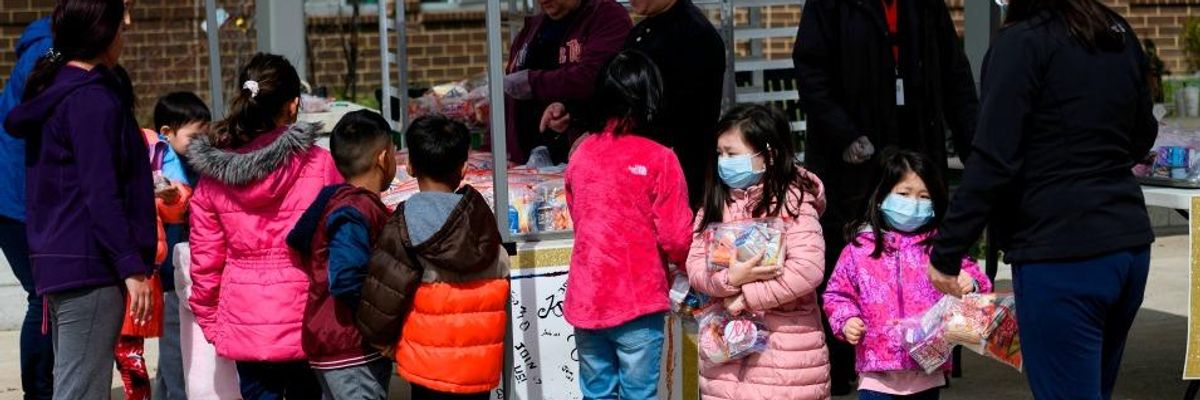
Children, some wearing face masks as a preventive measure, pick up free lunch at Kenmore Middle School in Arlington, Virginia on March 16, 2020, after schools in the area closed due to the coronavirus outbreak. (Photo by Andrew Caballero-Reynolds/AFP via Getty Images)
Amid Pandemic and Economic Pain, UNICEF Unveils First-Ever Project to Combat Child Suffering in US
"Children in our country don't fare as well as children in other wealthy countries around the world, so we have a lot of work to do."
After decades of focusing mainly on supporting young people in developing countries affected by extreme poverty, war, and disease, the international children's aid agency UNICEF on Wednesday announced its first permanent initiative focused on aiding children in the United States--arguably the world's wealthiest and most powerful nation.
The U.S. affiliate of the U.N. agency marked International Youth Day by unveiling its Child-Friendly Cities Initiative in three major U.S. cities and one county. UNICEF USA will invest $1 million this year in supporting efforts in Minneapolis, Houston, San Francisco, and Prince George's County in Maryland aimed at making the communities more livable for children.
The initiative comes as Americans are increasingly distressed over the Trump administration's failed pandemic response and amid a push to reopen public schools even as the coronavirus continues to spread rapidly in states across the country.
The Covid-19 pandemic has exacerbated the precarious circumstances in which millions of U.S. children live. As many as 23 million families across the country could be evicted by October following the federal government's refusal to extend an eviction moratorium for people living in homes with federally-backed mortgages. The number of families relying on SNAP benefits jumped by six millionin the first three months of the pandemic, and a study by researchers at Northwestern University in April found that food insecurity for families with children was 40% higher that month than it was expected to be. At least 5.4 million Americans, including many with children, lost their employer-sponsored health insurance between February and April, according to Families USA, as the unemployment rate rose to nearly 15%.
Children in the U.S. are also 70% more likely than those in other wealthy countries to die before adulthood, coming in 20th place in a ranking of 20 countries in 2018. Teenagers are 82 times more likely to die as a result of gun violence in the U.S., and the nation's "fragmented healthcare system" and persistently high childhood poverty rates were linked to 600,000 excess child deaths which researchers said would likely not have happened in other wealthy countries.
Even without the coronavirus pandemic, UNICEF USA President Michael Nyenhuis told the Associated Press, "Children in our country don't fare as well as children in other wealthy countries around the world, so we have a lot of work to do."
"Then you magnify the reality of that with the Covid crisis and the issues of racial injustice, and you say, 'Something's wrong,'" he said.
Nyenhuis said he believed the key to helping U.S. children currently lies "at the municipal level rather than the federal level."
Under the Child-Friendly Cities Initiative, the local municipalities "will conduct a situation analysis of child well-being," UNICEF USA said.
"If you want to find out" if a city is child-friendly, the agency added, "just ask the kids who live there. Do they feel safe? Can they go to a doctor when they are sick? Do they like their school? Are there plenty of parks and playgrounds where they can go and meet up with friends? Do people listen to them when they talk--their teachers, parents, coaches? Do they feel--most of the time--like they get their fair share?"
Under the program, participating cities will be urged to make themselves safer for children and ensure equitable access to social programs and outdoor spaces.
The initiative "will empower leaders to address the impact of the coronavirus pandemic and system racism on children, work to combat discrimination and elevate their voices in local governance and decision-making."
We are at a crossroads
This country and this world are at a monumental crossroads. In a few short weeks, US voters will have an opportunity to beat back the forces of fascism and confront the billionaires who are rigging the economy, our media system, and our democracy, making it increasingly impossible for ordinary people to get by. We’re not just talking about the election. We’re talking about what must be done once these fascist elements are vanquished from power. We need a bolder set of solutions than what either major party has so far been willing to offer and a working-class movement ready to fight like hell for it. Trump didn't emerge from nowhere. The conditions that fueled MAGA authoritarianism were created by decades of radical neoliberal economic policies and a corrupt political system dominated by corporate interests. They slashed taxes on the super-rich, promising that the benefits would trickle down. They said giveaways to the corporate titans would make life more affordable for the rest of us. It was all bullshit. And when a bitter, betrayed populace searches for someone to blame, right-wing demagogues have little trouble finding scapegoats. People know when they're being lied to, but you won't hear any of this from the corporate media. Only independent journalism—powered and funded by people who believe in building a better world—can deliver truly trustworthy daily news. Our Fall Campaign is underway, and we need your help. To power our newsroom through the rest of the year, we need to raise $125,000 by midnight on October 31. So if you share our vision, please contribute whatever you can to sustain our work. |
After decades of focusing mainly on supporting young people in developing countries affected by extreme poverty, war, and disease, the international children's aid agency UNICEF on Wednesday announced its first permanent initiative focused on aiding children in the United States--arguably the world's wealthiest and most powerful nation.
The U.S. affiliate of the U.N. agency marked International Youth Day by unveiling its Child-Friendly Cities Initiative in three major U.S. cities and one county. UNICEF USA will invest $1 million this year in supporting efforts in Minneapolis, Houston, San Francisco, and Prince George's County in Maryland aimed at making the communities more livable for children.
The initiative comes as Americans are increasingly distressed over the Trump administration's failed pandemic response and amid a push to reopen public schools even as the coronavirus continues to spread rapidly in states across the country.
The Covid-19 pandemic has exacerbated the precarious circumstances in which millions of U.S. children live. As many as 23 million families across the country could be evicted by October following the federal government's refusal to extend an eviction moratorium for people living in homes with federally-backed mortgages. The number of families relying on SNAP benefits jumped by six millionin the first three months of the pandemic, and a study by researchers at Northwestern University in April found that food insecurity for families with children was 40% higher that month than it was expected to be. At least 5.4 million Americans, including many with children, lost their employer-sponsored health insurance between February and April, according to Families USA, as the unemployment rate rose to nearly 15%.
Children in the U.S. are also 70% more likely than those in other wealthy countries to die before adulthood, coming in 20th place in a ranking of 20 countries in 2018. Teenagers are 82 times more likely to die as a result of gun violence in the U.S., and the nation's "fragmented healthcare system" and persistently high childhood poverty rates were linked to 600,000 excess child deaths which researchers said would likely not have happened in other wealthy countries.
Even without the coronavirus pandemic, UNICEF USA President Michael Nyenhuis told the Associated Press, "Children in our country don't fare as well as children in other wealthy countries around the world, so we have a lot of work to do."
"Then you magnify the reality of that with the Covid crisis and the issues of racial injustice, and you say, 'Something's wrong,'" he said.
Nyenhuis said he believed the key to helping U.S. children currently lies "at the municipal level rather than the federal level."
Under the Child-Friendly Cities Initiative, the local municipalities "will conduct a situation analysis of child well-being," UNICEF USA said.
"If you want to find out" if a city is child-friendly, the agency added, "just ask the kids who live there. Do they feel safe? Can they go to a doctor when they are sick? Do they like their school? Are there plenty of parks and playgrounds where they can go and meet up with friends? Do people listen to them when they talk--their teachers, parents, coaches? Do they feel--most of the time--like they get their fair share?"
Under the program, participating cities will be urged to make themselves safer for children and ensure equitable access to social programs and outdoor spaces.
The initiative "will empower leaders to address the impact of the coronavirus pandemic and system racism on children, work to combat discrimination and elevate their voices in local governance and decision-making."