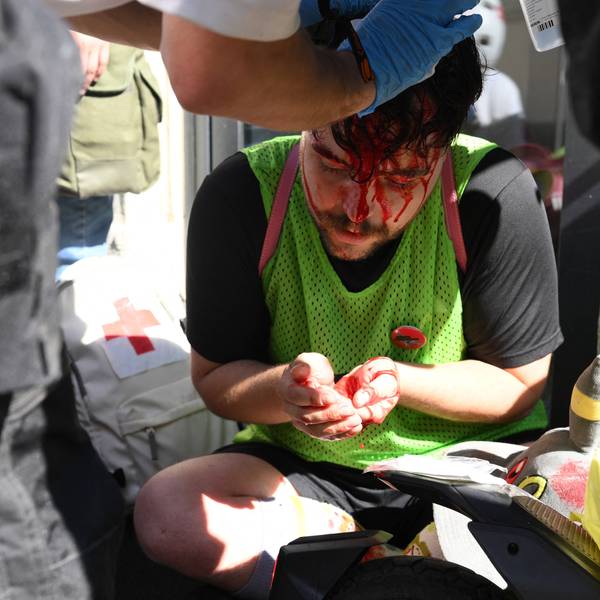

People help paramedics carry a person injured during a protest against the results of the 2020 Belarusian presidential election. (Photo: Viktor Drachev\TASS via Getty Images)
'Screams of Torture' as Authoritarian Government in Belarus Continues Attacks on Protesters, Journalists
Following what pro-democracy advocates say was a rigged election, world leaders condemn the violence against protestors and the press, and the authoritarian regime's main opponent has fled the country.
A United Nations official Wednesday joined world leaders in condemning the Belarusian government's violent crackdown on protestors and journalists following last Sunday's presidential election there, which critics have called an undemocratic sham.
"I remind the Belarusian authorities that the use of force during protests should always be exceptional and a measure of last resort, clearly differentiating between any violent individuals and peaceful protesters, against whom force should not be used," Michelle Bachelet, high commissioner for human rights at the U.N., said in a statement.
"State authorities must allow and facilitate the exercise of the rights to freedom of expression and of peaceful assembly and not repress it," she added. "People have the right to speak up and express dissent, even more in the context of elections, when democratic freedoms should be upheld, not supressed."
People have the right to speak up and express dissent, even more in the context of elections, when democratic freedoms should be upheld, not supressed.
--Michelle Bachelet, United Nations
Belarusian President Aleksander Lukashenko, who Axios reported is known as "Europe's last dictator," has ruled the country in Eastern Europe since 1994. Lukashenko declared victory with 80% of the vote Sunday, after jailing or exiling many of his opponents, leaving Svetlana G. Tikhanovskaya, who's husband was among those jailed, as Lukashenko's main opponent in the election.
Amid mounting protests and reported pressure from Belarusian authorities, Tikhanovskaya fled to Lithuania Tuesday and later released a cryptic video saying she "took a very difficult decision" to leave Belarus.
Meanwhile, protests have continued in Belarus and Lukashenko has detained detractors, arresting more than 6,000 people. At least two protestors have died, and numerous others report abuse at the hands of the Belarusian authorities, which world leaders have condemned. Humanitarian groups including Amnesty International and the Committee to Protect Journalists have also called on the regime to halt its attacks on the press.
Lukashenko's regime appears undeterred by accusations of humanitarian abuse. Belarusian state TV Wednesday broadcast video footage of six visibly beaten protestors with their hands bound behind their backs promising to give up. "Will we be making a revolution?" a guard asks them. "No, never," two reply.
Nonviolent protests carried on in Belarus, including a group of women in the nation's capitol, Minsk, Thursday forming what they called a "chain of solidarity," holding hands and waving flowers and flashing peace signs.
"Free flow of information is crucial in any democratic society, and especially in a context of crisis and social unrest," said Bachelet.
The U.N. commissioner also addressed reports of nationwide internet disruption, which she and others have called an attempt at censorship amid unrest.
"Even more so, in the current situation of the Covid-19 pandemic, and where people might feel compelled to express dissent online rather than on the streets," she said. "The right to peacefully protest online must be also protected."
We are at a crossroads
This country and this world are at a monumental crossroads. In a few short weeks, US voters will have an opportunity to beat back the forces of fascism and confront the billionaires who are rigging the economy, our media system, and our democracy, making it increasingly impossible for ordinary people to get by. We’re not just talking about the election. We’re talking about what must be done once these fascist elements are vanquished from power. We need a bolder set of solutions than what either major party has so far been willing to offer and a working-class movement ready to fight like hell for it. Trump didn't emerge from nowhere. The conditions that fueled MAGA authoritarianism were created by decades of radical neoliberal economic policies and a corrupt political system dominated by corporate interests. They slashed taxes on the super-rich, promising that the benefits would trickle down. They said giveaways to the corporate titans would make life more affordable for the rest of us. It was all bullshit. And when a bitter, betrayed populace searches for someone to blame, right-wing demagogues have little trouble finding scapegoats. People know when they're being lied to, but you won't hear any of this from the corporate media. Only independent journalism—powered and funded by people who believe in building a better world—can deliver truly trustworthy daily news. Our Fall Campaign is underway, and we need your help. To power our newsroom through the rest of the year, we need to raise $125,000 by midnight on October 31. So if you share our vision, please contribute whatever you can to sustain our work. |
A United Nations official Wednesday joined world leaders in condemning the Belarusian government's violent crackdown on protestors and journalists following last Sunday's presidential election there, which critics have called an undemocratic sham.
"I remind the Belarusian authorities that the use of force during protests should always be exceptional and a measure of last resort, clearly differentiating between any violent individuals and peaceful protesters, against whom force should not be used," Michelle Bachelet, high commissioner for human rights at the U.N., said in a statement.
"State authorities must allow and facilitate the exercise of the rights to freedom of expression and of peaceful assembly and not repress it," she added. "People have the right to speak up and express dissent, even more in the context of elections, when democratic freedoms should be upheld, not supressed."
People have the right to speak up and express dissent, even more in the context of elections, when democratic freedoms should be upheld, not supressed.
--Michelle Bachelet, United Nations
Belarusian President Aleksander Lukashenko, who Axios reported is known as "Europe's last dictator," has ruled the country in Eastern Europe since 1994. Lukashenko declared victory with 80% of the vote Sunday, after jailing or exiling many of his opponents, leaving Svetlana G. Tikhanovskaya, who's husband was among those jailed, as Lukashenko's main opponent in the election.
Amid mounting protests and reported pressure from Belarusian authorities, Tikhanovskaya fled to Lithuania Tuesday and later released a cryptic video saying she "took a very difficult decision" to leave Belarus.
Meanwhile, protests have continued in Belarus and Lukashenko has detained detractors, arresting more than 6,000 people. At least two protestors have died, and numerous others report abuse at the hands of the Belarusian authorities, which world leaders have condemned. Humanitarian groups including Amnesty International and the Committee to Protect Journalists have also called on the regime to halt its attacks on the press.
Lukashenko's regime appears undeterred by accusations of humanitarian abuse. Belarusian state TV Wednesday broadcast video footage of six visibly beaten protestors with their hands bound behind their backs promising to give up. "Will we be making a revolution?" a guard asks them. "No, never," two reply.
Nonviolent protests carried on in Belarus, including a group of women in the nation's capitol, Minsk, Thursday forming what they called a "chain of solidarity," holding hands and waving flowers and flashing peace signs.
"Free flow of information is crucial in any democratic society, and especially in a context of crisis and social unrest," said Bachelet.
The U.N. commissioner also addressed reports of nationwide internet disruption, which she and others have called an attempt at censorship amid unrest.
"Even more so, in the current situation of the Covid-19 pandemic, and where people might feel compelled to express dissent online rather than on the streets," she said. "The right to peacefully protest online must be also protected."