

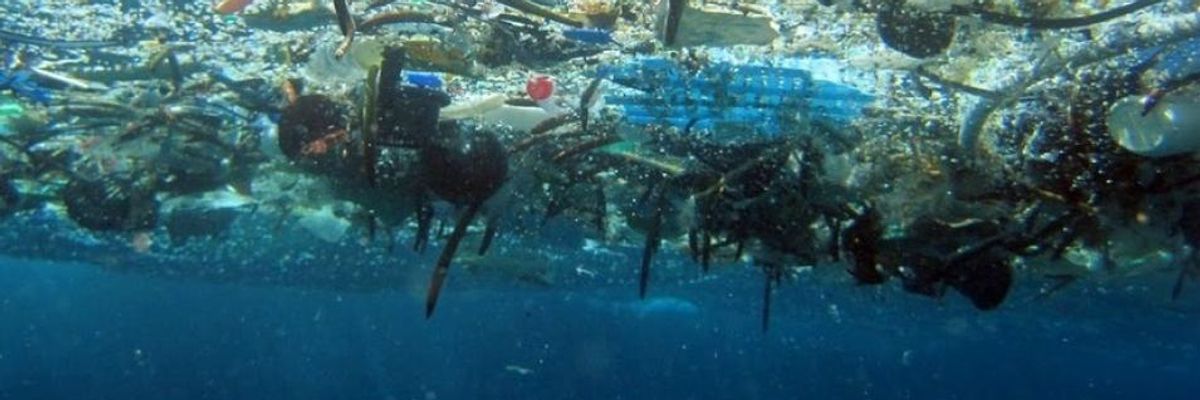
Underneath the floating debris in the Pacific Ocean.
Activists Demand Bolder Efforts to Address Pollution After Scientists Find Microplastics in Human Organs
"The best way to tackle the problem is to massively reduce the amount of plastic that's being made and used."
Bolstering activists' demands to reduce plastic pollution worldwide, Arizona State University scientists on Monday presented their research on finding micro- and nanoplastics in human organs to the American Chemical Society.
Greenpeace U.K. responded to the reporting on the study by calling to "massively" reduce the amount of plastic produced and used worldwide.
Microplastics are plastics that are less than five millimeters in diameter and nanoplastics are less than 0.001 millimeters in diameter. Both are broken down bits of larger plastic pieces that were dumped into the environment. According to PlasticsEurope.org, 359 million tons of plastic was produced globally in 2019.
Previous research has shown that people could be eating a credit card's worth of plastic a day; a study published in 2019 suggests humans eat, drink, and breathe almost 74,000 microplastic particles a year. Microplastics have been found in places ranging from the tallest mountains in the world to the depths of the Mariana Trench. Plastic particles in wildlife have been shown to substantially harm entire ecosystems, especially marine organisms.
The Arizona State University scientists developed and tested a new method to identify dozens of plastics in human tissue that could eventually be used to collect global data on microplastic pollution and its impact on people. To test the technique, the scientists used 47 tissue samples from lung, liver, spleen, and kidney samples collected from a tissue bank. Researchers then added particles to the samples and found they could detect microplastics in every sample.
These specific tissues were used because these organs are the most likely to be exposed to, filter, or collect plastics in the human body. Because the samples were taken from a tissue bank, scientists also were able to analyze the donors' lifestyles including environmental and occupational exposures.
"It would be naive to believe there is plastic everywhere but just not in us," Rolf Halden, a scientist on the team, told The Guardian. "We are now providing a research platform that will allow us and others to look for what is invisible--these particles too small for the naked eye to see. The risk [to health] really resides in the small particles ... This shared resource will help build a plastic exposure database so that we can compare exposures in organs and groups of people over time and geographic space."
The researchers found bisphenol A (BPA) in all 47 samples and were also able to detect polyethylene terephthalate (PET)--a chemical used in plastic drink bottles and shopping bags. They also found and analyzed polycarbonate (PC) and polyethylene (PE). These particles can end up in human bodies through the air or by consuming wildlife like seafood that has eaten plastic; or by consuming other foods with trace amounts of plastic from packaging.
The team also developed a computer program that converts the collected data on plastic particle count into units of mass and area.
"In a few short decades, we've gone from seeing plastic as a wonderful benefit to considering it a threat," Charles Rolsky, a member of the team, said in a press release. "There's evidence that plastic is making its way into our bodies, but very few studies have looked for it there. And at this point, we don't know whether this plastic is just a nuisance or whether it represents a human health hazard."
We are at a crossroads
This country and this world are at a monumental crossroads. In a few short weeks, US voters will have an opportunity to beat back the forces of fascism and confront the billionaires who are rigging the economy, our media system, and our democracy, making it increasingly impossible for ordinary people to get by. We’re not just talking about the election. We’re talking about what must be done once these fascist elements are vanquished from power. We need a bolder set of solutions than what either major party has so far been willing to offer and a working-class movement ready to fight like hell for it. Trump didn't emerge from nowhere. The conditions that fueled MAGA authoritarianism were created by decades of radical neoliberal economic policies and a corrupt political system dominated by corporate interests. They slashed taxes on the super-rich, promising that the benefits would trickle down. They said giveaways to the corporate titans would make life more affordable for the rest of us. It was all bullshit. And when a bitter, betrayed populace searches for someone to blame, right-wing demagogues have little trouble finding scapegoats. People know when they're being lied to, but you won't hear any of this from the corporate media. Only independent journalism—powered and funded by people who believe in building a better world—can deliver truly trustworthy daily news. Our Fall Campaign is underway, and we need your help. To power our newsroom through the rest of the year, we need to raise $125,000 by midnight on October 31. So if you share our vision, please contribute whatever you can to sustain our work. |
Bolstering activists' demands to reduce plastic pollution worldwide, Arizona State University scientists on Monday presented their research on finding micro- and nanoplastics in human organs to the American Chemical Society.
Greenpeace U.K. responded to the reporting on the study by calling to "massively" reduce the amount of plastic produced and used worldwide.
Microplastics are plastics that are less than five millimeters in diameter and nanoplastics are less than 0.001 millimeters in diameter. Both are broken down bits of larger plastic pieces that were dumped into the environment. According to PlasticsEurope.org, 359 million tons of plastic was produced globally in 2019.
Previous research has shown that people could be eating a credit card's worth of plastic a day; a study published in 2019 suggests humans eat, drink, and breathe almost 74,000 microplastic particles a year. Microplastics have been found in places ranging from the tallest mountains in the world to the depths of the Mariana Trench. Plastic particles in wildlife have been shown to substantially harm entire ecosystems, especially marine organisms.
The Arizona State University scientists developed and tested a new method to identify dozens of plastics in human tissue that could eventually be used to collect global data on microplastic pollution and its impact on people. To test the technique, the scientists used 47 tissue samples from lung, liver, spleen, and kidney samples collected from a tissue bank. Researchers then added particles to the samples and found they could detect microplastics in every sample.
These specific tissues were used because these organs are the most likely to be exposed to, filter, or collect plastics in the human body. Because the samples were taken from a tissue bank, scientists also were able to analyze the donors' lifestyles including environmental and occupational exposures.
"It would be naive to believe there is plastic everywhere but just not in us," Rolf Halden, a scientist on the team, told The Guardian. "We are now providing a research platform that will allow us and others to look for what is invisible--these particles too small for the naked eye to see. The risk [to health] really resides in the small particles ... This shared resource will help build a plastic exposure database so that we can compare exposures in organs and groups of people over time and geographic space."
The researchers found bisphenol A (BPA) in all 47 samples and were also able to detect polyethylene terephthalate (PET)--a chemical used in plastic drink bottles and shopping bags. They also found and analyzed polycarbonate (PC) and polyethylene (PE). These particles can end up in human bodies through the air or by consuming wildlife like seafood that has eaten plastic; or by consuming other foods with trace amounts of plastic from packaging.
The team also developed a computer program that converts the collected data on plastic particle count into units of mass and area.
"In a few short decades, we've gone from seeing plastic as a wonderful benefit to considering it a threat," Charles Rolsky, a member of the team, said in a press release. "There's evidence that plastic is making its way into our bodies, but very few studies have looked for it there. And at this point, we don't know whether this plastic is just a nuisance or whether it represents a human health hazard."