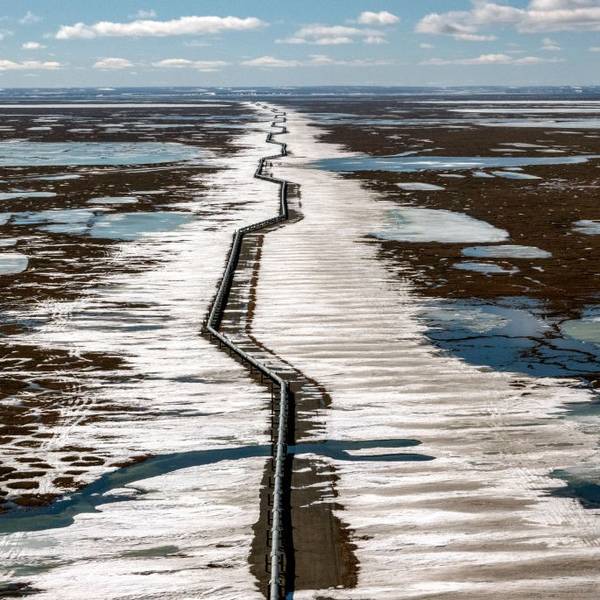
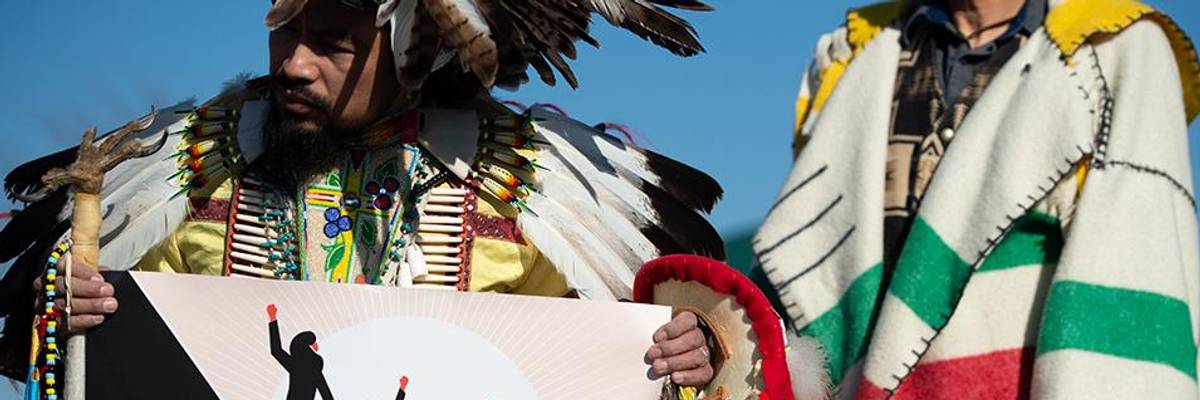
Native American leaders hold signs against drilling in the Arctic Refuge on the 58th anniversary of the Arctic National Wildlife Refuge, during a press conference outside Washington, DC in 2018. The U.S. Department of Interior Monday announced it is moving forward with plans to lease land in the refuge for oil and gas drilling. (Photo: Saul Loeb/AFP via Getty Images)
Trump Administration Denounced for 'Foolish and Deeply Damaging' Plan to Drill in Arctic Wildlife Refuge
Local residents, who rely on caribou native to the refuge for sustenance, have called the area 'the heart and soul of mother earth.'
Environmental advocates vowed to sue the U.S. Department of Interior following its announcement Monday that the Trump administration has finalized plans to auction off oil and gas leasing rights in Alaska's Arctic National Wildlife Refuge.
"The door is being flung wide open for oil and gas drilling to impose irreversible harm to one of America's iconic spaces," Steve Blackledge, senior conservation program director for Environment America, said in a statement Monday. "Claims that this thoroughly invasive industrial work can be done in an environmentally responsible way are either naive or, even worse, cynically deceptive."
Secretary of the Interior David Bernhardt pointed to congressional action in 2017 that set the stage for leasing in the refuge.
"Congress directed us to hold lease sales in the ANWR Coastal Plain, and we have taken a significant step in meeting our obligations by determining where and under what conditions the oil and gas development program will occur," he said in a statement."
Congress did approve the program as Bernhardt mentioned, and, in 2018, the Bureau of Land Management "concluded drilling could be conducted within the coastal plain area without harming wildlife," the New York Times reported.
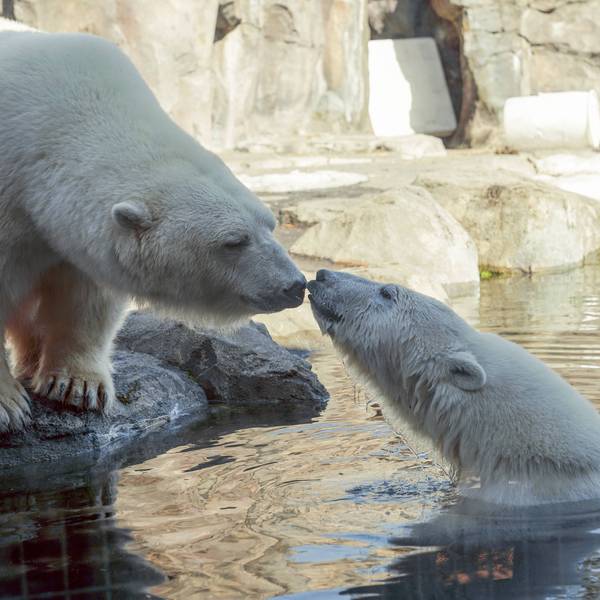
Controversy over an area of about 1.6 million acres, known as 1002, located in the refuge, has existed since Congress established ANWR in 1980 and left open the possibility of drilling in the coastal plain. The refuge, which encompasses about 19 million acres, is home to wildlife including polar bears and caribou, among others. Local tribes, particularly the Gwich'in people native to the land there, rely on the caribou there for sustenance.
"That's the heart and soul of Mother Earth that's being messed with up there," Michael Peter a member of the Gwichyaa Zee Gwich'in Tribal Government told the BLM at a public forum held in Alaska in 2019.
Another Gwichyaa leader, Richard Carroll, noted at that same forum that the Gwich'in people were not being considered in the U.S. government's assessment of drilling in the refuge.
"It's going to set us back about 50 years, but that's another story," Carroll said. "Our nation is being run by profit-made corporations only. Human rights of the Gwich'in people have been totally ignored."
But politicians, including Sen. Lisa Murkowski (R-Alaska), are celebrating Monday's announcement and dismissing concerns that drilling may be unsafe.
"New opportunity in the 1002 Area is needed both now, as Alaskans navigate incredibly challenging times, and well into the future as we seek a lasting economic foundation for our state," Murkowski tweeted Monday.
But advocates say moving forward and opening the area to oil and gas exploration will only hurt the Gwich'in people and the wildlife that call the refuge home.
"The terrible plan for the Arctic Refuge could lead to destructive, widespread development on the sacred calving grounds of the Porcupine Caribou Herd," The Wilderness Society tweeted Monday. "The Gwich'in and Inupiat people who depend on the herd for their survival deserve better."
We are at a crossroads
This country and this world are at a monumental crossroads. In a few short weeks, US voters will have an opportunity to beat back the forces of fascism and confront the billionaires who are rigging the economy, our media system, and our democracy, making it increasingly impossible for ordinary people to get by. We’re not just talking about the election. We’re talking about what must be done once these fascist elements are vanquished from power. We need a bolder set of solutions than what either major party has so far been willing to offer and a working-class movement ready to fight like hell for it. Trump didn't emerge from nowhere. The conditions that fueled MAGA authoritarianism were created by decades of radical neoliberal economic policies and a corrupt political system dominated by corporate interests. They slashed taxes on the super-rich, promising that the benefits would trickle down. They said giveaways to the corporate titans would make life more affordable for the rest of us. It was all bullshit. And when a bitter, betrayed populace searches for someone to blame, right-wing demagogues have little trouble finding scapegoats. People know when they're being lied to, but you won't hear any of this from the corporate media. Only independent journalism—powered and funded by people who believe in building a better world—can deliver truly trustworthy daily news. Our Fall Campaign is underway, and we need your help. To power our newsroom through the rest of the year, we need to raise $125,000 by midnight on October 31. So if you share our vision, please contribute whatever you can to sustain our work. |
Environmental advocates vowed to sue the U.S. Department of Interior following its announcement Monday that the Trump administration has finalized plans to auction off oil and gas leasing rights in Alaska's Arctic National Wildlife Refuge.
"The door is being flung wide open for oil and gas drilling to impose irreversible harm to one of America's iconic spaces," Steve Blackledge, senior conservation program director for Environment America, said in a statement Monday. "Claims that this thoroughly invasive industrial work can be done in an environmentally responsible way are either naive or, even worse, cynically deceptive."
Secretary of the Interior David Bernhardt pointed to congressional action in 2017 that set the stage for leasing in the refuge.
"Congress directed us to hold lease sales in the ANWR Coastal Plain, and we have taken a significant step in meeting our obligations by determining where and under what conditions the oil and gas development program will occur," he said in a statement."
Congress did approve the program as Bernhardt mentioned, and, in 2018, the Bureau of Land Management "concluded drilling could be conducted within the coastal plain area without harming wildlife," the New York Times reported.
Controversy over an area of about 1.6 million acres, known as 1002, located in the refuge, has existed since Congress established ANWR in 1980 and left open the possibility of drilling in the coastal plain. The refuge, which encompasses about 19 million acres, is home to wildlife including polar bears and caribou, among others. Local tribes, particularly the Gwich'in people native to the land there, rely on the caribou there for sustenance.
"That's the heart and soul of Mother Earth that's being messed with up there," Michael Peter a member of the Gwichyaa Zee Gwich'in Tribal Government told the BLM at a public forum held in Alaska in 2019.
Another Gwichyaa leader, Richard Carroll, noted at that same forum that the Gwich'in people were not being considered in the U.S. government's assessment of drilling in the refuge.
"It's going to set us back about 50 years, but that's another story," Carroll said. "Our nation is being run by profit-made corporations only. Human rights of the Gwich'in people have been totally ignored."
But politicians, including Sen. Lisa Murkowski (R-Alaska), are celebrating Monday's announcement and dismissing concerns that drilling may be unsafe.
"New opportunity in the 1002 Area is needed both now, as Alaskans navigate incredibly challenging times, and well into the future as we seek a lasting economic foundation for our state," Murkowski tweeted Monday.
But advocates say moving forward and opening the area to oil and gas exploration will only hurt the Gwich'in people and the wildlife that call the refuge home.
"The terrible plan for the Arctic Refuge could lead to destructive, widespread development on the sacred calving grounds of the Porcupine Caribou Herd," The Wilderness Society tweeted Monday. "The Gwich'in and Inupiat people who depend on the herd for their survival deserve better."