

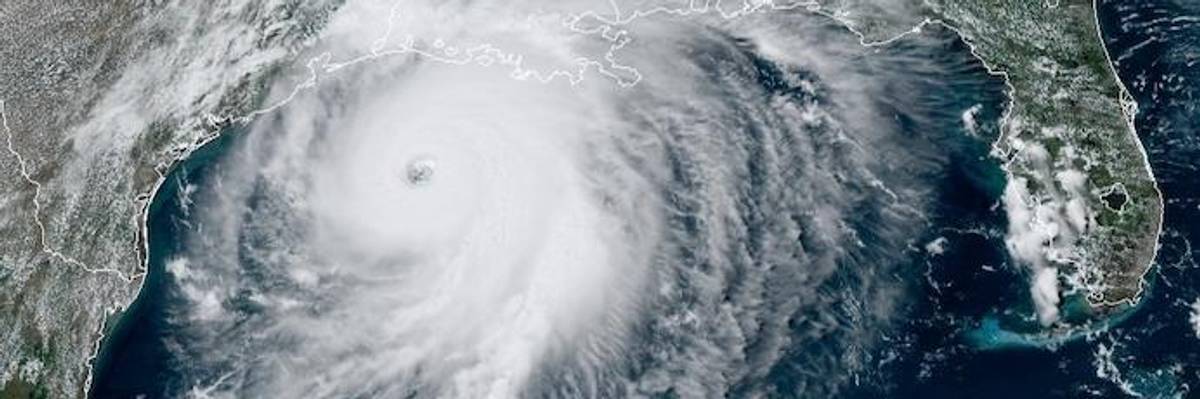
Satellite imagery from NOAA taken August 26, 2020, shows Hurricane Laura in the Gulf of Mexico. (Image: NOAA)
Warning of 'Unsurvivable' Storm Surge as Category 4 Hurricane Laura Barrels Toward US
"Little time remains to protect life and property," said the National Hurricane Center.
This is a developing story. Check back for possible updates.
The National Hurricane Center warned Wednesday that "little time remains to protect life and property" as Hurricane Laura--"an extremely dangerous Category 4 hurricane"--neared landfall and was poised to bring an "unsurvivable storm surge" for parts of Texas and Louisiana.
The 2:00 pm warning from the center came hours after a morning message conveying the possible dangers of the storm and the urgency with which residents should act, as Laura is expected to make landfall in Texas and Louisiana along the Gulft coast Wednesday night. From the center:
Unsurvivable storm surge with large and destructive waves will cause catastrophic damage from Sea Rim State Park, Texas, to Intracoastal City, Louisiana, including Calcasieu and Sabine Lakes. This surge could penetrate up to 30 miles inland from the immediate coastline. Only a few hours remain to protect life and property and all actions should be rushed to completion.
Forecasters said that catastrophic wind damage was expected "where Laura's eyewall makes landfall." Hurricane-force winds were expected to "spread well inland."
Areas of eastern Texas, Louisiana, and Arkansas should also prepare for flash flooding.
Explaining the storm's rapid strengthening, meteorologist Jeff Masters wrote at Yale Climate Connections:
Laura rapidly intensified by an impressive 50 mph in the 24 hours ending at 11 a.m. EDT Wednesday, with the winds rising from 75 mph to 125 mph and the pressure falling from 990 mb to 956 mb. This far exceeds the definition of rapid intensification, which is a 24 mb drop in 24 hours. Buoy 42395, located just east of Laura's eye on Wednesday morning, reported sustained winds of up to 76 mph, wind gusts as high as 107 mph, and a wave height of 37 feet (11 meters).
Climate activist and author Bill McKibben put the storm in the context of the climate crisis, tweeting Wednesday, "It is terrifying to watch the speed with which Hurricane Laura is intensifying."
"The hot waters of the Gulf are an endless source of destructive power," wrote McKibben.
We are at a crossroads
This country and this world are at a monumental crossroads. In a few short weeks, US voters will have an opportunity to beat back the forces of fascism and confront the billionaires who are rigging the economy, our media system, and our democracy, making it increasingly impossible for ordinary people to get by. We’re not just talking about the election. We’re talking about what must be done once these fascist elements are vanquished from power. We need a bolder set of solutions than what either major party has so far been willing to offer and a working-class movement ready to fight like hell for it. Trump didn't emerge from nowhere. The conditions that fueled MAGA authoritarianism were created by decades of radical neoliberal economic policies and a corrupt political system dominated by corporate interests. They slashed taxes on the super-rich, promising that the benefits would trickle down. They said giveaways to the corporate titans would make life more affordable for the rest of us. It was all bullshit. And when a bitter, betrayed populace searches for someone to blame, right-wing demagogues have little trouble finding scapegoats. People know when they're being lied to, but you won't hear any of this from the corporate media. Only independent journalism—powered and funded by people who believe in building a better world—can deliver truly trustworthy daily news. Our Fall Campaign is underway, and we need your help. To power our newsroom through the rest of the year, we need to raise $125,000 by midnight on October 31. So if you share our vision, please contribute whatever you can to sustain our work. |
This is a developing story. Check back for possible updates.
The National Hurricane Center warned Wednesday that "little time remains to protect life and property" as Hurricane Laura--"an extremely dangerous Category 4 hurricane"--neared landfall and was poised to bring an "unsurvivable storm surge" for parts of Texas and Louisiana.
The 2:00 pm warning from the center came hours after a morning message conveying the possible dangers of the storm and the urgency with which residents should act, as Laura is expected to make landfall in Texas and Louisiana along the Gulft coast Wednesday night. From the center:
Unsurvivable storm surge with large and destructive waves will cause catastrophic damage from Sea Rim State Park, Texas, to Intracoastal City, Louisiana, including Calcasieu and Sabine Lakes. This surge could penetrate up to 30 miles inland from the immediate coastline. Only a few hours remain to protect life and property and all actions should be rushed to completion.
Forecasters said that catastrophic wind damage was expected "where Laura's eyewall makes landfall." Hurricane-force winds were expected to "spread well inland."
Areas of eastern Texas, Louisiana, and Arkansas should also prepare for flash flooding.
Explaining the storm's rapid strengthening, meteorologist Jeff Masters wrote at Yale Climate Connections:
Laura rapidly intensified by an impressive 50 mph in the 24 hours ending at 11 a.m. EDT Wednesday, with the winds rising from 75 mph to 125 mph and the pressure falling from 990 mb to 956 mb. This far exceeds the definition of rapid intensification, which is a 24 mb drop in 24 hours. Buoy 42395, located just east of Laura's eye on Wednesday morning, reported sustained winds of up to 76 mph, wind gusts as high as 107 mph, and a wave height of 37 feet (11 meters).
Climate activist and author Bill McKibben put the storm in the context of the climate crisis, tweeting Wednesday, "It is terrifying to watch the speed with which Hurricane Laura is intensifying."
"The hot waters of the Gulf are an endless source of destructive power," wrote McKibben.