SUBSCRIBE TO OUR FREE NEWSLETTER
Daily news & progressive opinion—funded by the people, not the corporations—delivered straight to your inbox.
5
#000000
#FFFFFF
To donate by check, phone, or other method, see our More Ways to Give page.
Daily news & progressive opinion—funded by the people, not the corporations—delivered straight to your inbox.
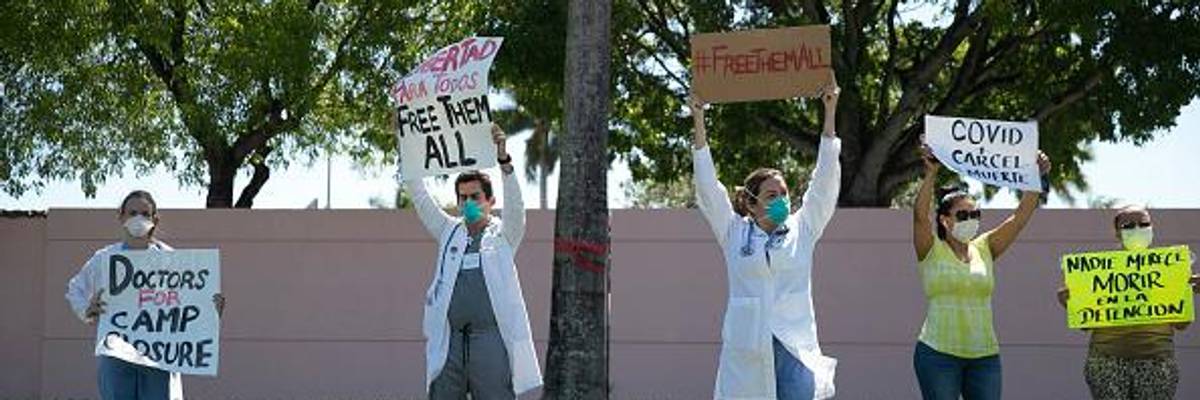
Healthcare professionals and opponents of carceral facilities demand the release of people detained at the Immigration and Customs Enforcement's Broward Transitional Center in Pompano Beach, Florida on May 1, 2020.
The American Friends Service Committee and several other groups have planned several consecutive days of actions beginning Tuesday, during which opponents of mass incarceration will mobilize in communities across the U.S. to demand people be released from prisons, jails, and immigration and juvenile detention centers.
As "a Quaker organization with more than a century of experience working to end militarism and violence," the AFSC is opposed to "punitive approaches" to public safety, which it considers "dehumanizing and harmful," and at odds with its goal of moving "toward a more peaceful world."
In a statement, the AFSC explained its preference for pursuing policies that "actually work to interrupt and prevent cycles of violence, end harm, and provide access to tools to ensure everyone's well-being," noting the organization's desire to see resources shifted away from "incarceration in all forms" and toward "institutions our communities most need... to thrive"
According to the AFSC, the U.S. carceral system is an unjust institution that violates the dignity and rights of 2.3 million people, disproportionately poor people and people of color, who are imprisoned with inadequate access to healthcare and other resources. Furthermore, despite having the highest incarceration rate in the world, the U.S. continues to experience "incredibly high rates of gun violence and sexual assault," meaning that "warehousing" millions of people is an ineffective crime deterrent that does "little to stop harm or help survivors of violence and communities heal."
"If incarceration stopped violence, the U.S. would be the safest country in the world," said Lewis Webb, coordinator of the AFSC's Healing Justice program. "Instead, we have 2.3 million people in cages while our communities lack access to quality healthcare, education, employment, addiction, and mental health services, and an approach to justice that actually addresses the root causes of violence. We believe another approach isn't only possible, but absolutely necessary for the well-being of our communities."
Kristin Kumpf, AFSC's director of human migration and mobility, explained that "thousands of people are in immigration detention--including people who recently came to the U.S. seeking asylum and those who have lived here with their families for years before getting caught up in the Trump administration's cruel immigration policies." She added, "We are calling on Immigration and Customs Enforcement (ICE) and Customs and Border Protection (CBP) to immediately release everyone in their custody."
While the AFSC seeks to shrink the carceral system and transform public safety in general, it made the case that the coronavirus pandemic renders imprisonment particularly deadly and strengthens the impetus for change. To date, there have been more than 176,000 positive cases among incarcerated people as well as staff--and at least 1,000 people have died, according to a statement shared by the organization.
The group explained that "both infection rates and death rates are much higher" inside carceral facilities, where "the nature of confinement makes it almost impossible for people to practice social distancing, and inadequate healthcare and limited sanitation supplies help Covid-19 spread"--conditions that Common Dreams reported on last week.
In a video urging viewers to join the call to #FreeThemAll, the AFSC described how the pandemic multiplies the dangers of incarceration, "making every sentence a potential death sentence" and "turning every cell and cage into a potential death chamber."
For all of these reasons, the AFSC and over a dozen partner organizations are asking people to safely participate in the national days of action that kick off Tuesday evening to demand local, state, and federal leaders:
The AFSC noted that those unable to attend an event in-person can still take action online if they choose by telling their governor, ICE, and the Bureau of Prisons to protect people in prisons, jails, and detention centers from Covid-19 by releasing as many incarcerated people as possible.
The events coincide with the 49th anniversary of the Attica uprising, when more than 2,000 people incarcerated in upstate New York occupied the prison yard to demand access to education, medical care, wages, and more.
A list of actions by state can be found here.
Dear Common Dreams reader, It’s been nearly 30 years since I co-founded Common Dreams with my late wife, Lina Newhouser. We had the radical notion that journalism should serve the public good, not corporate profits. It was clear to us from the outset what it would take to build such a project. No paid advertisements. No corporate sponsors. No millionaire publisher telling us what to think or do. Many people said we wouldn't last a year, but we proved those doubters wrong. Together with a tremendous team of journalists and dedicated staff, we built an independent media outlet free from the constraints of profits and corporate control. Our mission has always been simple: To inform. To inspire. To ignite change for the common good. Building Common Dreams was not easy. Our survival was never guaranteed. When you take on the most powerful forces—Wall Street greed, fossil fuel industry destruction, Big Tech lobbyists, and uber-rich oligarchs who have spent billions upon billions rigging the economy and democracy in their favor—the only bulwark you have is supporters who believe in your work. But here’s the urgent message from me today. It's never been this bad out there. And it's never been this hard to keep us going. At the very moment Common Dreams is most needed, the threats we face are intensifying. We need your support now more than ever. We don't accept corporate advertising and never will. We don't have a paywall because we don't think people should be blocked from critical news based on their ability to pay. Everything we do is funded by the donations of readers like you. When everyone does the little they can afford, we are strong. But if that support retreats or dries up, so do we. Will you donate now to make sure Common Dreams not only survives but thrives? —Craig Brown, Co-founder |
The American Friends Service Committee and several other groups have planned several consecutive days of actions beginning Tuesday, during which opponents of mass incarceration will mobilize in communities across the U.S. to demand people be released from prisons, jails, and immigration and juvenile detention centers.
As "a Quaker organization with more than a century of experience working to end militarism and violence," the AFSC is opposed to "punitive approaches" to public safety, which it considers "dehumanizing and harmful," and at odds with its goal of moving "toward a more peaceful world."
In a statement, the AFSC explained its preference for pursuing policies that "actually work to interrupt and prevent cycles of violence, end harm, and provide access to tools to ensure everyone's well-being," noting the organization's desire to see resources shifted away from "incarceration in all forms" and toward "institutions our communities most need... to thrive"
According to the AFSC, the U.S. carceral system is an unjust institution that violates the dignity and rights of 2.3 million people, disproportionately poor people and people of color, who are imprisoned with inadequate access to healthcare and other resources. Furthermore, despite having the highest incarceration rate in the world, the U.S. continues to experience "incredibly high rates of gun violence and sexual assault," meaning that "warehousing" millions of people is an ineffective crime deterrent that does "little to stop harm or help survivors of violence and communities heal."
"If incarceration stopped violence, the U.S. would be the safest country in the world," said Lewis Webb, coordinator of the AFSC's Healing Justice program. "Instead, we have 2.3 million people in cages while our communities lack access to quality healthcare, education, employment, addiction, and mental health services, and an approach to justice that actually addresses the root causes of violence. We believe another approach isn't only possible, but absolutely necessary for the well-being of our communities."
Kristin Kumpf, AFSC's director of human migration and mobility, explained that "thousands of people are in immigration detention--including people who recently came to the U.S. seeking asylum and those who have lived here with their families for years before getting caught up in the Trump administration's cruel immigration policies." She added, "We are calling on Immigration and Customs Enforcement (ICE) and Customs and Border Protection (CBP) to immediately release everyone in their custody."
While the AFSC seeks to shrink the carceral system and transform public safety in general, it made the case that the coronavirus pandemic renders imprisonment particularly deadly and strengthens the impetus for change. To date, there have been more than 176,000 positive cases among incarcerated people as well as staff--and at least 1,000 people have died, according to a statement shared by the organization.
The group explained that "both infection rates and death rates are much higher" inside carceral facilities, where "the nature of confinement makes it almost impossible for people to practice social distancing, and inadequate healthcare and limited sanitation supplies help Covid-19 spread"--conditions that Common Dreams reported on last week.
In a video urging viewers to join the call to #FreeThemAll, the AFSC described how the pandemic multiplies the dangers of incarceration, "making every sentence a potential death sentence" and "turning every cell and cage into a potential death chamber."
For all of these reasons, the AFSC and over a dozen partner organizations are asking people to safely participate in the national days of action that kick off Tuesday evening to demand local, state, and federal leaders:
The AFSC noted that those unable to attend an event in-person can still take action online if they choose by telling their governor, ICE, and the Bureau of Prisons to protect people in prisons, jails, and detention centers from Covid-19 by releasing as many incarcerated people as possible.
The events coincide with the 49th anniversary of the Attica uprising, when more than 2,000 people incarcerated in upstate New York occupied the prison yard to demand access to education, medical care, wages, and more.
A list of actions by state can be found here.
The American Friends Service Committee and several other groups have planned several consecutive days of actions beginning Tuesday, during which opponents of mass incarceration will mobilize in communities across the U.S. to demand people be released from prisons, jails, and immigration and juvenile detention centers.
As "a Quaker organization with more than a century of experience working to end militarism and violence," the AFSC is opposed to "punitive approaches" to public safety, which it considers "dehumanizing and harmful," and at odds with its goal of moving "toward a more peaceful world."
In a statement, the AFSC explained its preference for pursuing policies that "actually work to interrupt and prevent cycles of violence, end harm, and provide access to tools to ensure everyone's well-being," noting the organization's desire to see resources shifted away from "incarceration in all forms" and toward "institutions our communities most need... to thrive"
According to the AFSC, the U.S. carceral system is an unjust institution that violates the dignity and rights of 2.3 million people, disproportionately poor people and people of color, who are imprisoned with inadequate access to healthcare and other resources. Furthermore, despite having the highest incarceration rate in the world, the U.S. continues to experience "incredibly high rates of gun violence and sexual assault," meaning that "warehousing" millions of people is an ineffective crime deterrent that does "little to stop harm or help survivors of violence and communities heal."
"If incarceration stopped violence, the U.S. would be the safest country in the world," said Lewis Webb, coordinator of the AFSC's Healing Justice program. "Instead, we have 2.3 million people in cages while our communities lack access to quality healthcare, education, employment, addiction, and mental health services, and an approach to justice that actually addresses the root causes of violence. We believe another approach isn't only possible, but absolutely necessary for the well-being of our communities."
Kristin Kumpf, AFSC's director of human migration and mobility, explained that "thousands of people are in immigration detention--including people who recently came to the U.S. seeking asylum and those who have lived here with their families for years before getting caught up in the Trump administration's cruel immigration policies." She added, "We are calling on Immigration and Customs Enforcement (ICE) and Customs and Border Protection (CBP) to immediately release everyone in their custody."
While the AFSC seeks to shrink the carceral system and transform public safety in general, it made the case that the coronavirus pandemic renders imprisonment particularly deadly and strengthens the impetus for change. To date, there have been more than 176,000 positive cases among incarcerated people as well as staff--and at least 1,000 people have died, according to a statement shared by the organization.
The group explained that "both infection rates and death rates are much higher" inside carceral facilities, where "the nature of confinement makes it almost impossible for people to practice social distancing, and inadequate healthcare and limited sanitation supplies help Covid-19 spread"--conditions that Common Dreams reported on last week.
In a video urging viewers to join the call to #FreeThemAll, the AFSC described how the pandemic multiplies the dangers of incarceration, "making every sentence a potential death sentence" and "turning every cell and cage into a potential death chamber."
For all of these reasons, the AFSC and over a dozen partner organizations are asking people to safely participate in the national days of action that kick off Tuesday evening to demand local, state, and federal leaders:
The AFSC noted that those unable to attend an event in-person can still take action online if they choose by telling their governor, ICE, and the Bureau of Prisons to protect people in prisons, jails, and detention centers from Covid-19 by releasing as many incarcerated people as possible.
The events coincide with the 49th anniversary of the Attica uprising, when more than 2,000 people incarcerated in upstate New York occupied the prison yard to demand access to education, medical care, wages, and more.
A list of actions by state can be found here.