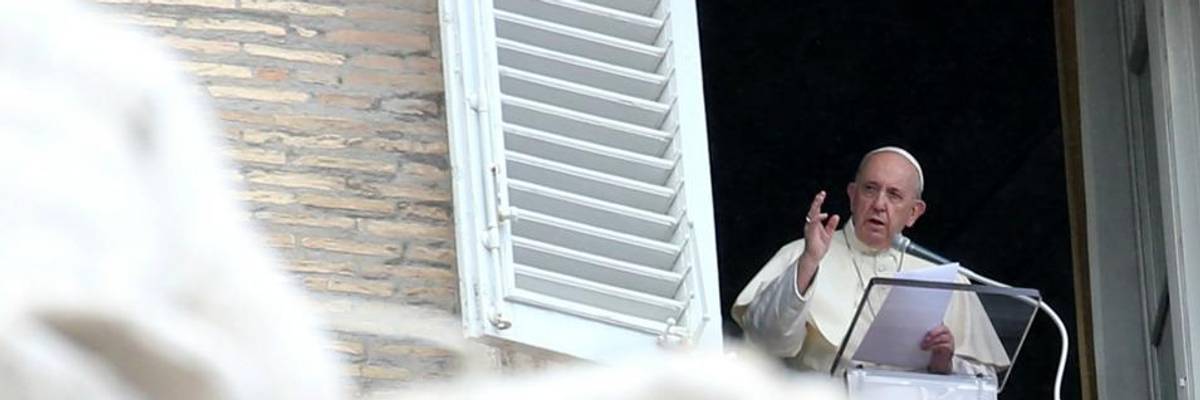
Pope Francis delivers his Sunday Angelus Blessing from the window of his studio overlooking St. Peter's Square on October 04, 2020 in Vatican City, Vatican. (Photo: Franco Origlia/Getty Images)
In Address on Inequality Amid Pandemic, Pope Calls on Global Community to Confront 'Destructive Effects of Empire of Money'
"Anyone who thinks that the only lesson to be learned was the need to improve what we were already doing, or to refine existing systems and regulations, is denying reality."
In his third encyclical Sunday morning, Pope Francis denounced free market capitalism and the "magic" theory of trickle-down economics, saying the coronavirus pandemic has once and for all disproven the notion that economic policies that are aimed at benefiting the already-rich will benefit low-income people through job creation and investments.
The 45,000 word document, titled "Fratelli Tutti" meaning "Brothers All" or "Brothers and Sisters All," indicated the pope's belief that the pandemic has shown that a major overhaul of global economic systems is needed, as the crisis has disproportionately affected the poor in countries including the U.S., Brazil, and the U.K.; revealed the divide between low-income workers all over the world who have had limited access to government aid and professionals who are able to work from home; and caused the "most unequal" recession in modern U.S. history.
"Anyone who thinks that the only lesson to be learned was the need to improve what we were already doing, or to refine existing systems and regulations, is denying reality," Pope Francis said.
"The fragility of world systems in the face of the pandemic has demonstrated that not everything can be resolved by market freedom," the encyclical continued.
The document implicitly rebuked conservative and neo-liberal views in the U.S. and other wealthy nations. In the U.S., the pandemic has so far eliminated low-paying jobs at eight times the rate of high-wage jobs, and Republican leaders in the Senate have scoffed at Democrats' proposal to continue the $600-per-week unemployment benefit introduced in March, despite evidence that it had a measurable positive impact on poverty levels in the United States for several months this year. Instead, the GOP has prioritized protecting corporations from liability should their employees contract the coronavirus after returning to work.
Previous economic crises, such as the recession in 2008 and 2009, have ultimately "increased freedom for the truly powerful, who always find a way to escape unscathed," Pope Francis remarked. Now, he said, society must confront "the destructive effects of the empire of money."
Those with economic power must "administer it for the good of all" rather than hoarding wealth, he said, suggesting that this applies both to individual countries like the U.S.--where a recent analysis by the People's Policy Project showed that nearly 80% of wealth is currently owned by millionaires and billionaires, who make up just 12% of the population--and to the global community, where leaders of developing countries recently asked if their populations will be "left to die" after the U.S., Russia, and Brazil refused to commit to a global effort to make a Covid-19 vaccine available to all.
Private property cannot be considered a right if a select few in a society live in luxury while others have nothing, the pope added.
Jonathan Wilson-Hartgrove, a spiritual writer and leader of the Poor People's Campaign in the U.S., interpreted Pope Francis's words as a call for an "international Poor People's Campaign."
"There seems to be no place for popular movements that unite the unemployed, temporary and informal workers, and many others who do not easily find a place in existing structures," said the Pope.
Rev. Dr. William Barber II, co-chair of the Poor People's Campaign, thanked the pope for "calling the church to stand with poor people's movements around the world" in the midst of the pandemic and beyond.
We are at a crossroads
This country and this world are at a monumental crossroads. US voters have an opportunity to beat back the forces of fascism and confront the billionaires who are rigging the economy, our media system, and our democracy, making it increasingly impossible for ordinary people to get by. We’re not just talking about the election. We’re talking about what must be done once these fascist elements are vanquished from power. We need a bolder set of solutions than what either major party has so far been willing to offer and a working-class movement ready to fight like hell for it. Trump didn't emerge from nowhere. The conditions that fueled MAGA authoritarianism were created by decades of radical neoliberal economic policies and a corrupt political system dominated by corporate interests. They slashed taxes on the super-rich, promising that the benefits would trickle down. They said giveaways to the corporate titans would make life more affordable for the rest of us. It was all bullshit. And when a bitter, betrayed populace searches for someone to blame, right-wing demagogues have little trouble finding scapegoats. People know when they're being lied to, but you won't hear any of this from the corporate media. Only independent journalism—powered and funded by people who believe in building a better world—can deliver truly trustworthy daily news. Our Fall Campaign is underway, and we need your help. To power our newsroom through the rest of the year, we need to raise $125,000 by midnight on October 31. So if you share our vision, please contribute whatever you can to sustain our work. |
In his third encyclical Sunday morning, Pope Francis denounced free market capitalism and the "magic" theory of trickle-down economics, saying the coronavirus pandemic has once and for all disproven the notion that economic policies that are aimed at benefiting the already-rich will benefit low-income people through job creation and investments.
The 45,000 word document, titled "Fratelli Tutti" meaning "Brothers All" or "Brothers and Sisters All," indicated the pope's belief that the pandemic has shown that a major overhaul of global economic systems is needed, as the crisis has disproportionately affected the poor in countries including the U.S., Brazil, and the U.K.; revealed the divide between low-income workers all over the world who have had limited access to government aid and professionals who are able to work from home; and caused the "most unequal" recession in modern U.S. history.
"Anyone who thinks that the only lesson to be learned was the need to improve what we were already doing, or to refine existing systems and regulations, is denying reality," Pope Francis said.
"The fragility of world systems in the face of the pandemic has demonstrated that not everything can be resolved by market freedom," the encyclical continued.
The document implicitly rebuked conservative and neo-liberal views in the U.S. and other wealthy nations. In the U.S., the pandemic has so far eliminated low-paying jobs at eight times the rate of high-wage jobs, and Republican leaders in the Senate have scoffed at Democrats' proposal to continue the $600-per-week unemployment benefit introduced in March, despite evidence that it had a measurable positive impact on poverty levels in the United States for several months this year. Instead, the GOP has prioritized protecting corporations from liability should their employees contract the coronavirus after returning to work.
Previous economic crises, such as the recession in 2008 and 2009, have ultimately "increased freedom for the truly powerful, who always find a way to escape unscathed," Pope Francis remarked. Now, he said, society must confront "the destructive effects of the empire of money."
Those with economic power must "administer it for the good of all" rather than hoarding wealth, he said, suggesting that this applies both to individual countries like the U.S.--where a recent analysis by the People's Policy Project showed that nearly 80% of wealth is currently owned by millionaires and billionaires, who make up just 12% of the population--and to the global community, where leaders of developing countries recently asked if their populations will be "left to die" after the U.S., Russia, and Brazil refused to commit to a global effort to make a Covid-19 vaccine available to all.
Private property cannot be considered a right if a select few in a society live in luxury while others have nothing, the pope added.
Jonathan Wilson-Hartgrove, a spiritual writer and leader of the Poor People's Campaign in the U.S., interpreted Pope Francis's words as a call for an "international Poor People's Campaign."
"There seems to be no place for popular movements that unite the unemployed, temporary and informal workers, and many others who do not easily find a place in existing structures," said the Pope.
Rev. Dr. William Barber II, co-chair of the Poor People's Campaign, thanked the pope for "calling the church to stand with poor people's movements around the world" in the midst of the pandemic and beyond.