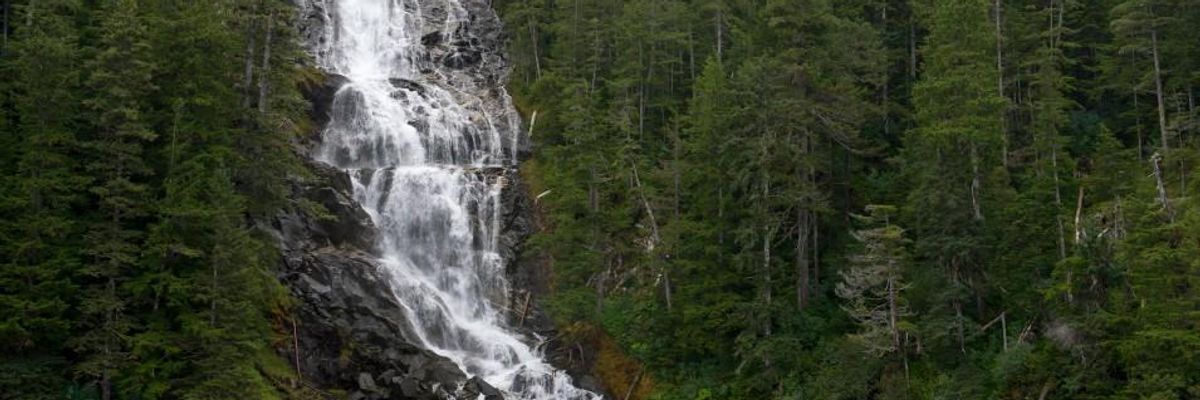
Waterfall on Baranof Island, Tongass National Forest in Southeast Alaska. (Photo: Wolfgang Kaehler/LightRocket via Getty Images)
'One Word for This: Vandalism': Six Days Before Election, Trump Finalizes Plan for 'Catastrophic' Attack on Largest National Forest
"Destructive development in the country's largest national forest—such as extractive logging and expansive road building—will be catastrophic for generations to come," warned Greenpeace.
Cue the chainsaws and bulldozers.
The Trump administration on Wednesday announced its finalized plan to gut protections for the nation's largest national forest, Alaska's Tongass, opening the carbon sink to clear-cut logging and irreparable ecological destruction.
The change--at total odds with public opinion--means 9.3 million acres of the wild public lands, home to the planet's largest intact temperate rainforest, are exempted from the Clinton-era Roadless Rule, which prevented industrial activity.
"There's one word for this: vandalism. There's one emotion: fury. There's one response, at least this week: Vote," tweeted author and climate activist Bill McKibben.
The announcement of the final Record of Decision, which comes just six days before Election Day, follows the U.S. Forest Service's September release of the plan's Final Environmental Impact Statement (EIS).
The final plan is set to be published at the Federal Register Thursday.
Dr. Amy Moas, Greenpeace USA senior forests campaigner, warned that the loss of protections "will have permanent consequences for the Tongass National Forest, the wildlife it houses, the carbon it holds, and the Native Alaskans who rely on it."
"Destructive development in the country's largest national forest--such as extractive logging and expansive road building--will be catastrophic for generations to come, both increasing pollution and curbing our natural ability to minimize its impacts," said Moas. "Healthy forests are our first line of defense in the fight against the growing climate emergency."
In a statement earlier this month, conservation group NRDC outlined why, amid the ecological and climate crises, keeping the Roadless Rule in place for Tongass was so crucial:
The Tongass stores more carbon per acre than almost any other forest on the planet, which makes preserving it a matter of real urgency in the fight against climate change. [...]
America's largest national forest, the 17-million-acre Tongass is home to species like wild Pacific salmon, the Alexander Archipelago wolf, and many others that depend on its majestic old growth forests. So, too, do local Indigenous communities, who rely on these pristine lands for traditional hunting, gathering, and cultural practices. Roadless areas of the Tongass are key to sustaining customary and traditional use of forest and streams by Native Alaskans.
The Juneau-based Southeast Alaska Conservation Council (SEACC) also blasted the Trump administration's attack on the forest.
"The decision to rollback the Roadless Rule on the Tongass was made in spite of, not in support of, Southeast Alaskans and our communities," SEACC executive eirector Meredith Trainor said in a statement.
"In making this decision, the Trump administration and the sham rulemaking process they undertook in our region ignored economic realities, environmental imperatives, and worst of all," she continued, "the will of the people who actually live here."
The real motivation for gutting the conservation protections, according to SEACC, can be seen in the paper trail left by state officials including Alaska Gov. Mike Dunleavy and Sen. Lisa Murkowski who pressured the Trump administration to take the timber industry-friendly action. The group pointed as one example to FOIA records revealing Agriculture Secretary Sonny Perdue giving preference to meetings with the timber industry over Southeast Tribes.
In fact, said Trainor, "The Final Environmental Impact Statement itself makes clear that a full exemption for the Tongass was a foregone conclusion from the moment the State of Alaska made its request."
Trainor said her group was nonetheless undeterred in fighting for protection of the area, saying, "we are committed to taking any and all necessary steps, including litigation, to keep these national Roadless Rule protections in place on the Tongass National Forest in perpetuity."
To achieve that goal, Greenpeace's Moas pointed to pending legislation that would permanently protect areas designated under the Roadless Rule.
"We're calling on Congress once again to codify the Roadless Area Conservation Act and reverse this reckless decision so our prized wild places are permanently protected," Moas said. "Our legislators must act now."
We are at a crossroads
This country and this world are at a monumental crossroads. US voters have an opportunity to beat back the forces of fascism and confront the billionaires who are rigging the economy, our media system, and our democracy, making it increasingly impossible for ordinary people to get by. We’re not just talking about the election. We’re talking about what must be done once these fascist elements are vanquished from power. We need a bolder set of solutions than what either major party has so far been willing to offer and a working-class movement ready to fight like hell for it. Trump didn't emerge from nowhere. The conditions that fueled MAGA authoritarianism were created by decades of radical neoliberal economic policies and a corrupt political system dominated by corporate interests. They slashed taxes on the super-rich, promising that the benefits would trickle down. They said giveaways to the corporate titans would make life more affordable for the rest of us. It was all bullshit. And when a bitter, betrayed populace searches for someone to blame, right-wing demagogues have little trouble finding scapegoats. People know when they're being lied to, but you won't hear any of this from the corporate media. Only independent journalism—powered and funded by people who believe in building a better world—can deliver truly trustworthy daily news. Our Fall Campaign is underway, and we need your help. To power our newsroom through the rest of the year, we need to raise $125,000 by midnight on October 31. So if you share our vision, please contribute whatever you can to sustain our work. |
Cue the chainsaws and bulldozers.
The Trump administration on Wednesday announced its finalized plan to gut protections for the nation's largest national forest, Alaska's Tongass, opening the carbon sink to clear-cut logging and irreparable ecological destruction.
The change--at total odds with public opinion--means 9.3 million acres of the wild public lands, home to the planet's largest intact temperate rainforest, are exempted from the Clinton-era Roadless Rule, which prevented industrial activity.
"There's one word for this: vandalism. There's one emotion: fury. There's one response, at least this week: Vote," tweeted author and climate activist Bill McKibben.
The announcement of the final Record of Decision, which comes just six days before Election Day, follows the U.S. Forest Service's September release of the plan's Final Environmental Impact Statement (EIS).
The final plan is set to be published at the Federal Register Thursday.
Dr. Amy Moas, Greenpeace USA senior forests campaigner, warned that the loss of protections "will have permanent consequences for the Tongass National Forest, the wildlife it houses, the carbon it holds, and the Native Alaskans who rely on it."
"Destructive development in the country's largest national forest--such as extractive logging and expansive road building--will be catastrophic for generations to come, both increasing pollution and curbing our natural ability to minimize its impacts," said Moas. "Healthy forests are our first line of defense in the fight against the growing climate emergency."
In a statement earlier this month, conservation group NRDC outlined why, amid the ecological and climate crises, keeping the Roadless Rule in place for Tongass was so crucial:
The Tongass stores more carbon per acre than almost any other forest on the planet, which makes preserving it a matter of real urgency in the fight against climate change. [...]
America's largest national forest, the 17-million-acre Tongass is home to species like wild Pacific salmon, the Alexander Archipelago wolf, and many others that depend on its majestic old growth forests. So, too, do local Indigenous communities, who rely on these pristine lands for traditional hunting, gathering, and cultural practices. Roadless areas of the Tongass are key to sustaining customary and traditional use of forest and streams by Native Alaskans.
The Juneau-based Southeast Alaska Conservation Council (SEACC) also blasted the Trump administration's attack on the forest.
"The decision to rollback the Roadless Rule on the Tongass was made in spite of, not in support of, Southeast Alaskans and our communities," SEACC executive eirector Meredith Trainor said in a statement.
"In making this decision, the Trump administration and the sham rulemaking process they undertook in our region ignored economic realities, environmental imperatives, and worst of all," she continued, "the will of the people who actually live here."
The real motivation for gutting the conservation protections, according to SEACC, can be seen in the paper trail left by state officials including Alaska Gov. Mike Dunleavy and Sen. Lisa Murkowski who pressured the Trump administration to take the timber industry-friendly action. The group pointed as one example to FOIA records revealing Agriculture Secretary Sonny Perdue giving preference to meetings with the timber industry over Southeast Tribes.
In fact, said Trainor, "The Final Environmental Impact Statement itself makes clear that a full exemption for the Tongass was a foregone conclusion from the moment the State of Alaska made its request."
Trainor said her group was nonetheless undeterred in fighting for protection of the area, saying, "we are committed to taking any and all necessary steps, including litigation, to keep these national Roadless Rule protections in place on the Tongass National Forest in perpetuity."
To achieve that goal, Greenpeace's Moas pointed to pending legislation that would permanently protect areas designated under the Roadless Rule.
"We're calling on Congress once again to codify the Roadless Area Conservation Act and reverse this reckless decision so our prized wild places are permanently protected," Moas said. "Our legislators must act now."