
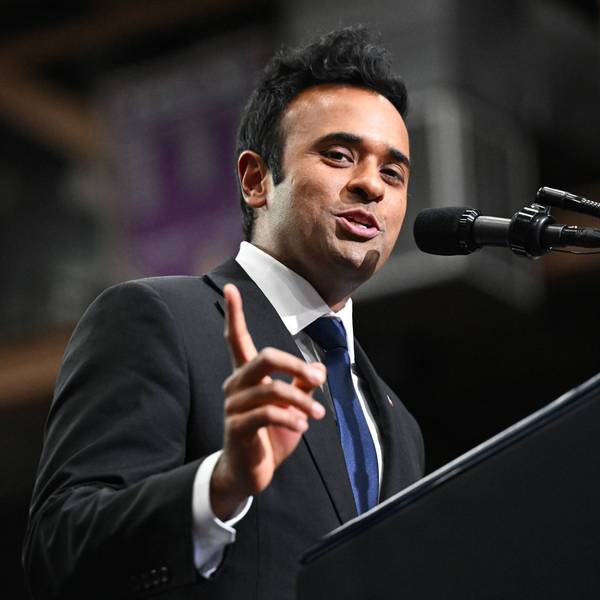

Vice Chair Rep. Joaquin Castro (D-Texas) wears a face mask during a House Committee on Foreign Affairs hearing looking into the firing of State Department Inspector General Steven Linick on September 16, 2020 in Washington, D.C. (Photo: Kevin Dietsch-Pool/Getty Images)
47 Groups Back Rep. Joaquin Castro for House Committee Chair Post to 'Build a More Restrained and Progressive Foreign Policy'
"Rep. Castro embodies a progressive vision for the U.S. in the world, one that prioritizes diplomacy and multilateralism over militarism."
With Democrats set to select a new chair for the House Foreign Affairs Committee by the end of November, 47 progressive advocacy groups on Friday put out a joint letter endorsing Texas Congressman Joaquin Castro, who is facing off against "two more senior and more traditional colleagues," as HuffPost noted Friday.
The letter, reported exclusively by HuffPost, explains that "Rep. Castro has demonstrated a strong commitment to bringing a diversity of voices into discussions on foreign policy. Too often, the voices of those impacted by U.S. foreign policy are left out of the conversations in Washington."
Castro is competing with Reps. Gregory Meeks (D-N.Y.) and Brad Sherman (D-Calif.) for the position, which is opening up because the current chair, Rep. Eliot Engel (D-N.Y.), was defeated by progressive challenger Jamaal Bowman in a June primary race. Bowman easily won the seat last week.
The groups behind the letter--which was organized by the Center for International Policy--are hopeful that Castro, as the committee's chair, would work "to build a more restrained and progressive foreign policy that genuinely serves the needs of communities here in the U.S. and abroad."
Yasmine Taeb, a senior fellow at the Center for International Policy, told HuffPost that "Rep. Castro embodies a progressive vision for the U.S. in the world, one that prioritizes diplomacy and multilateralism over militarism."
The letter says:
As Black, indigenous, and other communities of color face increased militarism at home, and as U.S. militarism abroad has led to disastrous endless wars, we are impressed with Rep. Castro's transparent and engaging campaign for HFAC chair, that focuses on the root causes of militarism. We hope to build with Rep. Castro towards a U.S. foreign policy that centers the perspectives and solutions of communities who have experienced harm as a result of U.S. policy, and that tackles the rise in right-wing authoritarianism around the world, which disproportionately impacts women, girls, the LGBTQ+ community, and communities of color.
Signatories--including CodePink, Friends of the Earth, IfNotNow, Jewish Voice for Peace Action, Justice Democrats, Peace Action, and the Sunrise Movement--praise his "commitment to support war powers reform legislation that would appropriately strengthen Congress's role in authorizing and overseeing the use of force."
The Texan "has also supported a diplomacy-driven approach to conflicts in the Middle East, including in Iran and ending reliance on collectively-punishing sanctions as a foreign policy tool," and "committed to ending U.S. support for the Saudi war in Yemen and reducing America's military presence in the region," the letter notes.
The letter also emphasizes the importance of having an HFAC chair who "puts addressing the climate crisis at the forefront of its agenda" and will "work to stem the massive and dangerous growth of our military by reallocating wasteful Pentagon spending, reducing the number of foreign bases and increasing diplomacy, eliminating use of private military contractors in combat, decreasing spending on nuclear weapons, and finally ending the wars in Afghanistan and Iraq."
In addition to supporting a measure to curb Pentagon spending, the congressman--who is currently chair of the Congressional Hispanic Caucus--has called out the U.S. Department of Homeland Security for violating the human rights of migrants and has been "a consistent supporter of reproductive rights" on a global scale.
The groups also applaud Castro's "recent commitment to include Palestinian voices in the formulation of policy impacting their lives and his specific condemnation of the Trump administration backing Israeli settlements and its overt and tacit approval of the annexation of the West Bank."
During a J Street webcast last month, Castro said that "for the long-term stability of both Israel and the Palestinians, I think the United States--especially on the congressional level--being able to hear the different voices would actually be helpful. And so I hope that we can make that happen next term."
Castro had similarly told the Washington Post in July that "over the years, there have been too many voices excluded; I think too often Palestinian voices have been excluded. If the United States is going to be an arbiter of peace, it has to be willing to hear from the different sides, and in my estimation we've not always done that."
As Amira Hassan, political director at Justice Democrats, told HuffPost: "Rep. Castro has shown a willingness to engage with progressive organizations and bring in diverse perspectives and voices to help chart a new path forward."
While Democrats have retained a majority in the House and President-elect Joe Biden's victory has denied President Donald Trump a second term, control of the Senate remains uncertain, with two runoff races in Georgia scheduled for January.
We are at a crossroads
This country and this world are at a monumental crossroads. US voters have an opportunity to beat back the forces of fascism and confront the billionaires who are rigging the economy, our media system, and our democracy, making it increasingly impossible for ordinary people to get by. We’re not just talking about the election. We’re talking about what must be done once these fascist elements are vanquished from power. We need a bolder set of solutions than what either major party has so far been willing to offer and a working-class movement ready to fight like hell for it. Trump didn't emerge from nowhere. The conditions that fueled MAGA authoritarianism were created by decades of radical neoliberal economic policies and a corrupt political system dominated by corporate interests. They slashed taxes on the super-rich, promising that the benefits would trickle down. They said giveaways to the corporate titans would make life more affordable for the rest of us. It was all bullshit. And when a bitter, betrayed populace searches for someone to blame, right-wing demagogues have little trouble finding scapegoats. People know when they're being lied to, but you won't hear any of this from the corporate media. Only independent journalism—powered and funded by people who believe in building a better world—can deliver truly trustworthy daily news. Our Fall Campaign is underway, and we need your help. To power our newsroom through the rest of the year, we need to raise $125,000 by midnight on October 31. So if you share our vision, please contribute whatever you can to sustain our work. |
With Democrats set to select a new chair for the House Foreign Affairs Committee by the end of November, 47 progressive advocacy groups on Friday put out a joint letter endorsing Texas Congressman Joaquin Castro, who is facing off against "two more senior and more traditional colleagues," as HuffPost noted Friday.
The letter, reported exclusively by HuffPost, explains that "Rep. Castro has demonstrated a strong commitment to bringing a diversity of voices into discussions on foreign policy. Too often, the voices of those impacted by U.S. foreign policy are left out of the conversations in Washington."
Castro is competing with Reps. Gregory Meeks (D-N.Y.) and Brad Sherman (D-Calif.) for the position, which is opening up because the current chair, Rep. Eliot Engel (D-N.Y.), was defeated by progressive challenger Jamaal Bowman in a June primary race. Bowman easily won the seat last week.
The groups behind the letter--which was organized by the Center for International Policy--are hopeful that Castro, as the committee's chair, would work "to build a more restrained and progressive foreign policy that genuinely serves the needs of communities here in the U.S. and abroad."
Yasmine Taeb, a senior fellow at the Center for International Policy, told HuffPost that "Rep. Castro embodies a progressive vision for the U.S. in the world, one that prioritizes diplomacy and multilateralism over militarism."
The letter says:
As Black, indigenous, and other communities of color face increased militarism at home, and as U.S. militarism abroad has led to disastrous endless wars, we are impressed with Rep. Castro's transparent and engaging campaign for HFAC chair, that focuses on the root causes of militarism. We hope to build with Rep. Castro towards a U.S. foreign policy that centers the perspectives and solutions of communities who have experienced harm as a result of U.S. policy, and that tackles the rise in right-wing authoritarianism around the world, which disproportionately impacts women, girls, the LGBTQ+ community, and communities of color.
Signatories--including CodePink, Friends of the Earth, IfNotNow, Jewish Voice for Peace Action, Justice Democrats, Peace Action, and the Sunrise Movement--praise his "commitment to support war powers reform legislation that would appropriately strengthen Congress's role in authorizing and overseeing the use of force."
The Texan "has also supported a diplomacy-driven approach to conflicts in the Middle East, including in Iran and ending reliance on collectively-punishing sanctions as a foreign policy tool," and "committed to ending U.S. support for the Saudi war in Yemen and reducing America's military presence in the region," the letter notes.
The letter also emphasizes the importance of having an HFAC chair who "puts addressing the climate crisis at the forefront of its agenda" and will "work to stem the massive and dangerous growth of our military by reallocating wasteful Pentagon spending, reducing the number of foreign bases and increasing diplomacy, eliminating use of private military contractors in combat, decreasing spending on nuclear weapons, and finally ending the wars in Afghanistan and Iraq."
In addition to supporting a measure to curb Pentagon spending, the congressman--who is currently chair of the Congressional Hispanic Caucus--has called out the U.S. Department of Homeland Security for violating the human rights of migrants and has been "a consistent supporter of reproductive rights" on a global scale.
The groups also applaud Castro's "recent commitment to include Palestinian voices in the formulation of policy impacting their lives and his specific condemnation of the Trump administration backing Israeli settlements and its overt and tacit approval of the annexation of the West Bank."
During a J Street webcast last month, Castro said that "for the long-term stability of both Israel and the Palestinians, I think the United States--especially on the congressional level--being able to hear the different voices would actually be helpful. And so I hope that we can make that happen next term."
Castro had similarly told the Washington Post in July that "over the years, there have been too many voices excluded; I think too often Palestinian voices have been excluded. If the United States is going to be an arbiter of peace, it has to be willing to hear from the different sides, and in my estimation we've not always done that."
As Amira Hassan, political director at Justice Democrats, told HuffPost: "Rep. Castro has shown a willingness to engage with progressive organizations and bring in diverse perspectives and voices to help chart a new path forward."
While Democrats have retained a majority in the House and President-elect Joe Biden's victory has denied President Donald Trump a second term, control of the Senate remains uncertain, with two runoff races in Georgia scheduled for January.