
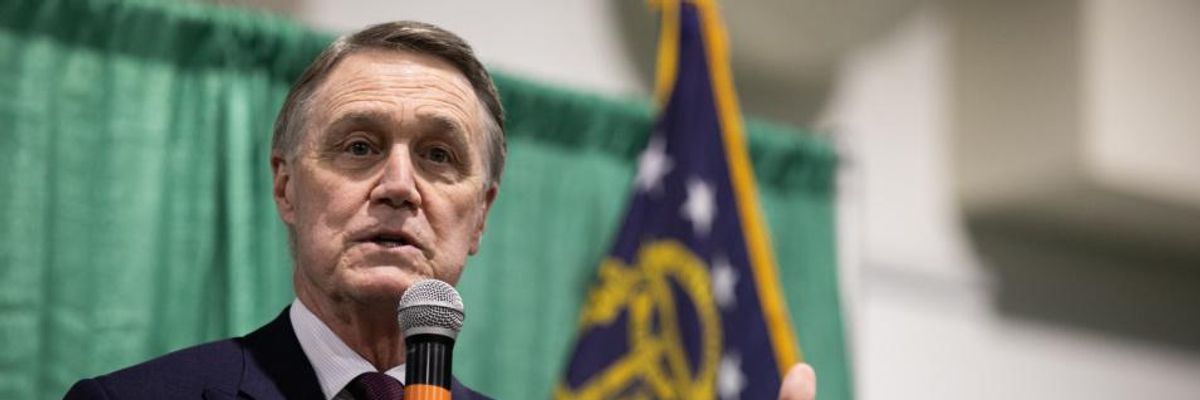
U.S. Sen. David Perdue (R-Ga.), who is facing Democratic U.S. Senate candidate Jon Ossoff in a runoff race on January 5, speaks to a crowd of supporters during a "Defend the Majority" rally at the Georgia National Fairgrounds and Agriculture Center on November 19, 2020 in Perry, Georgia. (Photo: Jessica McGowan/Getty Images)
'Utterly Inexcusable': Sen. Perdue of Georgia Profited From Defense Contractor's Stock While Overseeing Naval Spending
"He is blatantly exploiting his office to line his own pockets," said Democratic U.S. Senate candidate Jon Ossoff.
"David Perdue's corruption and self-dealing are flagrant. He is blatantly exploiting his office to line his own pockets. This conduct is utterly inexcusable."
That's what Democratic U.S. Senate candidate Jon Ossoff said in response to new records revealing more suspicious Wall Street investment activity by Sen. Perdue (R-Ga.), who bought stock in a Navy supplier just before taking a leading role in drafting a bill that increased submarine funding, after which he sold the stock--enriching himself by tens of thousands of dollars in the process.
The Daily Beast's congressional reporter Sam Brodey this week provided a detailed timeline and explanation of the GOP lawmaker's actions:
In January 2019, Perdue was named as the chairman of the Senate Armed Services Subcommittee on Seapower... But in the month before he took over the job, Perdue did something unusual: he acquired up to $190,000 worth of stock in BWX Technologies, a company he had never invested in before. The Virginia-based firm had lucrative contracts with the U.S. Navy to develop high-tech components for its fleet of nuclear submarines--and it was looking to expand that business when lawmakers took on the 2019 version of the sweeping annual legislation that sets funding benchmarks for the U.S. military, called the National Defense Authorization Act.
Perdue would have a key role in shaping the NDAA as Seapower chairman, and later as one of the few lawmakers hand-picked by party leadership to hammer out the final version of the bill between the House and Senate. By the time the bill passed the Senate in June, Perdue touted several wins--one of which was securing $4.7 billion for Virginia-class submarines. As it happens, BWX is one of two to three vendors with Pentagon contracts to design and make key parts for Virginia-class submarines, including nuclear reactors that power them and the systems that launch missiles from the submarines.
From February to July, as he was shaping the defense bill and working for that submarine funding, Perdue reported selling off all his shares of BWX--reaping a healthy profit in the process. The senator's final financial disclosure form for the year 2019 reported earnings of $15,000 to $50,000 in his trading of BWX. Due to the way congressional financial disclosures are structured--they ask lawmakers to classify the value of their assets in broad categories, not specific amounts--it is not possible to know the exact dollar value of Perdue's profits, or that of his purchases and sales of stock. But the company's stock price also rose from the time Perdue first bought, in December and January, through the six-month window during which he sold off the shares.
Scott Amey, general counsel at the Project on Government Oversight, expressed concern that with thousands of stocks to chose from, a senator would invest in a defense stock while serving on the Armed Services Committee.
"Members have inside information about our national security and defense spending, and personally benefiting from that information should be banned," Amey told The Daily Beast.
Ossoff, who is trying to unseat Perdue in one of two January 5 runoff elections in Georgia that will determine which party controls the Senate, went further, calling for a complete ban on stock trading on Capitol Hill.
Brodey explained that "Perdue's investment in BWX is not the first time the senator, one of the most active stock traders in Congress and one of its wealthiest members, has engaged in conspicuously timed trading."
As Common Dreams reported last month, Ossoff during a debate drew attention to the alleged insider trading of Perdue and other lawmakers who used information they gained in early briefings about the threat of coronavirus to buy and sell stocks.
Since Ossoff publicly eviscerated Perdue, calling him a "crook" who sought to profit from the Covid-19 pandemic while downplaying its severity and undermining his constituents' access to healthcare, the incumbent has refused to share a stage with his challenger.
In response to inquiries from The Daily Beast, Perdue's office told Brodey: "This has been asked and answered--Senator Perdue doesn't manage his trades, they are handled by outside financial advisors without his prior input or approval. No amount of lies from liberal media outlets or Democratic political groups will change that fact."
Kedric Payne, senior director of ethics at the Campaign Legal Center, a money-in-politics watchdog group, told Brodey that "it is nearly impossible to make decisions affecting an industry and then receive a personal financial benefit without appearing to have a conflict of interest."
"Even if officials rely on financial advisors to make trading decisions on their behalf," he added, "the perception of conflicts of interest remains because the public does not know if there are winks and nods prompting the trades."
"This is just a perfect example of why many members of Congress have decided on their own to not trade individual stocks," Payne told the New York Times.
Although "Perdue's office has maintained that a third-party investment adviser carries out his trades," Brodey noted, "the senator has rejected the use of a blind trust for his assets, which would put to bed any questions about his potential influence over trades."
Donna Nagy, a law professor at Indiana University who studies government officials and financial conflicts of interest, explained to The Daily Beast that "the conflict of interest situation is heightened when the member of Congress sits on a particular committee that is so pervasively affecting the company whose stock is in question."
"Did personal stock holdings influence his legislative activity?" Nagy asked. "We don't know the answer... [but] we're left with a series of questions... We shouldn't, as members of the public, be left to ask these questions about elected officials."
"A lawmaker can hold on to stock or hold on to the public's trust," said Payne, "but it is hard to do both."
We are at a crossroads
This country and this world are at a monumental crossroads. US voters have an opportunity to beat back the forces of fascism and confront the billionaires who are rigging the economy, our media system, and our democracy, making it increasingly impossible for ordinary people to get by. We’re not just talking about the election. We’re talking about what must be done once these fascist elements are vanquished from power. We need a bolder set of solutions than what either major party has so far been willing to offer and a working-class movement ready to fight like hell for it. Trump didn't emerge from nowhere. The conditions that fueled MAGA authoritarianism were created by decades of radical neoliberal economic policies and a corrupt political system dominated by corporate interests. They slashed taxes on the super-rich, promising that the benefits would trickle down. They said giveaways to the corporate titans would make life more affordable for the rest of us. It was all bullshit. And when a bitter, betrayed populace searches for someone to blame, right-wing demagogues have little trouble finding scapegoats. People know when they're being lied to, but you won't hear any of this from the corporate media. Only independent journalism—powered and funded by people who believe in building a better world—can deliver truly trustworthy daily news. Our Fall Campaign is underway, and we need your help. To power our newsroom through the rest of the year, we need to raise $125,000 by midnight on October 31. So if you share our vision, please contribute whatever you can to sustain our work. |
"David Perdue's corruption and self-dealing are flagrant. He is blatantly exploiting his office to line his own pockets. This conduct is utterly inexcusable."
That's what Democratic U.S. Senate candidate Jon Ossoff said in response to new records revealing more suspicious Wall Street investment activity by Sen. Perdue (R-Ga.), who bought stock in a Navy supplier just before taking a leading role in drafting a bill that increased submarine funding, after which he sold the stock--enriching himself by tens of thousands of dollars in the process.
The Daily Beast's congressional reporter Sam Brodey this week provided a detailed timeline and explanation of the GOP lawmaker's actions:
In January 2019, Perdue was named as the chairman of the Senate Armed Services Subcommittee on Seapower... But in the month before he took over the job, Perdue did something unusual: he acquired up to $190,000 worth of stock in BWX Technologies, a company he had never invested in before. The Virginia-based firm had lucrative contracts with the U.S. Navy to develop high-tech components for its fleet of nuclear submarines--and it was looking to expand that business when lawmakers took on the 2019 version of the sweeping annual legislation that sets funding benchmarks for the U.S. military, called the National Defense Authorization Act.
Perdue would have a key role in shaping the NDAA as Seapower chairman, and later as one of the few lawmakers hand-picked by party leadership to hammer out the final version of the bill between the House and Senate. By the time the bill passed the Senate in June, Perdue touted several wins--one of which was securing $4.7 billion for Virginia-class submarines. As it happens, BWX is one of two to three vendors with Pentagon contracts to design and make key parts for Virginia-class submarines, including nuclear reactors that power them and the systems that launch missiles from the submarines.
From February to July, as he was shaping the defense bill and working for that submarine funding, Perdue reported selling off all his shares of BWX--reaping a healthy profit in the process. The senator's final financial disclosure form for the year 2019 reported earnings of $15,000 to $50,000 in his trading of BWX. Due to the way congressional financial disclosures are structured--they ask lawmakers to classify the value of their assets in broad categories, not specific amounts--it is not possible to know the exact dollar value of Perdue's profits, or that of his purchases and sales of stock. But the company's stock price also rose from the time Perdue first bought, in December and January, through the six-month window during which he sold off the shares.
Scott Amey, general counsel at the Project on Government Oversight, expressed concern that with thousands of stocks to chose from, a senator would invest in a defense stock while serving on the Armed Services Committee.
"Members have inside information about our national security and defense spending, and personally benefiting from that information should be banned," Amey told The Daily Beast.
Ossoff, who is trying to unseat Perdue in one of two January 5 runoff elections in Georgia that will determine which party controls the Senate, went further, calling for a complete ban on stock trading on Capitol Hill.
Brodey explained that "Perdue's investment in BWX is not the first time the senator, one of the most active stock traders in Congress and one of its wealthiest members, has engaged in conspicuously timed trading."
As Common Dreams reported last month, Ossoff during a debate drew attention to the alleged insider trading of Perdue and other lawmakers who used information they gained in early briefings about the threat of coronavirus to buy and sell stocks.
Since Ossoff publicly eviscerated Perdue, calling him a "crook" who sought to profit from the Covid-19 pandemic while downplaying its severity and undermining his constituents' access to healthcare, the incumbent has refused to share a stage with his challenger.
In response to inquiries from The Daily Beast, Perdue's office told Brodey: "This has been asked and answered--Senator Perdue doesn't manage his trades, they are handled by outside financial advisors without his prior input or approval. No amount of lies from liberal media outlets or Democratic political groups will change that fact."
Kedric Payne, senior director of ethics at the Campaign Legal Center, a money-in-politics watchdog group, told Brodey that "it is nearly impossible to make decisions affecting an industry and then receive a personal financial benefit without appearing to have a conflict of interest."
"Even if officials rely on financial advisors to make trading decisions on their behalf," he added, "the perception of conflicts of interest remains because the public does not know if there are winks and nods prompting the trades."
"This is just a perfect example of why many members of Congress have decided on their own to not trade individual stocks," Payne told the New York Times.
Although "Perdue's office has maintained that a third-party investment adviser carries out his trades," Brodey noted, "the senator has rejected the use of a blind trust for his assets, which would put to bed any questions about his potential influence over trades."
Donna Nagy, a law professor at Indiana University who studies government officials and financial conflicts of interest, explained to The Daily Beast that "the conflict of interest situation is heightened when the member of Congress sits on a particular committee that is so pervasively affecting the company whose stock is in question."
"Did personal stock holdings influence his legislative activity?" Nagy asked. "We don't know the answer... [but] we're left with a series of questions... We shouldn't, as members of the public, be left to ask these questions about elected officials."
"A lawmaker can hold on to stock or hold on to the public's trust," said Payne, "but it is hard to do both."