
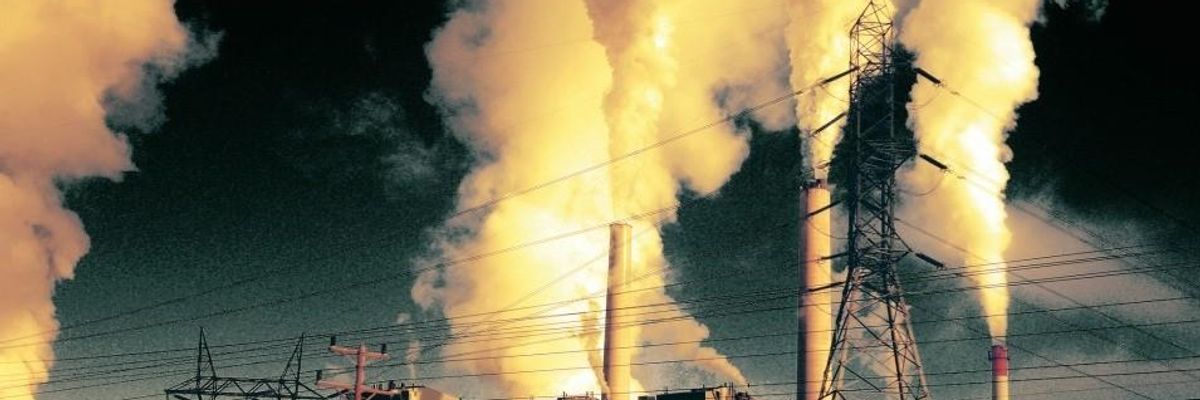
They got bailed out: Fossil fuel companies received $110 billion in direct and indirect financial assistance during the coronavirus pandemic, including up to $15.2 billion in direct federal relief. (Photo: Andrew Hart/Flickr/cc)
"Time to Cut Dirty Energy's Lifeline": Report Details How Fossil Fuel Industry Feasted on Covid-19 Relief Programs
"By artificially delaying the industry's inevitable decline at taxpayers' expense, the government has made it that much harder to make the necessary transition to clean energy sources."
In a year in which the United States has already suffered 16 climate-driven extreme weather events causing more than $1 billion in economic damages, and as millions of American workers face loss of essential unemployment benefits due to congressional inaction, a report published Monday reveals the Trump administration has given fossil fuel companies as much as $15.2 billion in direct relief--and tens of billions more indirectly--through federal Covid-19 recovery programs since March.
"The Biden administration and the next Congress will have a golden opportunity to ensure our efforts to rescue the economy no longer benefit the very companies most responsible for the devastation caused by climate change."
--Alan Zibel, Public Citizen
The report by BailoutWatch, Public Citizen, and Friends of the Earth--entitled Bailed Out and Propped Up--tracks taxpayer funds flowing to fossil fuel companies since pandemic-related bailouts began. It found a total of $110 billion in direct and indirect benefits went to 66 companies, including between $10.4 and $15.2 billion in direct disbursements to coal, oil, and gas companies that are largely responsible for the worsening climate emergency. Here's a breakdown, according to the report:
- At least $5.5 billion went to 70 money-losing polluters via the Coronavirus Aid, Relief, and Economic Security (CARES) Act.
- $582 million in direct, subsidized loans were approved for 37 mid-sized fossil fuel and related companies through the Federal Reserve's Main Street Lending Program.
- $4.3 to $9.1 billion in forgivable loans went to at least 25,931 companies through the Small Business Administration's Paycheck Protection Program.
- At least 229 oil and gas companies received waivers for fees normally paid to drill on public land--giveaways that cost the government a minimum of $4.5 million in lost revenue, and likely far more.
The report found that five fossil fuel companies--Diamondback Energy, EOG Resources, Marathon Petroleum, Phillips 66, and Valero--received more than 10% of the $110 billion in direct benefits, including tax refunds, and indirect support through the issuance of bonds, even if they were losing money. Reassured by the Fed's actions, private investors purchased more fossil fuel bonds, generating some $100 billion in additional indirect benefits.
"When the pandemic hit last spring, [President Donald] Trump's corporate cronies made sure the fossil fuel industry was able to squeeze whatever favors they could out of the resulting economic rescues," wrote Alan Zibel, research director of Public Citizen's Corporate Presidency Project and a co-author of the report. "The Biden administration and the next Congress will have a golden opportunity to ensure our efforts to rescue the economy no longer benefit the very companies most responsible for the devastation caused by climate change."
Christopher Kuveke, a BailoutWatch analyst and a co-author of the report, added that "the fossil fuel industry took advantage of the pandemic to put their hands out for help escaping a financial mess of their own making, and their allies in the federal government rode to the rescue."
"By artificially delaying the industry's inevitable decline at taxpayers' expense, the government has made it that much harder to make the necessary transition to clean energy sources," he added.
The report comes just after members of Congress headed home on vacation without having passed a new coronavirus relief bill, and as millions of Americans face the grim prospect of losing essential unemployment benefits as the CARES Act is set to expire at the end of the year.
Last week, Rep. Alexandria Ocasio-Cortez (D-N.Y.) excoriated Senate Majority Leader Mitch McConnell (R-Ky.) on the floor of the House of Representatives, accusing him of "abandoning our people."
"While... thousands of people in Texas lined up for food lines,... hospitals no longer have beds to house the sick,... [and] 30 million Americans are on the brink of eviction, [McConnell] dismissed the Senate," said Ocasio-Cortez. "Every single day, when we go back to our communities, people are asking us, 'Where is there going to be help? Is there going to be a second stimulus check? Are we going to get the resources that we need?"
Climate activists and many economists argue that giving money to those most culpable for carbon emissions is the exact opposite of what governments should be doing. One economist says that instead of selling fossil fuel bonds, governments should be promoting "Green Climate Bonds."
"With a mere fraction of the Covid-19 recovery funds, central banks could support climate protection," wrote World Future Council chief economist Matthias Kroll last week. He continued:
The price for coping with the systemically relevant climate crisis... appears almost to be a bargain: with a fraction of the funds used to overcome the Covid-19 crisis (or the banking crisis of 2008), the central banks could trigger investments in climate protection of a magnitude that would make the 1.5degC target [under the Paris agreement] achievable. The central banks would not even need to create additional money for this. It would be sufficient to replace expiring assets from previous purchase programs with new types of "Green Climate Bonds."
A May 2020 study by the World Future Council estimated the cost of a global "climate bailout" at a relatively modest $175 million per year, resulting in a one-third reduction in worldwide carbon emissions by the end of the decade.
"We need to start thinking about how to practically finance a Green New Deal and a swift transition to 100% renewable energy, and central banks should start playing a proactive role," wrote Kroll. "Let's treat the climate emergency as what it is, and let's bail out the climate, too!"
We are at a crossroads
This country and this world are at a monumental crossroads. US voters have an opportunity to beat back the forces of fascism and confront the billionaires who are rigging the economy, our media system, and our democracy, making it increasingly impossible for ordinary people to get by. We’re not just talking about the election. We’re talking about what must be done once these fascist elements are vanquished from power. We need a bolder set of solutions than what either major party has so far been willing to offer and a working-class movement ready to fight like hell for it. Trump didn't emerge from nowhere. The conditions that fueled MAGA authoritarianism were created by decades of radical neoliberal economic policies and a corrupt political system dominated by corporate interests. They slashed taxes on the super-rich, promising that the benefits would trickle down. They said giveaways to the corporate titans would make life more affordable for the rest of us. It was all bullshit. And when a bitter, betrayed populace searches for someone to blame, right-wing demagogues have little trouble finding scapegoats. People know when they're being lied to, but you won't hear any of this from the corporate media. Only independent journalism—powered and funded by people who believe in building a better world—can deliver truly trustworthy daily news. Our Fall Campaign is underway, and we need your help. To power our newsroom through the rest of the year, we need to raise $125,000 by midnight on October 31. So if you share our vision, please contribute whatever you can to sustain our work. |
In a year in which the United States has already suffered 16 climate-driven extreme weather events causing more than $1 billion in economic damages, and as millions of American workers face loss of essential unemployment benefits due to congressional inaction, a report published Monday reveals the Trump administration has given fossil fuel companies as much as $15.2 billion in direct relief--and tens of billions more indirectly--through federal Covid-19 recovery programs since March.
"The Biden administration and the next Congress will have a golden opportunity to ensure our efforts to rescue the economy no longer benefit the very companies most responsible for the devastation caused by climate change."
--Alan Zibel, Public Citizen
The report by BailoutWatch, Public Citizen, and Friends of the Earth--entitled Bailed Out and Propped Up--tracks taxpayer funds flowing to fossil fuel companies since pandemic-related bailouts began. It found a total of $110 billion in direct and indirect benefits went to 66 companies, including between $10.4 and $15.2 billion in direct disbursements to coal, oil, and gas companies that are largely responsible for the worsening climate emergency. Here's a breakdown, according to the report:
- At least $5.5 billion went to 70 money-losing polluters via the Coronavirus Aid, Relief, and Economic Security (CARES) Act.
- $582 million in direct, subsidized loans were approved for 37 mid-sized fossil fuel and related companies through the Federal Reserve's Main Street Lending Program.
- $4.3 to $9.1 billion in forgivable loans went to at least 25,931 companies through the Small Business Administration's Paycheck Protection Program.
- At least 229 oil and gas companies received waivers for fees normally paid to drill on public land--giveaways that cost the government a minimum of $4.5 million in lost revenue, and likely far more.
The report found that five fossil fuel companies--Diamondback Energy, EOG Resources, Marathon Petroleum, Phillips 66, and Valero--received more than 10% of the $110 billion in direct benefits, including tax refunds, and indirect support through the issuance of bonds, even if they were losing money. Reassured by the Fed's actions, private investors purchased more fossil fuel bonds, generating some $100 billion in additional indirect benefits.
"When the pandemic hit last spring, [President Donald] Trump's corporate cronies made sure the fossil fuel industry was able to squeeze whatever favors they could out of the resulting economic rescues," wrote Alan Zibel, research director of Public Citizen's Corporate Presidency Project and a co-author of the report. "The Biden administration and the next Congress will have a golden opportunity to ensure our efforts to rescue the economy no longer benefit the very companies most responsible for the devastation caused by climate change."
Christopher Kuveke, a BailoutWatch analyst and a co-author of the report, added that "the fossil fuel industry took advantage of the pandemic to put their hands out for help escaping a financial mess of their own making, and their allies in the federal government rode to the rescue."
"By artificially delaying the industry's inevitable decline at taxpayers' expense, the government has made it that much harder to make the necessary transition to clean energy sources," he added.
The report comes just after members of Congress headed home on vacation without having passed a new coronavirus relief bill, and as millions of Americans face the grim prospect of losing essential unemployment benefits as the CARES Act is set to expire at the end of the year.
Last week, Rep. Alexandria Ocasio-Cortez (D-N.Y.) excoriated Senate Majority Leader Mitch McConnell (R-Ky.) on the floor of the House of Representatives, accusing him of "abandoning our people."
"While... thousands of people in Texas lined up for food lines,... hospitals no longer have beds to house the sick,... [and] 30 million Americans are on the brink of eviction, [McConnell] dismissed the Senate," said Ocasio-Cortez. "Every single day, when we go back to our communities, people are asking us, 'Where is there going to be help? Is there going to be a second stimulus check? Are we going to get the resources that we need?"
Climate activists and many economists argue that giving money to those most culpable for carbon emissions is the exact opposite of what governments should be doing. One economist says that instead of selling fossil fuel bonds, governments should be promoting "Green Climate Bonds."
"With a mere fraction of the Covid-19 recovery funds, central banks could support climate protection," wrote World Future Council chief economist Matthias Kroll last week. He continued:
The price for coping with the systemically relevant climate crisis... appears almost to be a bargain: with a fraction of the funds used to overcome the Covid-19 crisis (or the banking crisis of 2008), the central banks could trigger investments in climate protection of a magnitude that would make the 1.5degC target [under the Paris agreement] achievable. The central banks would not even need to create additional money for this. It would be sufficient to replace expiring assets from previous purchase programs with new types of "Green Climate Bonds."
A May 2020 study by the World Future Council estimated the cost of a global "climate bailout" at a relatively modest $175 million per year, resulting in a one-third reduction in worldwide carbon emissions by the end of the decade.
"We need to start thinking about how to practically finance a Green New Deal and a swift transition to 100% renewable energy, and central banks should start playing a proactive role," wrote Kroll. "Let's treat the climate emergency as what it is, and let's bail out the climate, too!"