SUBSCRIBE TO OUR FREE NEWSLETTER
Daily news & progressive opinion—funded by the people, not the corporations—delivered straight to your inbox.
5
#000000
#FFFFFF
To donate by check, phone, or other method, see our More Ways to Give page.
Daily news & progressive opinion—funded by the people, not the corporations—delivered straight to your inbox.
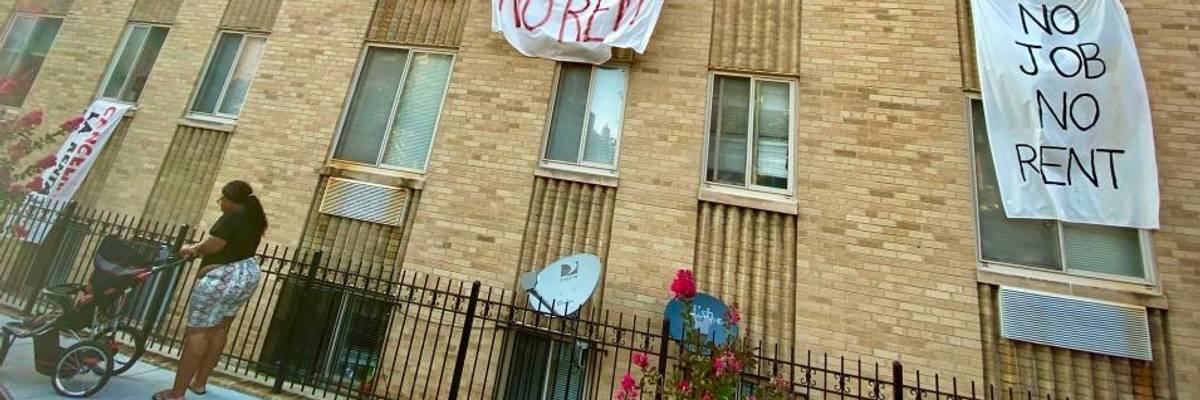
Banners against renters eviction reading, "No job, no rent" are displayed on a rent-controlled building in Washington, D.C. on August 9, 2020. (Photo: Eric Baradat/AFP via Getty Images)
Without a coronavirus relief package centered on helping working families who have lost jobs and watched their savings dwindle amid the pandemic, millions of people are "headed for absolute disaster," one observer said Monday as Moody's Analytics reported that 12 million renters are expected to owe an average of $5,850 in back rent and utilities after the new year.
The financial firm reported that $70 billion could be owed to landlords in January, after a federal moratorium on evictions--put in place in September by the Centers for Disease Control and Prevention, in the absence of any action from the Republican-led Senate aimed at helping working people--expires on December 31.
"Renters will owe up to $70 billion in back rent when eviction moratorium expires, more than they can possibly pay... Congress must extend the moratorium and provide rent relief now."
--Diane Yentel, National Low Income Housing Coalition
According to the Washington Post, many landlords have begun filing paperwork to evict struggling tenants already and others have joined renters in appealing to Congress for significant unemployment benefits and another round of $1,200 direct payments to Americans.
Separately from Moody's, the Federal Reserve Bank of Philadelphia reported in October that 1.3 million households that have faced unemployment during the pandemic owed an average of $5,400 in back payments to landlords and utilities. According to the U.S. Census Bureau, 29% of Black renters and 17% of Latino renters are behind in payments, and 21% of families with children have been pushed into debt.
Some families have been forced to begin selling their belongings since the Republican-led Senate allowed weekly unemployment benefits of $600 expire in July, according to the Post. Lawmakers on Monday were negotiating a new aid package after a bipartisan group of senators introduced a $908 billion bill last week.
According to Post reporter Jeff Stein, the package currently includes a $300 weekly payment which would be offered only from January to April, with no retroactive payments to help families who owe rent and other payments from recent months. The package includes $25 billion for rental housing assistance--far less than what's expected to be owed by families in January and only half of what the House Democrats' HEROES Act includes for low-income renters--and a proposal by Senate Majority Leader Mitch McConnell (R-Ky.) did not include anything for struggling renters.
"This is like a Charles Dickens novel," Mark Wolfe, executive director of the National Energy Assistance Directors' Association, told the Post. "It's an evolving story of how people at the bottom are suffering."
Diane Yentel, president and CEO of the National Low Income Housing Coalition, called on Congress to extend the current eviction moratorium and provide rent relief to struggling households.
Former Labor Secretary Robert Reich highlighted the reports of struggling renters as the latest evidence that Georgia voters must elect two Democrats, Rev. Raphael Warnock and Jon Ossoff, in the runoff election scheduled for January 5, to give the country any hope of having a Senate which will help working families in the coming year.
"We can't go on like this," tweeted Reich.
Dear Common Dreams reader, It’s been nearly 30 years since I co-founded Common Dreams with my late wife, Lina Newhouser. We had the radical notion that journalism should serve the public good, not corporate profits. It was clear to us from the outset what it would take to build such a project. No paid advertisements. No corporate sponsors. No millionaire publisher telling us what to think or do. Many people said we wouldn't last a year, but we proved those doubters wrong. Together with a tremendous team of journalists and dedicated staff, we built an independent media outlet free from the constraints of profits and corporate control. Our mission has always been simple: To inform. To inspire. To ignite change for the common good. Building Common Dreams was not easy. Our survival was never guaranteed. When you take on the most powerful forces—Wall Street greed, fossil fuel industry destruction, Big Tech lobbyists, and uber-rich oligarchs who have spent billions upon billions rigging the economy and democracy in their favor—the only bulwark you have is supporters who believe in your work. But here’s the urgent message from me today. It's never been this bad out there. And it's never been this hard to keep us going. At the very moment Common Dreams is most needed, the threats we face are intensifying. We need your support now more than ever. We don't accept corporate advertising and never will. We don't have a paywall because we don't think people should be blocked from critical news based on their ability to pay. Everything we do is funded by the donations of readers like you. When everyone does the little they can afford, we are strong. But if that support retreats or dries up, so do we. Will you donate now to make sure Common Dreams not only survives but thrives? —Craig Brown, Co-founder |
Without a coronavirus relief package centered on helping working families who have lost jobs and watched their savings dwindle amid the pandemic, millions of people are "headed for absolute disaster," one observer said Monday as Moody's Analytics reported that 12 million renters are expected to owe an average of $5,850 in back rent and utilities after the new year.
The financial firm reported that $70 billion could be owed to landlords in January, after a federal moratorium on evictions--put in place in September by the Centers for Disease Control and Prevention, in the absence of any action from the Republican-led Senate aimed at helping working people--expires on December 31.
"Renters will owe up to $70 billion in back rent when eviction moratorium expires, more than they can possibly pay... Congress must extend the moratorium and provide rent relief now."
--Diane Yentel, National Low Income Housing Coalition
According to the Washington Post, many landlords have begun filing paperwork to evict struggling tenants already and others have joined renters in appealing to Congress for significant unemployment benefits and another round of $1,200 direct payments to Americans.
Separately from Moody's, the Federal Reserve Bank of Philadelphia reported in October that 1.3 million households that have faced unemployment during the pandemic owed an average of $5,400 in back payments to landlords and utilities. According to the U.S. Census Bureau, 29% of Black renters and 17% of Latino renters are behind in payments, and 21% of families with children have been pushed into debt.
Some families have been forced to begin selling their belongings since the Republican-led Senate allowed weekly unemployment benefits of $600 expire in July, according to the Post. Lawmakers on Monday were negotiating a new aid package after a bipartisan group of senators introduced a $908 billion bill last week.
According to Post reporter Jeff Stein, the package currently includes a $300 weekly payment which would be offered only from January to April, with no retroactive payments to help families who owe rent and other payments from recent months. The package includes $25 billion for rental housing assistance--far less than what's expected to be owed by families in January and only half of what the House Democrats' HEROES Act includes for low-income renters--and a proposal by Senate Majority Leader Mitch McConnell (R-Ky.) did not include anything for struggling renters.
"This is like a Charles Dickens novel," Mark Wolfe, executive director of the National Energy Assistance Directors' Association, told the Post. "It's an evolving story of how people at the bottom are suffering."
Diane Yentel, president and CEO of the National Low Income Housing Coalition, called on Congress to extend the current eviction moratorium and provide rent relief to struggling households.
Former Labor Secretary Robert Reich highlighted the reports of struggling renters as the latest evidence that Georgia voters must elect two Democrats, Rev. Raphael Warnock and Jon Ossoff, in the runoff election scheduled for January 5, to give the country any hope of having a Senate which will help working families in the coming year.
"We can't go on like this," tweeted Reich.
Without a coronavirus relief package centered on helping working families who have lost jobs and watched their savings dwindle amid the pandemic, millions of people are "headed for absolute disaster," one observer said Monday as Moody's Analytics reported that 12 million renters are expected to owe an average of $5,850 in back rent and utilities after the new year.
The financial firm reported that $70 billion could be owed to landlords in January, after a federal moratorium on evictions--put in place in September by the Centers for Disease Control and Prevention, in the absence of any action from the Republican-led Senate aimed at helping working people--expires on December 31.
"Renters will owe up to $70 billion in back rent when eviction moratorium expires, more than they can possibly pay... Congress must extend the moratorium and provide rent relief now."
--Diane Yentel, National Low Income Housing Coalition
According to the Washington Post, many landlords have begun filing paperwork to evict struggling tenants already and others have joined renters in appealing to Congress for significant unemployment benefits and another round of $1,200 direct payments to Americans.
Separately from Moody's, the Federal Reserve Bank of Philadelphia reported in October that 1.3 million households that have faced unemployment during the pandemic owed an average of $5,400 in back payments to landlords and utilities. According to the U.S. Census Bureau, 29% of Black renters and 17% of Latino renters are behind in payments, and 21% of families with children have been pushed into debt.
Some families have been forced to begin selling their belongings since the Republican-led Senate allowed weekly unemployment benefits of $600 expire in July, according to the Post. Lawmakers on Monday were negotiating a new aid package after a bipartisan group of senators introduced a $908 billion bill last week.
According to Post reporter Jeff Stein, the package currently includes a $300 weekly payment which would be offered only from January to April, with no retroactive payments to help families who owe rent and other payments from recent months. The package includes $25 billion for rental housing assistance--far less than what's expected to be owed by families in January and only half of what the House Democrats' HEROES Act includes for low-income renters--and a proposal by Senate Majority Leader Mitch McConnell (R-Ky.) did not include anything for struggling renters.
"This is like a Charles Dickens novel," Mark Wolfe, executive director of the National Energy Assistance Directors' Association, told the Post. "It's an evolving story of how people at the bottom are suffering."
Diane Yentel, president and CEO of the National Low Income Housing Coalition, called on Congress to extend the current eviction moratorium and provide rent relief to struggling households.
Former Labor Secretary Robert Reich highlighted the reports of struggling renters as the latest evidence that Georgia voters must elect two Democrats, Rev. Raphael Warnock and Jon Ossoff, in the runoff election scheduled for January 5, to give the country any hope of having a Senate which will help working families in the coming year.
"We can't go on like this," tweeted Reich.