

SUBSCRIBE TO OUR FREE NEWSLETTER
Daily news & progressive opinion—funded by the people, not the corporations—delivered straight to your inbox.
5
#000000
#FFFFFF
To donate by check, phone, or other method, see our More Ways to Give page.
Daily news & progressive opinion—funded by the people, not the corporations—delivered straight to your inbox.
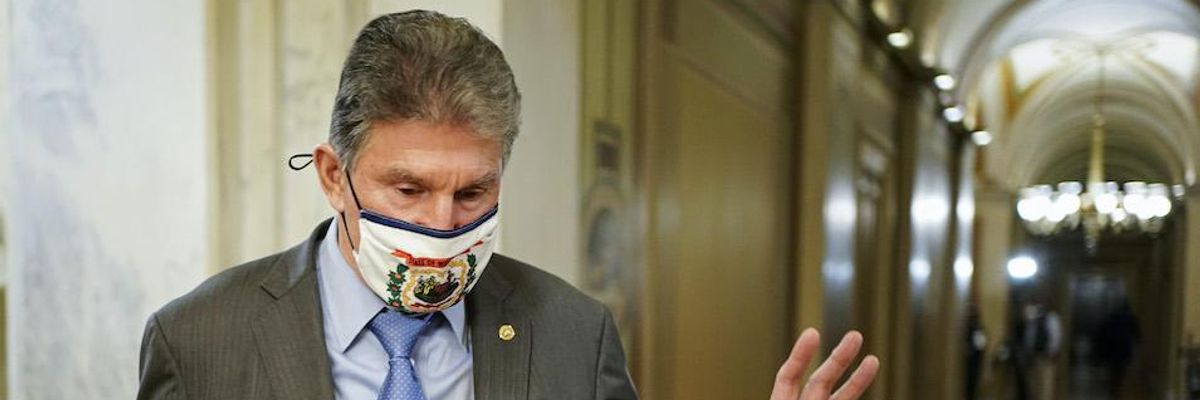
Sen. Joe Manchin (D-W.Va.) departs after the day's proceedings in the impeachment trial of former President Donald Trump at the U.S. Capitol on February 10, 2021 in Washington, D.C. (Photo: Joshua Roberts-Pool/Getty Images)
Democratic Senator Joe Manchin of West Virginia is under sustained fire--including from low-paid workers in his own state--for his resistance to a provision in the Senate's coronavirus rescue package that would raise the federal minimum wage to $15 an hour.
"I'm speaking to you, Senator Manchin," Jean Evansmore of the West Virginia Poor People's Campaign said at an online event Monday. "You know that in West Virginia the minimum wage needs to be $23 in order for people to live, not wonder where their next meal is coming from."
"Enough's enough," added Pam Garrison, also with the West Virginia Poor People's Campaign. "When will you give us a living wage?"
Evansmore and Garrison's comments came during an online Moral Monday event organized by the campaign. The event highlighted voices of those impacted by low wages and the campaign's suite of policy priorities for the White House and new Congress, including lifting the minimum wage to $15--a change they group frames as a way to "lift from the bottom and take seriously the costs of inequality."
Manchin and fellow Democrat Sen. Kyrsten Sinema of Arizona have publicly announced their opposition to the popular wage hike proposal.
The bill in question, the House-passed Raise the Wage Act, would incrementally raise the federal minimum wage from $7.25 an hour to $15 an hour by 2025.
West Virginia's minimum wage is currently $8.75 an hour, and while that's higher than the federal wage floor, it's far below the $24 an hour the wage would be now if it kept pace with productivity growth, and well below the $28.70 an hour rate MIT estimates to be a "living wage" for an adult with one child working full time.
"We cannot be fooled that raising the minimum wage will do anything except to lift people from the bottom so that all of our society can rise."
--Rev. Liz Theoharis, Poor People's Campaign Amid the progressive push for better wages, the Poor People's Campaign said Monday that Manchin requested a meeting with the campaign--a meeting the anti-poverty group said was agreeable dependent upon the inclusion of "a diverse group of low-wage workers and moral leaders from the West Virginia Poor People's Campaign."
Sinema's assertion that the proposed minimum wage provision "is not a budget item" and thus doesn't belong in the reconciliation measure, meanwhile, was further undercut on Monday by a Congressional Budget Office analysis requested by Sen. Bernie Sanders (I-Vt.), chair of the budget committee, showing that the wage hike would have a broader budgetary impact than two provisions included in the GOP's 2017 tax bill--which were passed using the reconciliation process.
Despite the new finding from the CBO, it remains unclear whether the Senate parliamentarian will deem that the wage provision complies with the so-called "Byrd Rule"--a requirement that any provision must have a direct budget impact to be included under reconciliation. If the bill does emerge from the "Byrd bath," it will still need support of all Democrats to pass by a simple majority.
Sanders, for his part, told CNN Monday, "We absolutely believe that raising the minimum wage to $15 an hour is consistent with the rules of the Senate and the reconciliation process."
"It is popular, it is what the people want, it is what justice demands," said Sanders.
The Rev. Dr. William J. Barber II, co-chair of the Poor People's Campaign, gave similar assessment in his comments at the Monday event.
"We cannot heal this nation without full Covid relief of the minimum wage of $15. There is no way we can go through the pain and poverty prior and since Covid and not make this a major part of our economic recovery and economic future," he said.
"If you want to be serious about poor and low-wealth people, and 50 percent of West Virginians," said Barber, "then don't talk about money when you talk to everybody else, but then when you get to the poor folk, you say, 'Pray.'"
"No," he continued, "we need you to stop preying on poor and low-wealth folks and start paying poor and low-wealth folk so that they can live and have the fruit of their labor."
Simply allowing the nation's inequality to fester as part of a post-coronavirus recovery should simply not be an option, stressed Poor People's Campaign co-chair Rev. Liz Theoharis.
"Americans cannot in this moment be fooled into thinking that the very policies and measures that left this world in ours in a wreckage of inequality, poverty, and low wages can get us out of this mess," she said.
"We cannot be fooled that raising the minimum wage will do anything except to lift people from the bottom so that all of our society can rise," said Theoharis. "What will work is to build back better and build the power of 140 million poor and low-income Americans, hundreds of thousands of West Virginians who are not making a living wage, but who desperately need one."
This country and this world are at a monumental crossroads. US voters have an opportunity to beat back the forces of fascism and confront the billionaires who are rigging the economy, our media system, and our democracy, making it increasingly impossible for ordinary people to get by. We’re not just talking about the election. We’re talking about what must be done once these fascist elements are vanquished from power. We need a bolder set of solutions than what either major party has so far been willing to offer and a working-class movement ready to fight like hell for it. Trump didn't emerge from nowhere. The conditions that fueled MAGA authoritarianism were created by decades of radical neoliberal economic policies and a corrupt political system dominated by corporate interests. They slashed taxes on the super-rich, promising that the benefits would trickle down. They said giveaways to the corporate titans would make life more affordable for the rest of us. It was all bullshit. And when a bitter, betrayed populace searches for someone to blame, right-wing demagogues have little trouble finding scapegoats. People know when they're being lied to, but you won't hear any of this from the corporate media. Only independent journalism—powered and funded by people who believe in building a better world—can deliver truly trustworthy daily news. If you share our vision, please contribute whatever you can to sustain our work. |
Democratic Senator Joe Manchin of West Virginia is under sustained fire--including from low-paid workers in his own state--for his resistance to a provision in the Senate's coronavirus rescue package that would raise the federal minimum wage to $15 an hour.
"I'm speaking to you, Senator Manchin," Jean Evansmore of the West Virginia Poor People's Campaign said at an online event Monday. "You know that in West Virginia the minimum wage needs to be $23 in order for people to live, not wonder where their next meal is coming from."
"Enough's enough," added Pam Garrison, also with the West Virginia Poor People's Campaign. "When will you give us a living wage?"
Evansmore and Garrison's comments came during an online Moral Monday event organized by the campaign. The event highlighted voices of those impacted by low wages and the campaign's suite of policy priorities for the White House and new Congress, including lifting the minimum wage to $15--a change they group frames as a way to "lift from the bottom and take seriously the costs of inequality."
Manchin and fellow Democrat Sen. Kyrsten Sinema of Arizona have publicly announced their opposition to the popular wage hike proposal.
The bill in question, the House-passed Raise the Wage Act, would incrementally raise the federal minimum wage from $7.25 an hour to $15 an hour by 2025.
West Virginia's minimum wage is currently $8.75 an hour, and while that's higher than the federal wage floor, it's far below the $24 an hour the wage would be now if it kept pace with productivity growth, and well below the $28.70 an hour rate MIT estimates to be a "living wage" for an adult with one child working full time.
"We cannot be fooled that raising the minimum wage will do anything except to lift people from the bottom so that all of our society can rise."
--Rev. Liz Theoharis, Poor People's Campaign Amid the progressive push for better wages, the Poor People's Campaign said Monday that Manchin requested a meeting with the campaign--a meeting the anti-poverty group said was agreeable dependent upon the inclusion of "a diverse group of low-wage workers and moral leaders from the West Virginia Poor People's Campaign."
Sinema's assertion that the proposed minimum wage provision "is not a budget item" and thus doesn't belong in the reconciliation measure, meanwhile, was further undercut on Monday by a Congressional Budget Office analysis requested by Sen. Bernie Sanders (I-Vt.), chair of the budget committee, showing that the wage hike would have a broader budgetary impact than two provisions included in the GOP's 2017 tax bill--which were passed using the reconciliation process.
Despite the new finding from the CBO, it remains unclear whether the Senate parliamentarian will deem that the wage provision complies with the so-called "Byrd Rule"--a requirement that any provision must have a direct budget impact to be included under reconciliation. If the bill does emerge from the "Byrd bath," it will still need support of all Democrats to pass by a simple majority.
Sanders, for his part, told CNN Monday, "We absolutely believe that raising the minimum wage to $15 an hour is consistent with the rules of the Senate and the reconciliation process."
"It is popular, it is what the people want, it is what justice demands," said Sanders.
The Rev. Dr. William J. Barber II, co-chair of the Poor People's Campaign, gave similar assessment in his comments at the Monday event.
"We cannot heal this nation without full Covid relief of the minimum wage of $15. There is no way we can go through the pain and poverty prior and since Covid and not make this a major part of our economic recovery and economic future," he said.
"If you want to be serious about poor and low-wealth people, and 50 percent of West Virginians," said Barber, "then don't talk about money when you talk to everybody else, but then when you get to the poor folk, you say, 'Pray.'"
"No," he continued, "we need you to stop preying on poor and low-wealth folks and start paying poor and low-wealth folk so that they can live and have the fruit of their labor."
Simply allowing the nation's inequality to fester as part of a post-coronavirus recovery should simply not be an option, stressed Poor People's Campaign co-chair Rev. Liz Theoharis.
"Americans cannot in this moment be fooled into thinking that the very policies and measures that left this world in ours in a wreckage of inequality, poverty, and low wages can get us out of this mess," she said.
"We cannot be fooled that raising the minimum wage will do anything except to lift people from the bottom so that all of our society can rise," said Theoharis. "What will work is to build back better and build the power of 140 million poor and low-income Americans, hundreds of thousands of West Virginians who are not making a living wage, but who desperately need one."

