

SUBSCRIBE TO OUR FREE NEWSLETTER
Daily news & progressive opinion—funded by the people, not the corporations—delivered straight to your inbox.
5
#000000
#FFFFFF
To donate by check, phone, or other method, see our More Ways to Give page.
Daily news & progressive opinion—funded by the people, not the corporations—delivered straight to your inbox.
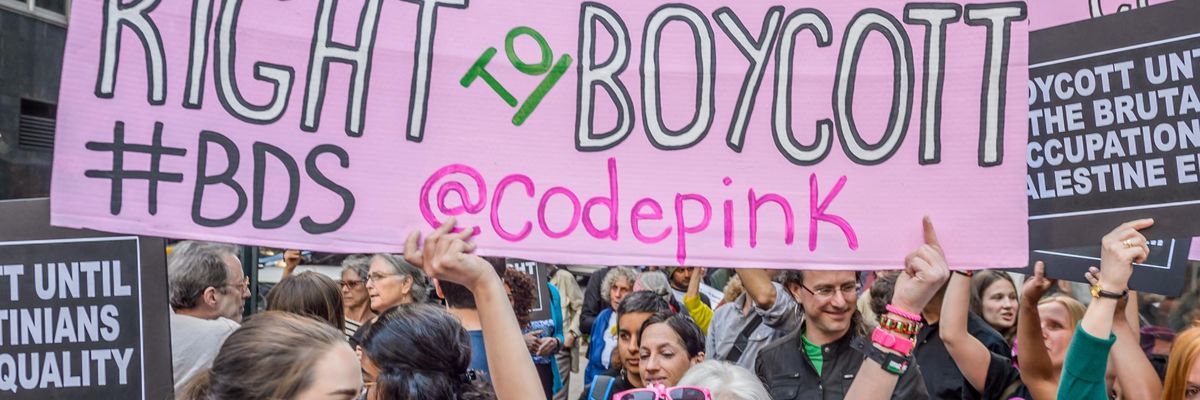
A protester holds up a sign affirming the constitutional right to boycott at a June 9, 2016 demonstration against New York Gov. Andrew Cuomo's executive order requiring state agencies to divest from organizations supporting boycotts of Israel. (Photo: Erik McGregor/LightRocket via Getty Images)
Free speech and Palestinian rights advocates on Monday hailed a ruling by a federal judge declaring the unconstitutionality of a Georgia law prohibiting the state from doing business with anyone advocating a boycott of Israel.
"My First Amendment rights were restricted on behalf of a foreign government, which flies in the face of the principles of freedom and democracy."
--Abby Martin, plaintiff
U.S. District Court Judge Mark Cohen's 29-page ruling (pdf) addresses a 2016 Georgia law stipulating that "the state shall not enter into a contract with an individual or company... unless the contract includes a written certification that such individual or company is not currently engaged in, and agrees for the duration of the contract not to engage in, a boycott of Israel."
After plaintiff Abby Martin--an award-winning U.S. journalist and filmmaker critical of Israeli crimes against Palestinians--refused to sign the pro-Israel oath, a planned paid speaking engagement at Georgia Southern University was canceled.
Announcing her lawsuit--in which she was represented by the Council on American-Islamic Relations (CAIR) and the Partnership for Civil Justice Fund (PCJF)--Martin declared in February 2020, "I will not forfeit my constitutional rights by signing this pledge."
Cohen's ruling states that Georgia's law "prohibits inherently expressive conduct protected by the First Amendment, burdens Martin's right to free speech, and is not narrowly tailored to further a substantial state interest."
"The requirement... that parties seeking to contract with the state of Georgia sign a certification that they are not engaged in a boycott of Israel is also unconstitutional compelled speech," Cohen wrote, citing as precedent the U.S. Supreme Court's 1982 NAACP v. Claiborne Hardware Company ruling, a landmark decision protecting the right to boycott.
Cohen also cited Baird v. State Bar of Arizona, a 1971 U.S. Supreme Court decision in favor of a law school graduate who refused to disclose whether she had ever been a member of the Communist Party or any organization advocating the forceful overthrow of the United States government.
"Even assuming that Georgia's interest in furthering foreign policy goals regarding relations with Israel is a substantial state interest, defendants fail to explain how Martin's advocacy of a boycott of Israel has any bearing on Georgia's ability to advance foreign policy goals with Israel," Cohen wrote.
Martin, CAIR, and PCJF applauded Monday's ruling.
"I am thrilled at the judge's decision finding this law unconstitutional as it so clearly violates the free speech rights of myself and so many others in Georgia," Martin said in a statement. "My First Amendment rights were restricted on behalf of a foreign government, which flies in the face of the principles of freedom and democracy."
"The government of Israel has pushed state legislatures to enact these laws only because they know that sympathy and support for the population they brutalize, occupy, ethnically cleanse, and subject to apartheid, is finally growing in popular consciousness," said Martin. "They want to hold back the tide of justice by preemptively restricting the right of American citizens to peacefully take a stand against their crimes."
PCJF counsel Mara Verheyden-Hilliard said that "this ruling comes at a crucial moment, when millions of Americans are questioning the use of U.S.-provided weapons in the onslaught against the Palestinian people, and makes clear that the Constitution protects participation in the [Boycott, Divestment, and Sanctions] movement, just as it protected the seminal civil rights and labor organizing boycotts that moved our society forward."
"This ruling comes at a crucial moment, when millions of Americans are questioning the use of U.S.-provided weapons in the onslaught against the Palestinian people, and makes clear that the Constitution protects participation in the BDS movement."
--Mara Verheyden-Hilliard, PCJF
Murtaza Khwaja, executive director of CAIR Georgia, said that "whether in speaking out against voter suppression laws here in Georgia or human rights violations against the Palestinian people, Georgians are actively engaged in their constitutionally protected right to free speech and coordinated boycott."
"Now, as much as ever, these rights must be cherished and preserved," Khwaja added. "The court's [decision] today is a significant step in ensuring Georgians are able to do so freely today and in future."
Spurred by pro-Israel politicians and a powerful lobby that often conflates opposition to Israeli policies and actions including the illegal occupation, settler colonization, and ethnic cleansing of Palestine and the perpetuation of what prominent critics call an apartheid system there, legislatures in dozens of states have passed laws (pdf) targeting the nonviolent Boycott, Divestment, and Sanctions (BDS) movement for human rights.
However, federal courts have now ruled that anti-BDS laws in three states--Texas, Arkansas, and Georgia--are unconstitutional.
This country and this world are at a monumental crossroads. US voters have an opportunity to beat back the forces of fascism and confront the billionaires who are rigging the economy, our media system, and our democracy, making it increasingly impossible for ordinary people to get by. We’re not just talking about the election. We’re talking about what must be done once these fascist elements are vanquished from power. We need a bolder set of solutions than what either major party has so far been willing to offer and a working-class movement ready to fight like hell for it. Trump didn't emerge from nowhere. The conditions that fueled MAGA authoritarianism were created by decades of radical neoliberal economic policies and a corrupt political system dominated by corporate interests. They slashed taxes on the super-rich, promising that the benefits would trickle down. They said giveaways to the corporate titans would make life more affordable for the rest of us. It was all bullshit. And when a bitter, betrayed populace searches for someone to blame, right-wing demagogues have little trouble finding scapegoats. People know when they're being lied to, but you won't hear any of this from the corporate media. Only independent journalism—powered and funded by people who believe in building a better world—can deliver truly trustworthy daily news. If you share our vision, please contribute whatever you can to sustain our work. |
Free speech and Palestinian rights advocates on Monday hailed a ruling by a federal judge declaring the unconstitutionality of a Georgia law prohibiting the state from doing business with anyone advocating a boycott of Israel.
"My First Amendment rights were restricted on behalf of a foreign government, which flies in the face of the principles of freedom and democracy."
--Abby Martin, plaintiff
U.S. District Court Judge Mark Cohen's 29-page ruling (pdf) addresses a 2016 Georgia law stipulating that "the state shall not enter into a contract with an individual or company... unless the contract includes a written certification that such individual or company is not currently engaged in, and agrees for the duration of the contract not to engage in, a boycott of Israel."
After plaintiff Abby Martin--an award-winning U.S. journalist and filmmaker critical of Israeli crimes against Palestinians--refused to sign the pro-Israel oath, a planned paid speaking engagement at Georgia Southern University was canceled.
Announcing her lawsuit--in which she was represented by the Council on American-Islamic Relations (CAIR) and the Partnership for Civil Justice Fund (PCJF)--Martin declared in February 2020, "I will not forfeit my constitutional rights by signing this pledge."
Cohen's ruling states that Georgia's law "prohibits inherently expressive conduct protected by the First Amendment, burdens Martin's right to free speech, and is not narrowly tailored to further a substantial state interest."
"The requirement... that parties seeking to contract with the state of Georgia sign a certification that they are not engaged in a boycott of Israel is also unconstitutional compelled speech," Cohen wrote, citing as precedent the U.S. Supreme Court's 1982 NAACP v. Claiborne Hardware Company ruling, a landmark decision protecting the right to boycott.
Cohen also cited Baird v. State Bar of Arizona, a 1971 U.S. Supreme Court decision in favor of a law school graduate who refused to disclose whether she had ever been a member of the Communist Party or any organization advocating the forceful overthrow of the United States government.
"Even assuming that Georgia's interest in furthering foreign policy goals regarding relations with Israel is a substantial state interest, defendants fail to explain how Martin's advocacy of a boycott of Israel has any bearing on Georgia's ability to advance foreign policy goals with Israel," Cohen wrote.
Martin, CAIR, and PCJF applauded Monday's ruling.
"I am thrilled at the judge's decision finding this law unconstitutional as it so clearly violates the free speech rights of myself and so many others in Georgia," Martin said in a statement. "My First Amendment rights were restricted on behalf of a foreign government, which flies in the face of the principles of freedom and democracy."
"The government of Israel has pushed state legislatures to enact these laws only because they know that sympathy and support for the population they brutalize, occupy, ethnically cleanse, and subject to apartheid, is finally growing in popular consciousness," said Martin. "They want to hold back the tide of justice by preemptively restricting the right of American citizens to peacefully take a stand against their crimes."
PCJF counsel Mara Verheyden-Hilliard said that "this ruling comes at a crucial moment, when millions of Americans are questioning the use of U.S.-provided weapons in the onslaught against the Palestinian people, and makes clear that the Constitution protects participation in the [Boycott, Divestment, and Sanctions] movement, just as it protected the seminal civil rights and labor organizing boycotts that moved our society forward."
"This ruling comes at a crucial moment, when millions of Americans are questioning the use of U.S.-provided weapons in the onslaught against the Palestinian people, and makes clear that the Constitution protects participation in the BDS movement."
--Mara Verheyden-Hilliard, PCJF
Murtaza Khwaja, executive director of CAIR Georgia, said that "whether in speaking out against voter suppression laws here in Georgia or human rights violations against the Palestinian people, Georgians are actively engaged in their constitutionally protected right to free speech and coordinated boycott."
"Now, as much as ever, these rights must be cherished and preserved," Khwaja added. "The court's [decision] today is a significant step in ensuring Georgians are able to do so freely today and in future."
Spurred by pro-Israel politicians and a powerful lobby that often conflates opposition to Israeli policies and actions including the illegal occupation, settler colonization, and ethnic cleansing of Palestine and the perpetuation of what prominent critics call an apartheid system there, legislatures in dozens of states have passed laws (pdf) targeting the nonviolent Boycott, Divestment, and Sanctions (BDS) movement for human rights.
However, federal courts have now ruled that anti-BDS laws in three states--Texas, Arkansas, and Georgia--are unconstitutional.

