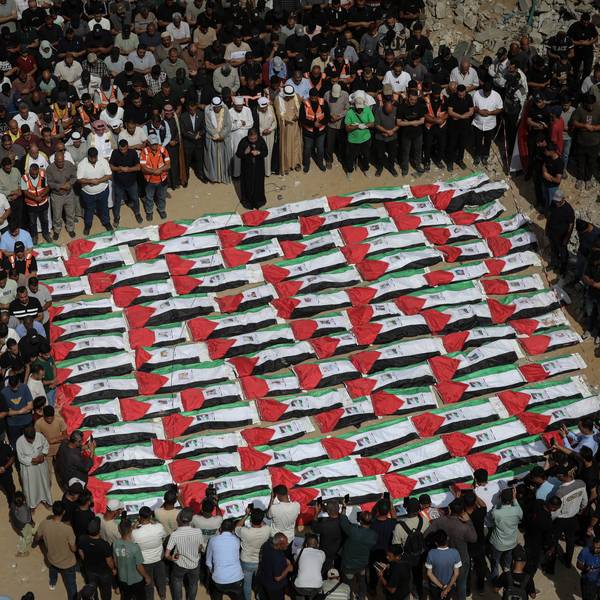
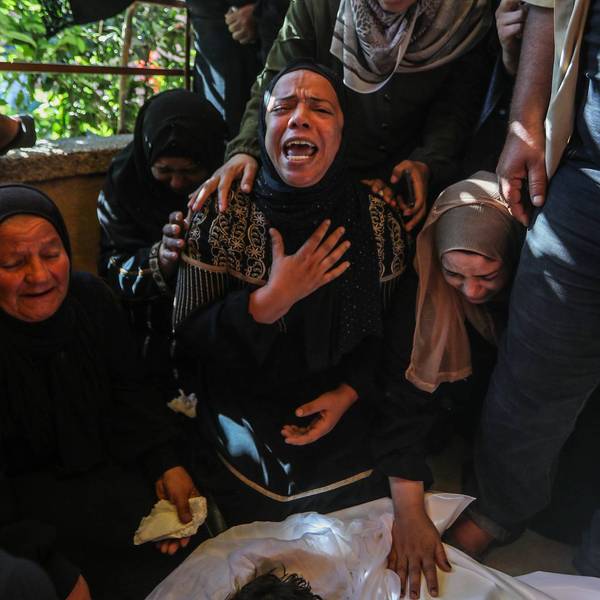

Relatives of Palestinian Diama Assalea, 11, mourn during her funeral following an Israeli airstrike in the northern Gaza Strip on May 20, 2021. (Photo: Momen Faiz/NurPhoto via Getty Images)
Study Shows 91% of People Killed or Injured by Explosives in Global Cities Were Civilians
In its new report, Action on Armed Violence urges states and others to "commit politically to stop using explosive weapons with wide area effects in populated areas."
On the heels of Israel's recent bombardment of the Gaza Strip, a London-based charity revealed Tuesday that civilians accounted for 91% of people killed or injured when explosive weapons were used in populated areas worldwide from 2011 to 2020.
The new Action on Armed Violence (AOAV) report (pdf) is based on data collected as part of the group's Explosive Violence Monitoring Project. It emphasizes that the data, taken from English-language media reporting, "is not an attempt to capture every single casualty of every incident around the world."
However, the report provides insight on the devastating impact of using explosive weapons--including air-dropped bombs, artillery shells, improvised explosive devices (IEDs), and mortars--in densely populated areas and demands global commitments to end such violence.
"Since the monitor began, AOAV has recorded the appalling suffering caused across the globe by both manufactured and improvised weapons," the report says. "We call on states and other users to commit politically to stop using explosive weapons with wide area effects in populated areas. The harm recorded over the last 10 years and reflected in this report illustrates the stark urgency needed for a political declaration detailing such a commitment."
AOAV tallied 357,370 deaths or injuries in 28,879 incidents across 123 countries and territories--and at least 262,413 of those casualties or 73% were civilians. Overall, explosive weapons killed 155,118 people--of which 92,588 or 60% were civilians--and injured 202,252 people, of which 169,825 or 84% were civilians.
As the report details:
Civilians were most at risk when explosive weapons were used in populated areas--a well-established pattern of harm.
60% of all recorded incidents took place in populated areas. In those attacks, AOAV recorded 263,798 casualties. Civilians accounted for 91% (238,892) of those killed or injured in populated areas. This compares to 25% of victims being reported as civilians when explosive weapons were used in areas not identified as highly populated areas.
AOAV executive director Iain Overton told The Guardian the report clearly demonstrates that "when explosive weapons are used in towns and cities, civilians will be harmed." That conclusion, he added, was "as true as it is today in Gaza as it was a decade ago in Iraq and beyond."
The highest numbers of civilian deaths and injuries were recorded in Syria (77,534), Iraq (56,316), Afghanistan (28,424), Pakistan (20,719), and Yemen (16,645).
Though Gaza and Lebanon ranked ninth and 13th in terms of civilian casualties by numbers, they had the highest percentages of deaths and injuries endured by civilians--90% and 91%, respectively.
IEDs were responsible for 52% of all deaths and injuries while manufactured explosive weapons accounted for another 47%. In other events, both types were used.
AOAV points out that the consequences of such incidents are not limited to immediate deaths and injuries, highlighting that "further casualties have been caused by the reverberating impacts."
"Explosive remnants of war contaminate the land, posing a risk to civilians for generations and frequently preventing local populations from returning or using the land for livelihood activities," explains the report.
"The destruction of civilian infrastructure takes years to repair and can leave civilians without access to clean drinking water and sanitation facilities or prevent access to services such as healthcare," AOAV continues. "Such impacts cost further lives, exacerbate the mental health impact for survivors, and see rises in poverty and disease."
In an effort to prevent future casualties and damage, Ireland put forth a "Draft Political Declaration on Strengthening the Protection of Civilians From Humanitarian Harm Arising From the Use of Explosive Weapons in Populated Areas" (pdf) in January, and has welcomed comments on the proposal.
The International Committee of the Red Cross is among the parties that have offered comments (pdf), stating that "in the ICRC's view, the revised draft provides a solid basis for further work towards clear and concrete political commitments to strengthen the protection of civilians from harm caused by these weapons," and detailing some recommendations aimed at "clarifying and strengthening the text."
The Guardian reports that though the draft "has won the support of Belgium and will be considered at a U.N. meeting in Geneva later this year," countries including the U.S., U.K., Israel, and France have reservations "while Russia, accused of repeated breaches of humanitarian law during indiscriminate bombing in Syria, has not participated."
According to AOAV's report, "For civilians living in conflict zones this declaration cannot come soon enough--states and civil society must ensure that stronger standards are not watered-down by states that reject the need for constraint."
"States should also seek to improve their policies and practices in light of the harm that is predicted when explosive weapons are used in populated areas," the group adds. "The international community must not only take note of the scale of the figures we have included in this report but be cognizant of the fact that each number represents a life, frequently young, and almost always a civilian."
Earlier this month, Israel's assault of Gaza--which included the destruction of medical facilities and apartment buildings, one of which housed international media offices--killed at least 248 Palestinians, including 66 children, and wounded over 1,900 people, according to local health officials. Although Palestinian groups also launched rockets toward Israel, most were stopped by the nation's air defenses; 13 people have been killed in Israel.
This post has been updated with more recent figures for deaths this month in Gaza and Israel.
We are at a crossroads
This country and this world are at a monumental crossroads. US voters have an opportunity to beat back the forces of fascism and confront the billionaires who are rigging the economy, our media system, and our democracy, making it increasingly impossible for ordinary people to get by. We’re not just talking about the election. We’re talking about what must be done once these fascist elements are vanquished from power. We need a bolder set of solutions than what either major party has so far been willing to offer and a working-class movement ready to fight like hell for it. Trump didn't emerge from nowhere. The conditions that fueled MAGA authoritarianism were created by decades of radical neoliberal economic policies and a corrupt political system dominated by corporate interests. They slashed taxes on the super-rich, promising that the benefits would trickle down. They said giveaways to the corporate titans would make life more affordable for the rest of us. It was all bullshit. And when a bitter, betrayed populace searches for someone to blame, right-wing demagogues have little trouble finding scapegoats. People know when they're being lied to, but you won't hear any of this from the corporate media. Only independent journalism—powered and funded by people who believe in building a better world—can deliver truly trustworthy daily news. Our Fall Campaign is underway, and we need your help. To power our newsroom through the rest of the year, we need to raise $125,000 by midnight on October 31. So if you share our vision, please contribute whatever you can to sustain our work. |
On the heels of Israel's recent bombardment of the Gaza Strip, a London-based charity revealed Tuesday that civilians accounted for 91% of people killed or injured when explosive weapons were used in populated areas worldwide from 2011 to 2020.
The new Action on Armed Violence (AOAV) report (pdf) is based on data collected as part of the group's Explosive Violence Monitoring Project. It emphasizes that the data, taken from English-language media reporting, "is not an attempt to capture every single casualty of every incident around the world."
However, the report provides insight on the devastating impact of using explosive weapons--including air-dropped bombs, artillery shells, improvised explosive devices (IEDs), and mortars--in densely populated areas and demands global commitments to end such violence.
"Since the monitor began, AOAV has recorded the appalling suffering caused across the globe by both manufactured and improvised weapons," the report says. "We call on states and other users to commit politically to stop using explosive weapons with wide area effects in populated areas. The harm recorded over the last 10 years and reflected in this report illustrates the stark urgency needed for a political declaration detailing such a commitment."
AOAV tallied 357,370 deaths or injuries in 28,879 incidents across 123 countries and territories--and at least 262,413 of those casualties or 73% were civilians. Overall, explosive weapons killed 155,118 people--of which 92,588 or 60% were civilians--and injured 202,252 people, of which 169,825 or 84% were civilians.
As the report details:
Civilians were most at risk when explosive weapons were used in populated areas--a well-established pattern of harm.
60% of all recorded incidents took place in populated areas. In those attacks, AOAV recorded 263,798 casualties. Civilians accounted for 91% (238,892) of those killed or injured in populated areas. This compares to 25% of victims being reported as civilians when explosive weapons were used in areas not identified as highly populated areas.
AOAV executive director Iain Overton told The Guardian the report clearly demonstrates that "when explosive weapons are used in towns and cities, civilians will be harmed." That conclusion, he added, was "as true as it is today in Gaza as it was a decade ago in Iraq and beyond."
The highest numbers of civilian deaths and injuries were recorded in Syria (77,534), Iraq (56,316), Afghanistan (28,424), Pakistan (20,719), and Yemen (16,645).
Though Gaza and Lebanon ranked ninth and 13th in terms of civilian casualties by numbers, they had the highest percentages of deaths and injuries endured by civilians--90% and 91%, respectively.
IEDs were responsible for 52% of all deaths and injuries while manufactured explosive weapons accounted for another 47%. In other events, both types were used.
AOAV points out that the consequences of such incidents are not limited to immediate deaths and injuries, highlighting that "further casualties have been caused by the reverberating impacts."
"Explosive remnants of war contaminate the land, posing a risk to civilians for generations and frequently preventing local populations from returning or using the land for livelihood activities," explains the report.
"The destruction of civilian infrastructure takes years to repair and can leave civilians without access to clean drinking water and sanitation facilities or prevent access to services such as healthcare," AOAV continues. "Such impacts cost further lives, exacerbate the mental health impact for survivors, and see rises in poverty and disease."
In an effort to prevent future casualties and damage, Ireland put forth a "Draft Political Declaration on Strengthening the Protection of Civilians From Humanitarian Harm Arising From the Use of Explosive Weapons in Populated Areas" (pdf) in January, and has welcomed comments on the proposal.
The International Committee of the Red Cross is among the parties that have offered comments (pdf), stating that "in the ICRC's view, the revised draft provides a solid basis for further work towards clear and concrete political commitments to strengthen the protection of civilians from harm caused by these weapons," and detailing some recommendations aimed at "clarifying and strengthening the text."
The Guardian reports that though the draft "has won the support of Belgium and will be considered at a U.N. meeting in Geneva later this year," countries including the U.S., U.K., Israel, and France have reservations "while Russia, accused of repeated breaches of humanitarian law during indiscriminate bombing in Syria, has not participated."
According to AOAV's report, "For civilians living in conflict zones this declaration cannot come soon enough--states and civil society must ensure that stronger standards are not watered-down by states that reject the need for constraint."
"States should also seek to improve their policies and practices in light of the harm that is predicted when explosive weapons are used in populated areas," the group adds. "The international community must not only take note of the scale of the figures we have included in this report but be cognizant of the fact that each number represents a life, frequently young, and almost always a civilian."
Earlier this month, Israel's assault of Gaza--which included the destruction of medical facilities and apartment buildings, one of which housed international media offices--killed at least 248 Palestinians, including 66 children, and wounded over 1,900 people, according to local health officials. Although Palestinian groups also launched rockets toward Israel, most were stopped by the nation's air defenses; 13 people have been killed in Israel.
This post has been updated with more recent figures for deaths this month in Gaza and Israel.