SUBSCRIBE TO OUR FREE NEWSLETTER
Daily news & progressive opinion—funded by the people, not the corporations—delivered straight to your inbox.
5
#000000
#FFFFFF
To donate by check, phone, or other method, see our More Ways to Give page.
Daily news & progressive opinion—funded by the people, not the corporations—delivered straight to your inbox.
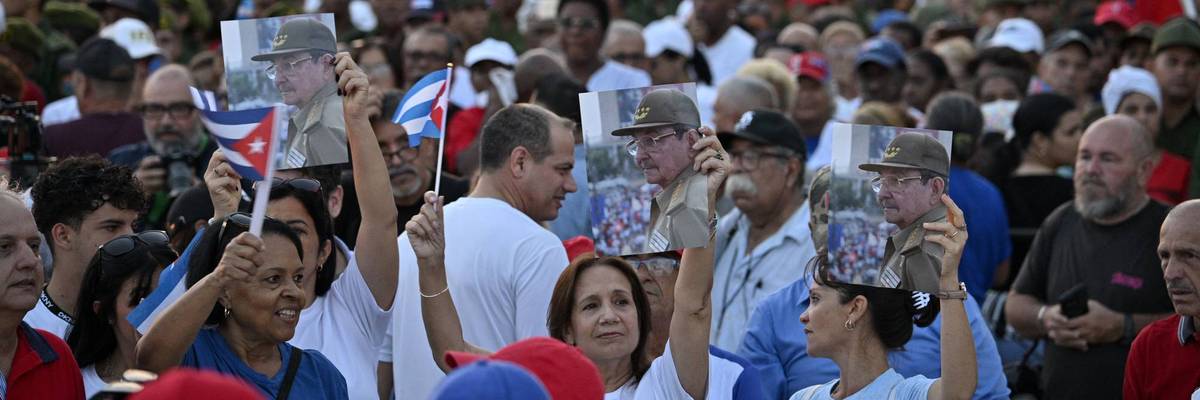
Cubans hold photos of revolutionary hero and former President Raúl Castro outside the US Embassy in Havana on May 22, 2026 amid threats of attack by the United States.
“Here we are prepared to fight imperialism," said Cuban lawmaker Mariela Castro, daughter of Raúl Castro. "Cuba is a small and poor country, but one with experience confronting US imperialism."
Tens of thousands of Cubans rallied Friday in Havana to denounce the Trump administration's indictment of former President Raúl Castro and threats to attack the island nation, whose socialist government has been preparing its citizens to defend their homeland and revolution against US aggression.
“No disrespect is shown to the heroes of the homeland!" Cuban President Miguel Díaz-Canel said as people flooded the streets outside the US Embassy in Havana. "History and traditions are not insulted without a response! That does not happen in Cuba!"
The massive rally followed Wednesday's US Department of Justice indictment of revolutionary hero Raúl Castro, who served as president for a decade after his older brother, Fidel Castro, stepped down in 2008. The DOJ indicted Castro for his alleged role in the 1996 shoot-down of planes operated by the counterrevolutionary group Brothers to the Rescue after repeated warnings that they had violated Cuban airspace.
Rallying under the slogan "Raúl is Raúl"—originally popularized during the transitional period of rule between the Castros to highlight the younger brother's reforms—Cubans vowed to defend their revolution in the face of the latest US threats.
“This new aggression has united us more and elevated the honor, dignity, and anti-imperialist spirit of a people already recognized around the world for their brave resistance to any form of subordination to the empire,” Díaz-Canel said.
Cuban legislator Mariela Castro, Raúl's granddaughter, told rallygoers that “we are prepared for combat."
"No one is going to kidnap him. I can assure you of that," she said, alluding to the US invasion and abduction of Venezuelan President Nicolás Maduro on dubious narco-terrorism charges earlier this year. "Neither him nor anyone else."
"My father is very calm, watching and smiling,” Castro added. "Here, we are prepared to fight imperialism. Cuba is a small and poor country, but one with experience confronting US imperialism. We know that as long as there is an anti-imperialist revolution, there will be a gigantic and ruthless enemy."
Critics noted the hypocrisy of the Castro indictment, given the ongoing illegal US bombing of boats that the Trump administration claims—without providing evidence—were smuggling drugs in the Caribbean Sea and Pacific Ocean.
“Washington has no moral authority to judge anyone,” Gerardo Hernández, coordinator of the Committees for the Defense of the Revolution, said, referring to the boat-bombing campaign, which has killed nearly 200 people in close to 60 reported attacks. “Cuba is a people of peace and reaffirms its legitimate right to self-defense."
"Cuba does not constitute a threat to US security," he continued. "On the contrary, Cuba is a state under attack by the United States."
Observers have pointed to the decadeslong US-backed campaign of anti-Castro terrorism against the Cuban people, including the 1976 bombing of Cubana Flight 455, a commercial airliner with 73 people aboard, including 11 Guyanese nationals and 24 teenage members of Cuba's junior Olympic fencing team. Perpetrators of the attack enjoyed safe haven in the United States, mainly in Miami, where the city celebrated a day in honor of one of the bombing's alleged masterminds.
“The Cuban people reaffirm the unwavering decision to defend their homeland and revolution," Hernández added. "With the greatest determination, they reaffirm their absolute and firm support for Army General Raúl Castro."
Mariela Castro said that "my family, like all Cuban families, is waiting for instructions to know where we need to go" in the event of a US attack.
As US Secretary of State Marco Rubio—whose parents immigrated to the United States from Cuba during the US-backed dictatorship that preceded the Castro-led revolution—said Thursday that the chances of a "negotiated and peaceful agreement" with Havana are "not high," Deputy Cuban Foreign Minister Carlos Fernández de Cossío acknowledged that his country is preparing for war, asserting that "we would be naive not to."
Cuban officials have been circulating a pamphlet titled a “Family Guide for Protection Against Military Aggression." The publication warns that the US is preparing "to launch a military assault and destroy our society with the aim of perpetuating capitalism... and annihilating the dream of our Commander-in-Chief, Fidel Castro.”
The pamphlet instructs Cubans to pack survival kits and seek shelter in the event of air-raid alerts. It also contains life-saving first aid instructions.
“Should the enemy attack, our Revolution will defend itself until victory is achieved and the aggressor is expelled," the pamphlet states.
US President Donald Trump recently tightened the internationally condemned 65-year US economic embargo on Cuba, imposing a fuel blockade that has exacerbated an energy emergency characterized by blackouts and deadly suffering among the most vulnerable Cubans, including sick people and children.
Last month, Trump said that “we may stop by Cuba after we’re finished" with the illegal US-Israeli war of choice against Iran. The president has also stated he believes he’ll “be having the honor of taking Cuba,” language echoing the 19th-century US imperialists who conquered the island along with Puerto Rico, Guam, and the Philippines from Spain in another war waged on dubious pretense.
“Whether I free it, take it—I think I can do anything I want,” Trump said of the island and its 11 million inhabitants.
BreakThrough News interviewed Havana residents earlier this week about the specter of US attack.
"We Cubans have to protect ourselves," elderly Havana resident Juan Hernández said. "We're not going to hand any Cuban over to a foreigner, because that would be immoral. It would be treason."
Hernández accused the US of "provocation" in order to "justify invading the country," adding "that would only lead to bloodshed on both sides."
"Besides," he added, "Cuba isn't a threat to them at all. What does Cuba have? Do we have atomic bombs? Do we have anything? We have nothing."
Dear Common Dreams reader, It’s been nearly 30 years since I co-founded Common Dreams with my late wife, Lina Newhouser. We had the radical notion that journalism should serve the public good, not corporate profits. It was clear to us from the outset what it would take to build such a project. No paid advertisements. No corporate sponsors. No millionaire publisher telling us what to think or do. Many people said we wouldn't last a year, but we proved those doubters wrong. Together with a tremendous team of journalists and dedicated staff, we built an independent media outlet free from the constraints of profits and corporate control. Our mission has always been simple: To inform. To inspire. To ignite change for the common good. Building Common Dreams was not easy. Our survival was never guaranteed. When you take on the most powerful forces—Wall Street greed, fossil fuel industry destruction, Big Tech lobbyists, and uber-rich oligarchs who have spent billions upon billions rigging the economy and democracy in their favor—the only bulwark you have is supporters who believe in your work. But here’s the urgent message from me today. It's never been this bad out there. And it's never been this hard to keep us going. At the very moment Common Dreams is most needed, the threats we face are intensifying. We need your support now more than ever. We don't accept corporate advertising and never will. We don't have a paywall because we don't think people should be blocked from critical news based on their ability to pay. Everything we do is funded by the donations of readers like you. When everyone does the little they can afford, we are strong. But if that support retreats or dries up, so do we. Will you donate now to make sure Common Dreams not only survives but thrives? —Craig Brown, Co-founder |
Tens of thousands of Cubans rallied Friday in Havana to denounce the Trump administration's indictment of former President Raúl Castro and threats to attack the island nation, whose socialist government has been preparing its citizens to defend their homeland and revolution against US aggression.
“No disrespect is shown to the heroes of the homeland!" Cuban President Miguel Díaz-Canel said as people flooded the streets outside the US Embassy in Havana. "History and traditions are not insulted without a response! That does not happen in Cuba!"
The massive rally followed Wednesday's US Department of Justice indictment of revolutionary hero Raúl Castro, who served as president for a decade after his older brother, Fidel Castro, stepped down in 2008. The DOJ indicted Castro for his alleged role in the 1996 shoot-down of planes operated by the counterrevolutionary group Brothers to the Rescue after repeated warnings that they had violated Cuban airspace.
Rallying under the slogan "Raúl is Raúl"—originally popularized during the transitional period of rule between the Castros to highlight the younger brother's reforms—Cubans vowed to defend their revolution in the face of the latest US threats.
“This new aggression has united us more and elevated the honor, dignity, and anti-imperialist spirit of a people already recognized around the world for their brave resistance to any form of subordination to the empire,” Díaz-Canel said.
Cuban legislator Mariela Castro, Raúl's granddaughter, told rallygoers that “we are prepared for combat."
"No one is going to kidnap him. I can assure you of that," she said, alluding to the US invasion and abduction of Venezuelan President Nicolás Maduro on dubious narco-terrorism charges earlier this year. "Neither him nor anyone else."
"My father is very calm, watching and smiling,” Castro added. "Here, we are prepared to fight imperialism. Cuba is a small and poor country, but one with experience confronting US imperialism. We know that as long as there is an anti-imperialist revolution, there will be a gigantic and ruthless enemy."
Critics noted the hypocrisy of the Castro indictment, given the ongoing illegal US bombing of boats that the Trump administration claims—without providing evidence—were smuggling drugs in the Caribbean Sea and Pacific Ocean.
“Washington has no moral authority to judge anyone,” Gerardo Hernández, coordinator of the Committees for the Defense of the Revolution, said, referring to the boat-bombing campaign, which has killed nearly 200 people in close to 60 reported attacks. “Cuba is a people of peace and reaffirms its legitimate right to self-defense."
"Cuba does not constitute a threat to US security," he continued. "On the contrary, Cuba is a state under attack by the United States."
Observers have pointed to the decadeslong US-backed campaign of anti-Castro terrorism against the Cuban people, including the 1976 bombing of Cubana Flight 455, a commercial airliner with 73 people aboard, including 11 Guyanese nationals and 24 teenage members of Cuba's junior Olympic fencing team. Perpetrators of the attack enjoyed safe haven in the United States, mainly in Miami, where the city celebrated a day in honor of one of the bombing's alleged masterminds.
“The Cuban people reaffirm the unwavering decision to defend their homeland and revolution," Hernández added. "With the greatest determination, they reaffirm their absolute and firm support for Army General Raúl Castro."
Mariela Castro said that "my family, like all Cuban families, is waiting for instructions to know where we need to go" in the event of a US attack.
As US Secretary of State Marco Rubio—whose parents immigrated to the United States from Cuba during the US-backed dictatorship that preceded the Castro-led revolution—said Thursday that the chances of a "negotiated and peaceful agreement" with Havana are "not high," Deputy Cuban Foreign Minister Carlos Fernández de Cossío acknowledged that his country is preparing for war, asserting that "we would be naive not to."
Cuban officials have been circulating a pamphlet titled a “Family Guide for Protection Against Military Aggression." The publication warns that the US is preparing "to launch a military assault and destroy our society with the aim of perpetuating capitalism... and annihilating the dream of our Commander-in-Chief, Fidel Castro.”
The pamphlet instructs Cubans to pack survival kits and seek shelter in the event of air-raid alerts. It also contains life-saving first aid instructions.
“Should the enemy attack, our Revolution will defend itself until victory is achieved and the aggressor is expelled," the pamphlet states.
US President Donald Trump recently tightened the internationally condemned 65-year US economic embargo on Cuba, imposing a fuel blockade that has exacerbated an energy emergency characterized by blackouts and deadly suffering among the most vulnerable Cubans, including sick people and children.
Last month, Trump said that “we may stop by Cuba after we’re finished" with the illegal US-Israeli war of choice against Iran. The president has also stated he believes he’ll “be having the honor of taking Cuba,” language echoing the 19th-century US imperialists who conquered the island along with Puerto Rico, Guam, and the Philippines from Spain in another war waged on dubious pretense.
“Whether I free it, take it—I think I can do anything I want,” Trump said of the island and its 11 million inhabitants.
BreakThrough News interviewed Havana residents earlier this week about the specter of US attack.
"We Cubans have to protect ourselves," elderly Havana resident Juan Hernández said. "We're not going to hand any Cuban over to a foreigner, because that would be immoral. It would be treason."
Hernández accused the US of "provocation" in order to "justify invading the country," adding "that would only lead to bloodshed on both sides."
"Besides," he added, "Cuba isn't a threat to them at all. What does Cuba have? Do we have atomic bombs? Do we have anything? We have nothing."
Tens of thousands of Cubans rallied Friday in Havana to denounce the Trump administration's indictment of former President Raúl Castro and threats to attack the island nation, whose socialist government has been preparing its citizens to defend their homeland and revolution against US aggression.
“No disrespect is shown to the heroes of the homeland!" Cuban President Miguel Díaz-Canel said as people flooded the streets outside the US Embassy in Havana. "History and traditions are not insulted without a response! That does not happen in Cuba!"
The massive rally followed Wednesday's US Department of Justice indictment of revolutionary hero Raúl Castro, who served as president for a decade after his older brother, Fidel Castro, stepped down in 2008. The DOJ indicted Castro for his alleged role in the 1996 shoot-down of planes operated by the counterrevolutionary group Brothers to the Rescue after repeated warnings that they had violated Cuban airspace.
Rallying under the slogan "Raúl is Raúl"—originally popularized during the transitional period of rule between the Castros to highlight the younger brother's reforms—Cubans vowed to defend their revolution in the face of the latest US threats.
“This new aggression has united us more and elevated the honor, dignity, and anti-imperialist spirit of a people already recognized around the world for their brave resistance to any form of subordination to the empire,” Díaz-Canel said.
Cuban legislator Mariela Castro, Raúl's granddaughter, told rallygoers that “we are prepared for combat."
"No one is going to kidnap him. I can assure you of that," she said, alluding to the US invasion and abduction of Venezuelan President Nicolás Maduro on dubious narco-terrorism charges earlier this year. "Neither him nor anyone else."
"My father is very calm, watching and smiling,” Castro added. "Here, we are prepared to fight imperialism. Cuba is a small and poor country, but one with experience confronting US imperialism. We know that as long as there is an anti-imperialist revolution, there will be a gigantic and ruthless enemy."
Critics noted the hypocrisy of the Castro indictment, given the ongoing illegal US bombing of boats that the Trump administration claims—without providing evidence—were smuggling drugs in the Caribbean Sea and Pacific Ocean.
“Washington has no moral authority to judge anyone,” Gerardo Hernández, coordinator of the Committees for the Defense of the Revolution, said, referring to the boat-bombing campaign, which has killed nearly 200 people in close to 60 reported attacks. “Cuba is a people of peace and reaffirms its legitimate right to self-defense."
"Cuba does not constitute a threat to US security," he continued. "On the contrary, Cuba is a state under attack by the United States."
Observers have pointed to the decadeslong US-backed campaign of anti-Castro terrorism against the Cuban people, including the 1976 bombing of Cubana Flight 455, a commercial airliner with 73 people aboard, including 11 Guyanese nationals and 24 teenage members of Cuba's junior Olympic fencing team. Perpetrators of the attack enjoyed safe haven in the United States, mainly in Miami, where the city celebrated a day in honor of one of the bombing's alleged masterminds.
“The Cuban people reaffirm the unwavering decision to defend their homeland and revolution," Hernández added. "With the greatest determination, they reaffirm their absolute and firm support for Army General Raúl Castro."
Mariela Castro said that "my family, like all Cuban families, is waiting for instructions to know where we need to go" in the event of a US attack.
As US Secretary of State Marco Rubio—whose parents immigrated to the United States from Cuba during the US-backed dictatorship that preceded the Castro-led revolution—said Thursday that the chances of a "negotiated and peaceful agreement" with Havana are "not high," Deputy Cuban Foreign Minister Carlos Fernández de Cossío acknowledged that his country is preparing for war, asserting that "we would be naive not to."
Cuban officials have been circulating a pamphlet titled a “Family Guide for Protection Against Military Aggression." The publication warns that the US is preparing "to launch a military assault and destroy our society with the aim of perpetuating capitalism... and annihilating the dream of our Commander-in-Chief, Fidel Castro.”
The pamphlet instructs Cubans to pack survival kits and seek shelter in the event of air-raid alerts. It also contains life-saving first aid instructions.
“Should the enemy attack, our Revolution will defend itself until victory is achieved and the aggressor is expelled," the pamphlet states.
US President Donald Trump recently tightened the internationally condemned 65-year US economic embargo on Cuba, imposing a fuel blockade that has exacerbated an energy emergency characterized by blackouts and deadly suffering among the most vulnerable Cubans, including sick people and children.
Last month, Trump said that “we may stop by Cuba after we’re finished" with the illegal US-Israeli war of choice against Iran. The president has also stated he believes he’ll “be having the honor of taking Cuba,” language echoing the 19th-century US imperialists who conquered the island along with Puerto Rico, Guam, and the Philippines from Spain in another war waged on dubious pretense.
“Whether I free it, take it—I think I can do anything I want,” Trump said of the island and its 11 million inhabitants.
BreakThrough News interviewed Havana residents earlier this week about the specter of US attack.
"We Cubans have to protect ourselves," elderly Havana resident Juan Hernández said. "We're not going to hand any Cuban over to a foreigner, because that would be immoral. It would be treason."
Hernández accused the US of "provocation" in order to "justify invading the country," adding "that would only lead to bloodshed on both sides."
"Besides," he added, "Cuba isn't a threat to them at all. What does Cuba have? Do we have atomic bombs? Do we have anything? We have nothing."