SUBSCRIBE TO OUR FREE NEWSLETTER
Daily news & progressive opinion—funded by the people, not the corporations—delivered straight to your inbox.
5
#000000
#FFFFFF
To donate by check, phone, or other method, see our More Ways to Give page.
Daily news & progressive opinion—funded by the people, not the corporations—delivered straight to your inbox.
Ever since November 7, when the election was more or less authoritatively "called" by all major media, a wide range of pundits have spoken as if the election was decided. Some of these pundits have explained away Trump's consistent and angry refusal of the results as a sign of his narcissism and immaturity; some have focused on the ineptitude of the Rudy Giuliani/Jenna Ellis legal team; and some have focused on the important fact that so many judges and state election officials, even Republican ones, have refused to comply with Trump's efforts to subvert the election. Most recently, attention has focused on the December 8 "Safe Harbor" date prescribed by federal law. The point: the results have now been certified, and Biden obviously must be selected next week by the Electoral College, and Trump's latest efforts are beside the point.
Donald Trump--the commander-in chief, chief executive, and current occupant of the White House--is doing his very best to organize a concerted effort to overthrow the results of the November election.
Just like with the Mueller Report in 2019 and the impeachment in 2020, Trump's crossing of certain lines seems both absurd and legally impossible; Trump then crosses the lines, with no real consequence; then a new line is identified; and then that line is crossed. And so attention has shifted from November 3 to November 7, to December 8--an entire monthlater--to December 14. And as time passes, it becomes clearer and clearer that Trump remains as determined as ever to resist what both law and custom demand, and that he has extraordinary support in this.
It is simply beyond me why any intelligent person would fail to see that the election contest is not yet over, and for one simple reason: as Barton Gellman argued in his seminal Atlanticessay many weeks ago, we are still in the middle of a legally arcane and complex interregnum, Trump and his criminal associates have prepared for this and in some ways even gamed it, and they are now continuing to pursue every obstructive option at their disposal exactly as planned.
And yet only today Tim Wu, a law professor at Columbia University, published in the New York Timesa piece asking "What Really Saved the Republic From Trump?" and answering that it was not formal institutions but civic virtue. Saved the republic from Trump? Saved? Really? Did I miss something? Has Trump decamped to Mar-a-Lago? I thought he was still at 1600 Pennsylvania Avenue, meeting with various Republican Congressmen and state Attorneys General and plotting the next phase of obstruction.
Meanwhile, over at the Atlantic--the same Atlantic that published the terrific piece by Gellman, and just published Zeynep Tufekci's equally terrific "'This Must Be Your First': Acting as if Trump is trying to stage a coup is the best way to ensure he won't"-- the usually excellent George Packer bizarrely offered "A Political Obituary for Donald Trump" that is neatly summed up in its lead caption: "The effects of his reign will linger. But democracy survived." Packer is surely correct that the effects of Trump's presidency will linger. He may also be correct that "democracy" will survive (if it does, it will be in the manner of a frail old man who is badly beaten and bruised but manages to stumble away). But survived--in the past tense, as if it is a foregone conclusion? And "obituary," as if the beast is dead?
This is crazy.
In all fairness to Packer, the Atlantic informs us at the bottom that "this article appears in the January/February 2021 print edition with the headline 'The Legacy of Donald Trump.'" But both the author and the editors should be embarrassed for their abominable decision to produce a retrospective in early December that is intended for next year--months away--and then to publish it online in early December, even as Trump remains in office and continues to threaten democracy.
Packer, Wu, Ari Melber on MSNBC--all too many otherwise very smart people insist on talking, and behaving, as if Biden is not simply the President-elect but the President--some TV personalities actually sometimes slip and call him "President Biden"-or at least as if the transition from the first role to the second is a mere formality.
For decades, perhaps centuries, it has been more or less a formality.
But it is not a formality now. This is obvious and it is known.
Right now the Supreme Court is considering a lawsuit, filed by Republican Attorney General Ken Paxton of Texas, that claims that the electoral practices and results in Georgia, Michigan, Wisconsin, and Pennsylvania "harm" Texas voters and should be invalidated, and that Republican legislatures in those states ought to be empowered to investigate the election "fraud" and then make the ultimate decision about certification and the naming of Electoral College teams.
This lawsuit is widely considered by legal scholars-who alas do not rule the world-to be absurd.
But it is being supported by the Republican Attorneys General of seventeen other red states, who have jointly filed an amicus brief.
It is also being supported by 106 Republican members of the U.S. House of Representatives, who have also filed an amicus brief.
Amicus briefs of support have also been filed by Republican state legislators in many states, including Pennsylvania and Michigan.
And, of course, the suit is supported by Trump.
Will this suit succeed? It seems unlikely. At the same time, we do not know. More important, the widespread support for the maneuver by Republican national and state elected officials is deeply troubling, and signals a real determination to overturn the election.
This effort is part of a much broader mobilization of the Republican base and the Republican party leadership behind Trump.
Republican Congressman Mike Johnson (R-La.) is whipping House members, making lists of supporters for the President.
Republican Senator Ron Johnson (R-Wis.), chair of the Senate Homeland Security Committee, has announced that he will hold public hearings next week on allegations of election fraud.
A number of Republican Congressmen and Senators have threatened to challenge the Electoral College results on the floor of Congress on January 6, and at least two, Rep. Mo Brooks (R-Ala.)) and Barry Moore (R-Ala.), have promised to do so (the toxic Jim Jordan has also indicated a willingness to do this).
In the meantime, state public officials--from the Democratic Secretary of State of Michigan to the Republican Secretary of State of Georgia--are receiving death threats; in Arizona the state Republican committee is urging supporters to "fight to the death" on behalf of Trump; and "Stop the Steal" protests and harassments are spreading. Yesterday's New York Timesheadline said it well: "As Trump Rails Against His Loss, His Supporters Become More Threatening."
Donald Trump--the commander-in chief, chief executive, and current occupant of the White House--is doing his very best to organize a concerted effort to overthrow the results of the November election. And he is doing it with the tacit support of the entire Republican Senate and House leadership, with the explicit support of many U.S. Senators, over a hundred U.S. Representatives, hundreds of Republican state legislators across the country, and a large proportion of the 73 million people who voted for him.
This is happening. Now.
And it is dangerous.
Might the outrageous lawsuit fail? Yes. Maybe. Probably even.
Might the effort of Brooks and others to obstruct the validation of the Electoral College vote by Congress on January 6 fail? Yes. Maybe. Probably.
But we do not know.
More importantly: we have no reason to believe that Trump will stop there. Because if he has been consistent in anything these past four years, it is this: he has no respect for laws or norms, and he will always push boundaries, and he will do almost anything to stay on top.
How far will he go?
Back in August, John Nagl and Paul Yingling--two very distinguished military intellectuals and retired U.S. Army officers--published an important piece entitled "'. . . All Enemies Foreign and Domestic': An Open Letter to Gen Milley." Their basic point was simple: "If Donald Trump refuses to leave office at the expiration of his constitutional term, the United States military must remove him by force, and you must give that order." This piece generated incredible controversy. Many, Trump supporters but also people on the center and left, disparaged the piece as a call for direct military intervention in domestic politics, and almost as a call for a kind of coup. I believe this was a serious misreading of the piece, and I said so back then. But their specific argument notwithstanding, their piece was a brave and important identification of some very real scenarios: what if Trump refuses to leave on January 20, and what if he uses Homeland Security forces--the forces that were deployed on the streets of Portland--to overwhelm Secret Service officers seeking to escort him out? Or, what if he refuses to leave, and there are mass demonstrations in Washington, D.C, and he calls out federal forces, or even the U.S. military, to suppress the protests, perhaps invoking the Insurrection Act? What then? What happens then? Nagl and Yingling's basic point is that all U.S. military forces and all federal agents have a duty to defend the Constitution, and this means that they should not follow illegal orders, and must be prepared--if it comes to this--to uphold the law. If it comes to this.
The very fact that these two highly respected figures thought it necessary to raise these issues in public was telling, and remains telling. And indeed, the fact that so many smart people challenged their specific argument and sought to make more nuanced arguments about the role of the military in the event that Trump refuses to step down underscores the fact that this is not a crazy scenario. It might not be probable. But it is not impossible. Not at all.
Do you really think that Trump would never adamantly refuse to leave, and even call upon federal troops to support him? How confident of this are you? Really?
As Zeynep Tufekci has argued, what Trump is doing now surely seems like what political scientists call an "autcoup." How far will he go? We do not know. But everything we do know tells us that we should be afraid. Very afraid.
Joe Biden is the President-elect whose very status is the outcome of a contentious process that is not yet over. Donald Trump is the President. For many years he told us that he could not legitimately lose an election. Now he is telling us that he did not legitimately lose, and he in fact won, and he has no intention of giving up power. And he is methodically doing everything in his power to remain in power. He is a clear in present danger to democracy. And he is not gone yet.
It is not over until it's over.
And it is definitely not over.
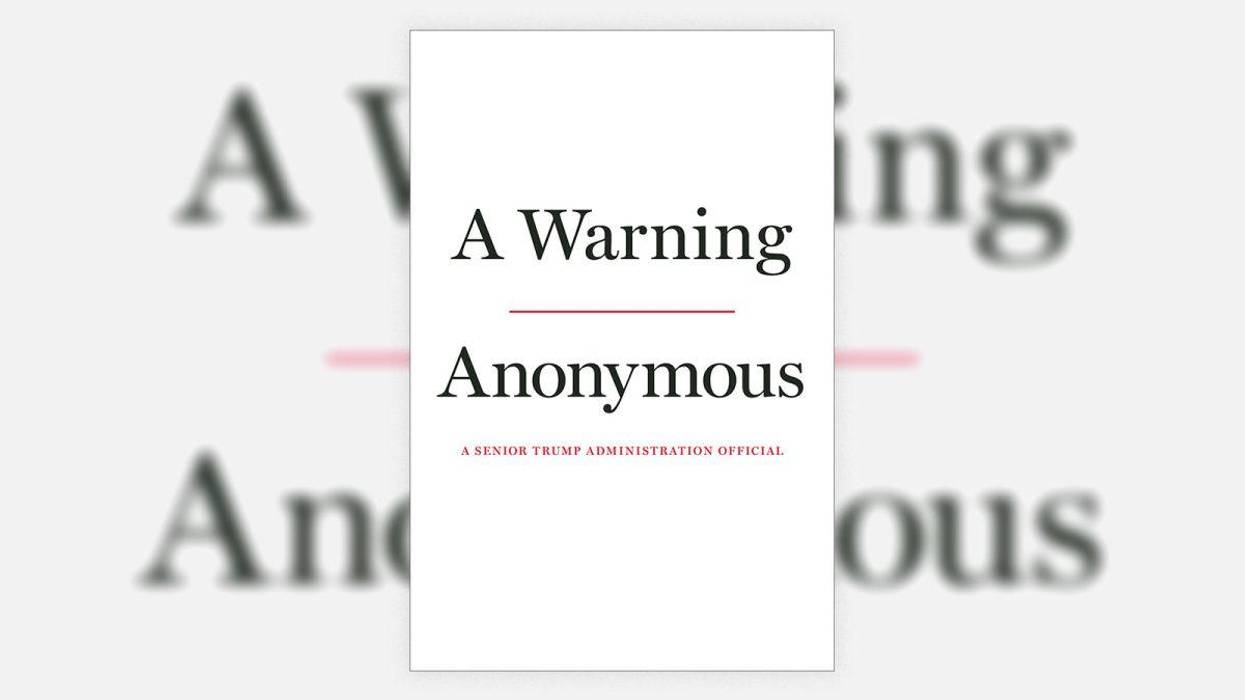
Ending over two years of mystery and speculation, former Department of Homeland Security chief of staff Miles Taylor on Wednesday revealed himself to be the author of an anonymous 2018 New York Times editorial that claimed "many of the senior officials" within the Trump administration formed a "resistance" that actively worked to undermine President Donald Trump's agenda.
"Too often in times of crisis, I saw Donald Trump prove he is a man without character, and his personal defects have resulted in leadership failures so significant that they can be measured in lost American lives."
--Miles Taylor, aka "Anonymous"
In a Medium post also published by the Times, Taylor wrote that it "wasn't easy" to come out as "Anonymous" but "we owe... the American people the truth." He claimed he was revealing himself so that others might also speak out against the president.
"That's why I'm writing this note--to urge you to speak out if you haven't," he wrote. "While I hope a few more Trump officials will quickly find their consciences, your words are now more important than theirs. It's time to come forward and shine a light on the discord that's infected our public discourse."
"The country cannot rely on well-intentioned, unelected bureaucrats around the president to steer him toward what's right," said Taylor. "He has purged most of them anyway. Nor can they rely on Congress to deliver us from Trump's wayward whims."
"The people themselves are the ultimate check on the nation's chief executive," he argued.
Taylor's admission marks a reversal from as recently as August, when he told CNN host Anderson Cooper that he was not "Anonymous," and that he only wears masks for "Halloweens and pandemics."
Speculation surrounding the identity of "Anonymous" ran the gamut from former Homeland Security Secretary Kirstjen Nielsen--who some former administration officials say was pressured into acquiescing to family separation--to Vice President Mike Pence, who, like "Anonymous," is fond of the word "lodestar."
During his DHS tenure, Taylor worked as Nielsen's chief of staff when she signed the infamous memorandum authorizing the Justice Department separation of undocumented immigrant families--including children and infants--many of whom legally presented themselves at U.S. ports of entry to request asylum.
Critics including Physicians for Human Rights have called the policy "government-sanctioned child abuse" and even "torture," and although the separation policy was formally ended after international outrage, the U.S. government to this day cannot find the parents of some 545 children it seized from them.
Taylor first publicly spoke against Trump in August, admitting he "should have done more" when faced with one of the most egregious U.S. human rights crimes of the century, and endorsing Democratic presidential nominee in an advertisement that aired during the Democratic National Convention. He also published a Washington Post opinion piece in which he argued that "the country is less secure as a direct result of the president's actions."
In a statement later on Wednesday, White House Press Secretary Kayleigh McEnany called Taylor a "low-level, disgruntled former staffer" who "is a liar and a coward who chose anonymity over action and leaking over leading."
As he so often does, Trump falsely claimed he didn't know Taylor and called his revelation "another @nytimes SCAM."
Read Taylor's full statement--titled "Why I'm No Longer 'Anonymous'"--as it appeared in the Times on Wednesday, below:
More than two years ago, I published an anonymous opinion piece in The New York Times about Donald Trump's perilous presidency, while I was serving under him. He responded with a short but telling tweet: "TREASON?"
Trump sees personal criticism as subversive.
I take a different view. As Theodore Roosevelt wrote, "To announce that there must be no criticism of the president, or that we are to stand by the president, right or wrong, is not only unpatriotic and servile, but is morally treasonable to the American public. Nothing but the truth should be spoken about him or anyone else. But it is even more important to tell the truth, pleasant or unpleasant, about him than about anyone else."
We do not owe the president our silence. We owe him and the American people the truth.
Make no mistake: I am a Republican, and I wanted this president to succeed. That's why I came into the administration with John Kelly, and it's why I stayed on as chief of staff at the Department of Homeland Security. But too often in times of crisis, I saw Donald Trump prove he is a man without character, and his personal defects have resulted in leadership failures so significant that they can be measured in lost American lives. I witnessed Trump's inability to do his job over the course of two-and-a-half years. Everyone saw it, though most were hesitant to speak up for fear of reprisals.
So when I left the administration I wrote A Warning, a character study of the current Commander in Chief and a caution to voters that it wasn't as bad as it looked inside the Trump administration--it was worse. While I claim sole authorship of the work, the sentiments expressed within it were widely held among officials at the highest levels of the federal government. In other words, Trump's own lieutenants were alarmed by his instability.
Much has been made of the fact that these writings were published anonymously. The decision wasn't easy, I wrestled with it, and I understand why some people consider it questionable to levy such serious charges against a sitting president under the cover of anonymity. But my reasoning was straightforward, and I stand by it. Issuing my critiques without attribution forced the president to answer them directly on their merits or not at all, rather than creating distractions through petty insults and name-calling. I wanted the attention to be on the arguments themselves. At the time I asked, "What will he do when there is no person to attack, only an idea?" We got the answer. He became unhinged. And the ideas stood on their own two feet.
To be clear, writing those works was not about eminence (they were published without attribution), not about money (I declined a hefty monetary advance and pledged to donate the bulk of the proceeds), and not about crafting a score-settling "tell all" (my focus was on the president himself and his character, not denigrating former colleagues).
Nevertheless, I made clear I wasn't afraid to criticize the president under my name. In fact, I pledged to do so. That is why I've already been vocal throughout the general election. I've tried to convey as best I can--based on my own experience--how Donald Trump has made America less safe, less certain of its identity and destiny, and less united. He has responded predictably, with personal attacks meant to obscure the underlying message that he is unfit for the office he holds.
Yet Trump has failed to bury the truth.
Why? Because since the op-ed was published, I've been joined by an unprecedented number of former colleagues who've chosen to speak out against the man they once served. Donald Trump's character and record have now been challenged in myriad ways by his own former chief of staff, national security advisor, communications director, secretary of state, secretary of defense, director of national intelligence, vice chairman of the Joint Chiefs of Staff, and others he personally appointed.
History will also record the names of those souls who had everything to lose but stood up anyway, including Trump officials Fiona Hill, Michael McKinley, John Mitnick, Elizabeth Neumann, Bob Shanks, Olivia Troye, Josh Venable, Alexander Vindman, and many more. I applaud their courage. These are not "Deep Staters" who conspired to thwart their boss. Many of them were Trump supporters, and all of them are patriots who accepted great personal risks to speak candidly about a man they've seen retaliate and even incite violence against his opponents. (I've likewise experienced the cost of condemning the president, as doing so has taken a considerable toll on my job, daily life, marriage, finances, and personal safety.)
These public servants were not intimidated. And you shouldn't be either. As descendants of revolutionaries, honest dissent is part of our American character, and we must reject the culture of political intimidation that's been cultivated by this president. That's why I'm writing this note--to urge you to speak out if you haven't. While I hope a few more Trump officials will quickly find their consciences, your words are now more important than theirs. It's time to come forward and shine a light on the discord that's infected our public discourse. You can speak loudest with your vote and persuade others with your voice. Don't be afraid of open debate. As I've said before, there is no better screen test for truth than to see it audition next to delusion.
This election is a two-part referendum: first, on the character of a man, and second, on the character of our nation. That's why I'm also urging fellow Republicans to put country over party, even if that means supporting Trump's Democratic opponent. Although former Vice President Joe Biden is likely to pursue progressive reforms that conservatives oppose (and rest assured, we will challenge them in the loyal opposition), his policy agenda cannot equal the damage done by the current president to the fabric of our republic. I believe Joe Biden's decency will bring us back together where Donald Trump's dishonesty has torn us apart.
Trump has been exactly what we conservatives always said government should NOT be: expansive, wasteful, arbitrary, unpredictable, and prone to abuses of power. Worse still, as I've noted previously, he's waged an all-out assault on reason, preferring to enthrone emotion and impulse in the seat of government. The consequences have been calamitous, and if given four more years, he will push the limits of his power further than the "high crimes and misdemeanors" for which he was already impeached.
Trust me. We spent years trying to ameliorate Trump's poor decisions (often unsuccessfully), many of which will be back with a vengeance in a second term. Recall, this is the man who told us, "When somebody's president of the United States, the authority is total." I believe more than ever that Trump unbound will mean a nation undone--a continued downward slide into social acrimony, with the United States fading into the background of a world stage it once commanded, to say nothing of the damage to our democratic institutions.
I was wrong, however, about one major assertion in my original op-ed. The country cannot rely on well-intentioned, unelected bureaucrats around the President to steer him toward what's right. He has purged most of them anyway. Nor can they rely on Congress to deliver us from Trump's wayward whims. The people themselves are the ultimate check on the nation's chief executive. We alone must determine whether his behavior warrants continuance in office, and we face a momentous decision, as our choice about Trump's future will affect our future for years to come. With that in mind, he doesn't deserve a second term in office, and we don't deserve to live through it.
Removing Trump will not be the end of our woes, unfortunately. While on the road visiting swing states for the past month, it's become clear to me how far apart Americans have grown from one another. We've perpetuated the seemingly endless hostility stoked by this divisive President, so if we really want to restore vibrance to our civic life, the change must begin with each of us, not just with the occupant of the Oval Office. Fortunately, past generations have lit the way toward national reconciliation in even harder times.
On the brink of a civil war that literally split our nation in two, Abraham Lincoln called on the people not to lose sight of one other. He said in his Inaugural Address:
We are not enemies, but friends. We must not be enemies. Though passion may have strained it must not break our bonds of affection. The mystic chords of memory, stretching from every battlefield and patriot grave to every living heart and hearthstone all over this broad land, will yet swell the chorus of the Union, when again touched, as surely they will be, by the better angels of our nature.
Heed Lincoln's words. We must return to our founding principles. We must rediscover our better angels. And we must reconcile with each other, repairing the bonds of affection that make us fellow Americans.
Miles Taylor
October 2020
Our country, at the beginning of this year, faced four major threats: Climate change, Covid-19, Russian election meddling, and a worldwide nuclear arms race.
Donald Trump lied to us about all four of them. As a result, each, today, represents a larger threat than it did before he became president and hundreds of thousands of Americans have or soon will die because of his lies.
Trump lied to us about climate change and took billions from FEMA to give to unemployed people in Texas; that money ran out today. He claimed that forest fires in the west were because we weren't "raking the forest floors," one of the more stupid and simplistic ways he lied about climate change to satisfy his fossil fuel donors. And now Americans are dying and losing their homes in a dozen western states.
"Trump has been a lifelong grifter, money launderer and minor criminal. Now he has brought that criminality to the White House and guided himself from his criminal instinct to lie and cheat."
He lied, as we now have learned from Bob Woodward, to all of us about the severity of Covid-19. He knew in January how deadly this disease was, that it could strike even young children, and that it was transmitted through the air. Instead of warning us, instead of warning parents, instead of issuing a national mask mandate, he lied to us and said it was "just like the flu" and a "Democrat hoax." He then spent months lying to his supporters, packing them into events to stroke his ego even as he knew that some would end up like Herman Cain: dead.
He was repeatedly warned the Russians and others were attempting to manipulate our election, from activity on Facebook and in other news and social media venues to hacking into our election systems. Not only did he lie to Americans about this, but this week we learned that he ordered his illegal toady at DHS, Chad Wolf, to order those below him to hide this information from the American public.
Finally, Trump blithered on to Bob Woodward about a top-secret new nuclear weapons program the United States has developed. Once that information was published, it kicked off a new international nuclear arms race. We could hope that Trump was lying to Woodward about this, but it turns out that instead he had been lying to us and the world, and now that the truth is out it has put the entire world at increased danger of war and an extinction-causing nuclear winter.
And now a fifth crisis has arisen, because of the way Trump screwed up the Covid-19 and climate crises. Our economy has collapsed more severely than any time since the Republican Great Depression, and the only companies that are being meaningfully bailed out are the corporate behemoths. People are losing their homes, their life savings, and hope.
Donald Trump has been a lifelong grifter, money launderer and minor criminal. Now he has brought that criminality to the White House and guided himself from his criminal instinct to lie and cheat.
The result over the short term is the end of the American Dream and American Exceptionalism. The result over the long term could be the loss of democracy, both here in the United States and across the planet.
Nobody expected we would have to pay such a steep price for electing a mentally ill criminal as president. And nobody believed an entire political party would support a race-baiting fascist, but here we are.
The big questions now are whether the domestic terrorists Trump has activated will realize he's been playing them for suckers, or will their loyalty to white supremacy cause them to stick with him?
Or, will he successfully reach out to them and ratchet up racially motivated violence across this country as we go into, through, and past the election season this year?
All leaders are demagogues. You may not realize this, because we've come to associate the word "demagogue" with only dangerous populist leaders. But in Greek, the word just means "leader of the people" (demos "the people" + agogos "leading").
Some demagogues are good, and some are dangerous. The fundamental difference between leaders who are good demagogues and leaders who are dangerous demagogues is found in the answer to this simple question: Are they accountable for their words and actions?
Obviously, an unaccountable leader is dangerous in any political community.
Donald Trump is a demagogue - he's a heroic demagogue to his followers, and he's a dangerous demagogue to everyone else.
I've been analyzing Trump's rhetoric since 2015 and, despite how it may appear to some critics, Trump is a rhetorical genius. I describe why in my new book, "Demagogue For President: The Rhetorical Genius of Donald Trump."
He's a genius at using rhetoric like a dangerous demagogue does, to prevent the country from holding him accountable.
Trump campaigned as an unaccountable leader. He promised that he would fight for his followers and wouldn't be accountable to established leaders in his party, the media, fact-checkers, political correctness or common standards of decency.
Trump has used six rhetorical strategies repeatedly since 2015. Three ingratiate Trump with his followers, and three alienate Trump and his followers from everyone else. The effect is to unify his followers against everyone else and to make Trump the fulcrum for all political discussion and debate.
All of the strategies are used to set the nation's agenda, distract the nation's attention and frame how we understand reality.
Ad populum: appealing to the wisdom of the crowd, using popularity as the measure of value.
Dangerous demagogues have no power if they have no followers, so they use ad populum to solidify their base and wield their supporters as a cudgel against opponents.
Trump routinely praises his people as the smartest, best, most patriotic, hardest-working Americans. They are great and good, and everyone else is not. For example, when he claimed that he could "stand in the middle of Fifth Avenue and shoot somebody and I wouldn't lose any voters," that was an ad populum appeal about the loyalty of Trump's base.
Trump's ad populum appeal was designed to silence his Never Trump critics while distracting attention away from their central criticism of him: that he was a populist, not a real conservative.
Popularity (crowds, opinion polls, ratings, votes) is the only sign of value to Trump. Conservativism itself has no value unless it is popular.
Paralipsis: I'm not saying; I'm just saying.
Dangerous demagogues use paralipsis because it gives them plausible deniability to assert that they didn't actually say some controversial thing or that they were merely joking or being sarcastic.
Trump uses this strategy to spread rumor and innuendo and to give a "backstage" or "real" view of what he supposedly really thinks. It is rewarding for Trump because it allows him to say two things at once, without being held accountable.
For example, Trump repeatedly amplified racist white nationalist content on his Twitter feed while denying that he agreed with them.
"I don't know about retweeting," Trump told Jake Tapper. "You retweet somebody and they turn out to be white supremacists. I know nothing about these groups that are supporting me."
He also claimed that there was a difference between tweeting something and retweeting something, refusing to take responsibility for his retweets. His retweets functioned as a paralipsis: It allowed him to say and not say and provided him with the out of plausible deniability.
American exceptionalism: This refers to America's unique role in the world, simplified by Trump as "America winning."
Dangerous demagogues use American exceptionalism to take advantage of their followers' patriotism and feelings of national pride for the demagogue's gain.
Trump presents himself as the apotheosis of American exceptionalism and claims that he is the heroic figure who can make America great again by defeating corruption and conspiracy. Trump will win for Trump's people - he's their hero.
For example, Trump claimed that he was uniquely qualified to "drain the swamp" of corruption. His campaign presented a hero narrative of sacrifice and struggle. He had been "the ultimate insider," he claimed, but once he decided to run for president and make America great again, he had been purified. As "the ultimate outsider" Trump would "drain the swamp" and end corruption. He said that it would be easy for him to do.
Ad hominem: attacking the person instead of their argument.
Dangerous demagogues use ad hominem appeals to mock and delegitimize legitimate opposition.
Trump routinely attacks people with name-calling, appeals to hypocrisy and insults to distract the nation away from criticisms made about him. He uses these strategies to avoid accountability by undermining the legitimacy of his opposition.
For example, he mocked a reporter with a physical disability. Trump did this to distract attention from his misrepresentation of events on 9/11 by arguing that the reporter's memory was as impaired as his body. This allowed Trump to claim that his version of history was the only truth, without actually proving that his version of history was accurate.
Ad baculum: threats of force or intimidation.
Dangerous demagogues use ad baculum to change the subject of debate and use force to silence legitimate opposition.
Trump silences his opposition by threatening them with mean tweets, violent mobs and condoning, or refusing to condemn, violence conducted in his name.
For example, he used threats and appeals to fear when he repeatedly told his supporters that Hillary Clinton was determined to take away their guns, leaving them defenseless against rapists and murders. When he accepted the National Rifle Association's endorsement, he threatened, "If she gets to appoint her judges she will, as part of it, abolish the Second Amendment." If that happened, Trump threatened, then gun owners would lose "any chance they have of survival."
Reification: treating people as objects.
Dangerous demagogues use reification to position opposition as less than human, thereby denying their standing to criticize or object. Reification is traditionally a part of war rhetoric or genocide.
Trump undermines his opposition by treating them as objects - things, animals - rather than as people. Objects shouldn't have the same rights as people, so it makes Trump's enemies easy to dismiss and attack.
For example, he treated Muslim refugees as dangerous enemy objects masquerading as people - as a "Trojan horse" that would unleash "a 200,000-man army, maybe. Or 50,000 or 80,000 or 100,000." The refugees weren't people in need of help; they were an army pretending to be people, dangerous because they were determined to attack America.
Denying the humanity of the refugees made it easier to deny them refuge, which is precisely what Trump proposed doing with his Muslim ban.
Did Trump "have the best words," as he once claimed?
Hardly. His words are weapons, well calculated to attack our public sphere by increasing distrust, polarization and frustration - making it more difficult to solve political problems.
Trump was so successful in using dangerous demagogic rhetoric that no one could hold him accountable for his words and actions during the 2016 campaign or since. He uses rhetoric to gain compliance rather than for persuasion - he deploys language as force, or as a "counterpunch," as he likes to explain.
Trump's rhetorical strategies correspond to how authoritarians have historically eroded democracy, which is why his rhetoric is so dangerous.
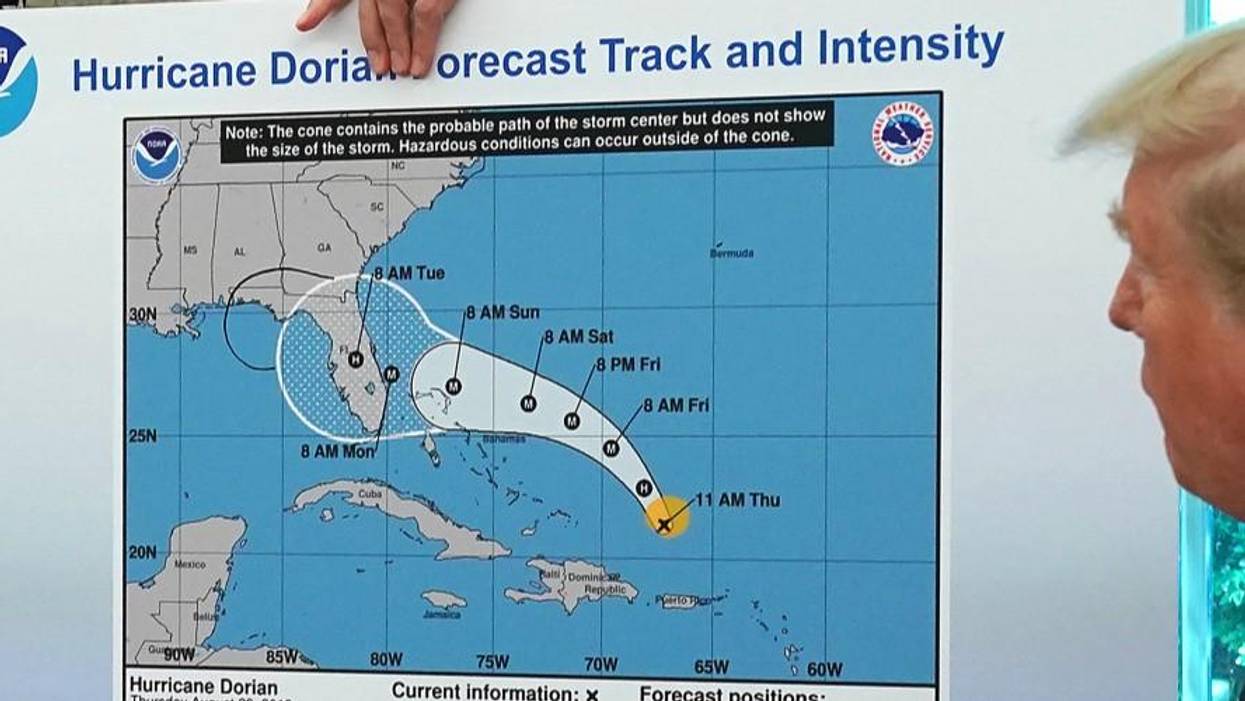
An independent investigation found Monday that the Trump-appointed leader of the National Oceanic and Atmospheric Administration and another former official violated the agency's scientific integrity policy last year when they released a statement backing up the president's claim that Hurricane Dorian was expected to hit Alabama.
Last September, Trump claimed Alabama would "most likely be hit (much) harder than anticipated" by the Category 5 hurricane, contradicting meteorologists' projections that the storm would mainly affect Florida.
After the National Weather Service's Birmingham, Alabama office tweeted that the president's claim was inaccurate, the president appeared in the Oval Office to display a map altered with a black marker to show the storm's path extended to include Alabama, in an incident widely derided as "Sharpiegate."
"We're about to be in another hurricane season and we're going to have more natural disasters like pandemics and there don't seem to be any consequences for manipulating the science, and that puts real communities, real people at risk."
--Andrew Rosenberg, Union of Concerned Scientists
According to the report Monday from the National Academy of Public Administration (NAPA), acting administrator Neil Jacobs and then-deputy chief of staff and communications director Julie Kay Roberts bowed to political pressure two days after the president's Oval Office appearance when they released a statement rebuking the National Weather Service.
"The Birmingham National Weather Service's Sunday morning tweet spoke in absolute terms that were inconsistent with probabilities from the best forecast products available at the time," said the statement.
NOAA's scientific integrity policy prohibits political interference in the agency's communications about its scientific findings. NAPA found that Roberts and Jacobs, a Trump appointee, violated the agency's code for science supervision and management by releasing the statement, which "compromised NOAA's integrity and reputation as an independent scientific agency."
"Dr. Jacobs and Julie Roberts did not believe it was a good idea to release a statement, but felt significant external pressure to do so," wrote Stephen M. Volz, NOAA's assistant administrator for satellite and information services, in a memo attached to NAPA's final report.
The report did not recommend any consequences for Jacobs and Roberts, instead recommending "scientific integrity training" at the agency and calling on the Commerce Department's inspector general to investigate such violations.
Andrew Rosenberg, a former NOAA administrator who joined two current employees and Rep. Paul Tonko (D-N.Y.) in calling on NAPA to investigate "Sharpiegate," expressed frustration that Roberts and Jacobs would not be held accountable for their actions.
"This is important stuff," Rosenberg, who now leads the Union for Concerned Scientists, told The Hill. "We're about to be in another hurricane season and we're going to have more natural disasters like pandemics and there don't seem to be any consequences for manipulating the science, and that puts real communities, real people at risk."
The report was released following numerous reports of Covid-19 infection and death rates being manipulated by state public health officials. Rebekah Jones, a government data scientist in Florida, said in May that she was fired for refusing to manipulate numbers "to drum up support for the plan to reopen."
In early May, the White House Council of Economic Advisors released a model showing Covid-19 deaths falling to zero by May 15. Since May 15, there have been about 20,000 new cases detected in the U.S. per day, and deaths have gone up to more than 116,000.
The retrospectives as the United States crosses the threshold of 100,000 deaths from the COVID-19 pandemic are moving and important, but they are missing something -- and it's not just the recognition that many of those deaths were avoidable.
It's the recognition -- the alarm, the feeling of panic -- that every day that goes by is another day that Donald Trump fails to lead, and that the federal government fails to take the steps that could save tens of thousands more lives in the weeks and months to come.
While we continue to lose people at the rate of about 1,000 every day, much of the Trump coverage has turned to other matters. What reporting there is about Trump and the virus has largely become about his astonishing lack of empathy, his unseemly rush to "reopen" and his sadistic campaign against mask-wearing -- all of which are legitimate stories.
But it's almost as if the D.C. media has forgotten what Trump and the federal government urgently need to do--and could be doing--to save people's lives.
As I have written repeatedly, experts in public health are essentially unanimous that minimizing the toll of the virus depends on forceful federal action to supercharge the supply chain for testing, massively increase the daily number of tests, mobilize a nationwide contact-tracing program and get infected people to self-isolate.
But when it comes to the virus, Washington is doing basically none of the things we need it to do.
An explanation of the Trump administration's testing strategy, required by Congress and released on Sunday, simply rephrased the intention to dump almost all the responsibility on the states.
In the New York Times, Apoorva Mandavilli and Catie Edmondson quoted Scott Becker, executive director of the Association of Public Health Laboratories, explaining that only the federal government is equipped to navigate national and international supply chains: "You can't leave it up to the states to do it for themselves. This is not the Hunger Games."
Meanwhile, major supply chain issues continue to slow testing initiatives around the country. A new survey of labs by the Association for Molecular Pathology found that supply chain disruptions "have had a significant impact on their testing capacity" and concluded that "additional resources are needed to implement and/or maintain testing."
"We have normalized a multiplicity of Trumpian excesses, abuses, and crimes over the past three and a half years. Will we now normalize mass deaths too?"
NPR's Joel Rose reported on Thursday about "a new bottleneck emerging: A shortage of the machines that process the tests and give results." Rose quoted dire warnings from Ashish Jha, director of the Harvard Global Health Institute, who called the problem "a classic market failure" that can only be resolved by the federal government:
"This is a place where I think the government just needs to step in and pay companies -- buy the machines for companies, or pay large amounts for these tests," Jha said. "This is what many of us have been asking for from the federal government. ... And it's very frustrating."
And Erik Ortiz wrote for NBC News that despite the importance of contract tracing, public health departments around the country "are wrestling with a lack of necessary resources from the federal government, a need for more qualified workers and a growing backlash of misinformation."
Ortiz noted "the absence of a cohesive national plan and coherent communication from the White House about the importance of contact tracing," and quoted Jeremy Konyndyk, a senior policy fellow at the Center for Global Development, calling it "a massive messaging failure from this administration."
Konyndyk told Ortiz that officials should have started preparing the public for the idea of tracing and the effort involved while most people were still isolating at home. "But the federal government chose not to own the issue," Konyndyk said.
Arguably the best overview of the continuing failure of the federal government to protect Americans I've seen recently came from William Wan and Carolyn Y. Johnson, in a Washington Post article on Wednesday that was ostensibly about how a vaccine won't solve everything. Read the whole thing. But let me pull out some of the key points:
There is, of course, no master plan.
"It's like we have attention-deficit disorder right now. Everything we're doing is just a knee-jerk response to the short-term," said Tom Frieden, former director of the Centers for Disease Control and Prevention. "People keep asking me, 'What's the one thing we have to do?' The one thing we have to do is to understand that there is not one thing. We need a comprehensive battle strategy, meticulously implemented."
All the sacrifices we have made thus far have essentially been for nothing.
Arriving at this moment of transition required countrywide shutdowns, soaring unemployment and devastating blows to our economy and mental health. All that effort was supposed to buy us time to think, plan and prepare, said Irwin Redlener, director of Columbia University's National Center for Disaster Preparedness.
"What's concerning is that I don't see any signs the federal government has learned any lessons and is doing anything differently to prepare for the next waves," he said.
Each of the "hundreds of cities and counties reopening" is like "a mini laboratory yielding valuable data on what will work against the virus in coming years." But the federal government has done nothing to help capture or interpret that data.
And you don't hear a word from Washington about the long-term changes that the virus may necessitate -- things like doors that don't require grasping a handle, traffic signals that pedestrians don't have to push, robots for meatpacking plants, routine diagnostic tests, and mandatory paid sick leave.
I wish more opinion writers had done what the USA Today editorial board did this week, using the passing of a somber threshold to judge Trump. The board wrote:
Now, with more than 100,000 Americans dead from the coronavirus epidemic and large sectors of the economy on life support, it's time to assess whether the president has lived up to his obligation and responsibility.
The inescapable conclusion is that he has not. Some disarray is inevitable during a rapidly evolving crisis, and COVID-19 is the worst health disaster the world has faced in a century. But Trump has compounded the damage by undermining his administration's scientists, heralding a risky antimalarial drug as a potential coronavirus game changer, ruminating about injecting patients with disinfectants, promoting magical thinking about the virus disappearing, and refusing to lead by example by wearing a mask in public....
Nearly five months into 2020, the president continues to claim vast authority while shuffling responsibility off to state and local officials. Even as Trump pushes for reopening businesses, schools and churches, the nation lacks the sort of comprehensive testing, tracing and isolating framework that public health officials say is needed to suppress outbreaks until there's a vaccine or cure.
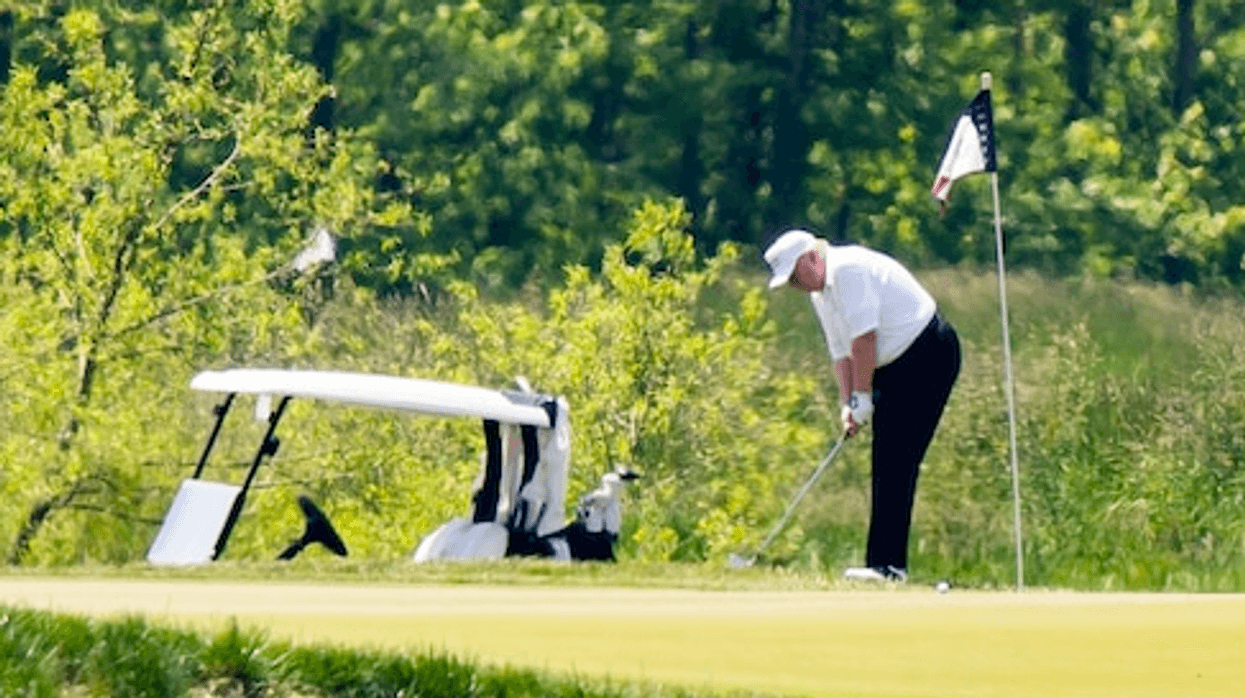
Trump, himself, has almost completely ignored the passing of the threshold. Ashley Parker noted in the Washington Post on Thursday that he "has focused much of his time in recent days on matters other than the coronavirus," for instance by spending the Memorial Day weekend playing golf and "attacking rivals in deeply personal and at times sexist terms."
But that doesn't mean that political reporters should follow his lead.
Mehdi Hasan of the Intercept asked a heart-breaking question on Wednesday: "We have normalized a multiplicity of Trumpian excesses, abuses, and crimes over the past three and a half years. Will we now normalize mass deaths too?"
The answer from news organizations should be a resounding "No."
President Donald Trump on Monday lashed out against those criticizing his decision to play golf over the weekend by blaming his predecessor Barack Obama for failing to defeat Islamic State forces and accusing his 2020 Democratic rival Joe Biden of having a "poor work ethic."
After footage emerged over the weekend of Trump golfing even as the nation's Covid-19 death toll neared 100,000 people, critics of the president pounced at the opportunity to denounce the decision and highlight his ongoing mismanagement of the pandemic crisis and indifference to its victims.
"The Fake & Totally Corrupt News makes it sound like a mortal sin [to play golf]," Trump tweeted Monday. "I knew this would happen! What they don't say is that it was my first golf in almost 3 months." Trump called journalists who reported on his trip to the links as "truly deranged" people who are "sick with hatred and dishonesty" aimed at him personally.
Deflecting the criticisms he widely faced, Trump in his Monday morning tweets took aim at Obama and "Sleepy Joe" Biden.
Independent journalist Judd Legum said sarcastically that the entire thread was a "poignant Memorial Day tribute by President Trump."
On Saturday night, Biden's campaign released a new campaign ad targeting Trump's golf game:
The golfing-while-president controversy is nothing new, of course, as the New York Times noted on Sunday:
Golfing during a crisis has always proved problematic for presidents. Dwight D. Eisenhower was criticized for playing after the Soviet Union launched Sputnik. George W. Bush gave up golfing during the Iraq war to avoid looking insensitive to the troops and their families. Barack Obama was excoriated for golfing after an American was beheaded by terrorists in the Middle East.
Among those who regularly assailed Mr. Obama for golfing was Mr. Trump--by one count, 27 times. "Can you believe that, with all of the problems and difficulties facing the U.S., President Obama spent the day playing golf," Mr. Trump wrote in 2014.
As anti-war critics have stated throughout Trump's tenure as commander-in-chief, the president's "bankrupt" foreign policy--including his assault on ISIS forces in the Middle East and Africa--has been marred by callousness and cruelty that sacrificed untold numbers of civilians in Syria, Iraq, Afghanistan, Somalia, and elsewhere to U.S. bombardment and massacre.
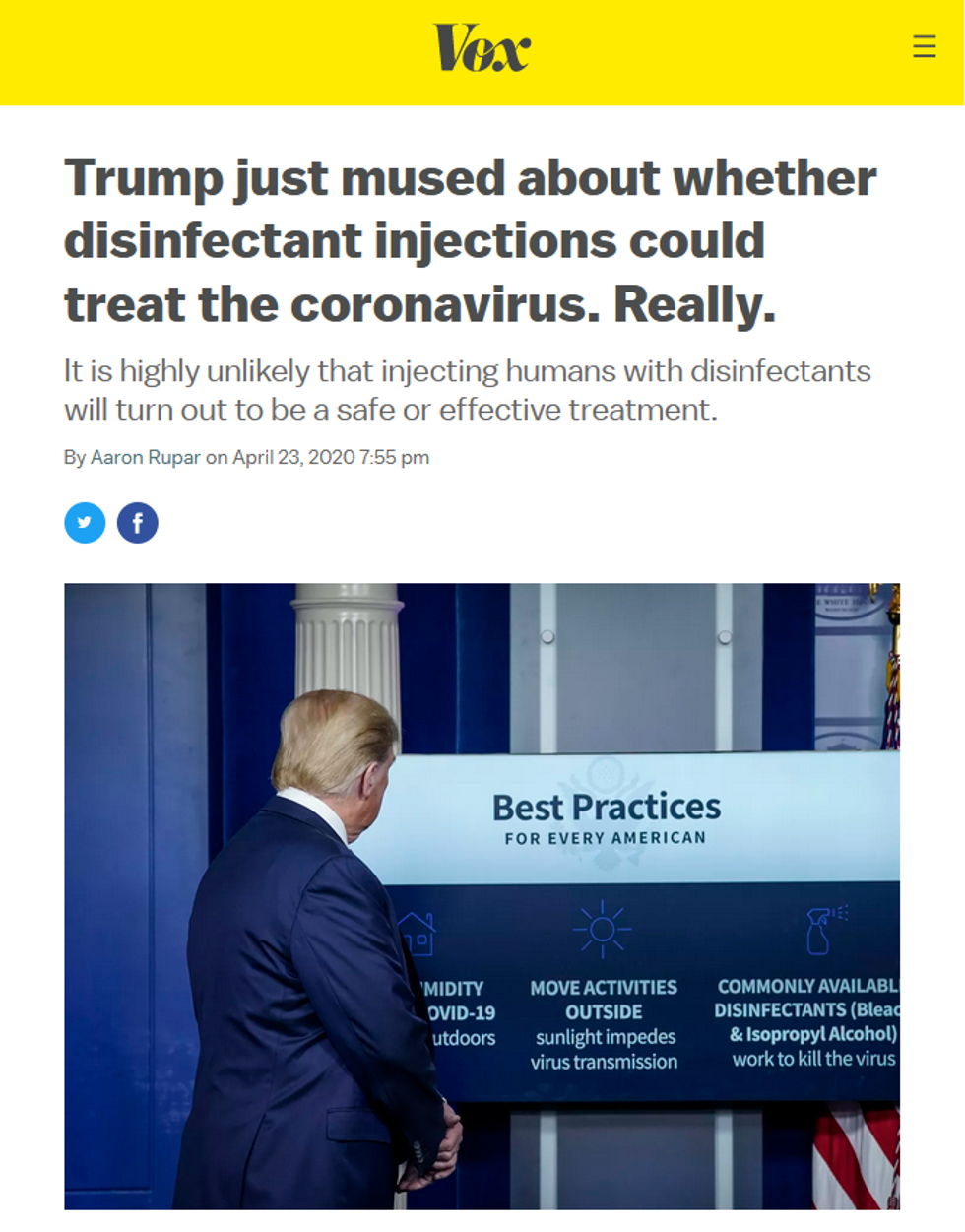
You probably saw Donald Trump's ridiculous, false and deadly claim last week: that ingesting chemical cleaners could cure humans of the coronavirus. At a White House press briefing on Thursday (4/23/20), the president said:
I see disinfectant, where it knocks it [coronavirus] out in a minute--one minute--and is there a way we can do something like that by injection inside, or almost a cleaning. Because you see it [coronavirus] gets in the lungs and it does a tremendous number on the lungs, so it'd be interesting to check that.
He also suggested that exposing patients to bright lights could help cure them, once again confusing what works on surfaces like tables with the inside of a human body.
It's worth taking a step back for a second and pausing on the fact that the person in charge of the United States thinks injecting bleach might be a good idea. Trump has consistently spread false information about the pandemic, claiming in February that it would be gone by April due to the warmer weather, and insisting that "we'll essentially have a flu shot for this in a fairly quick manner."
His pronouncements have already been fatal: After promoting the drug chloroquine, an Arizona man died and his wife was hospitalized after they ingested fish tank cleaner that contained the substance. Surely more deadly but harder to quantify are his outbursts proclaiming that states should "LIBERATE" themselves from oppressive lockdown measures (some of the lightest in the developed world), encouraging people to go out and demonstrate, thereby spreading the virus.
Unfortunately, for journalists stuck in a corporate media system that promotes deference to authority and finds equivalency even when there is none, the president's dangerous ramblings need to be treated as legitimate and worthy of discussion, even in apparently adversarial media. Vox (4/23/20), for example, said that it was only "highly unlikely that injecting humans with disinfectants will turn out to be a safe or effective treatment." The Washington Post (4/24/20) described Trump's statement as an "unsubstantiated and potentially dangerous" idea. At the risk of stating the obvious, it is not "highly unlikely" but impossible, and Trump's idea is not merely "potentially" dangerous: No amount of bleach is safe to inject into your body. It will kill human beings, as chemical cleaning product manufacturers immediately warned. (The Post did include a disclaimer: "Do not ingest any bleach or disinfectant.")
Despite this, USA Today (4/24/20) presented the story as a he-said she-said between two opposing views, describing (4/24/20) Trump's ludicrous outburst merely as "the latest in a pattern of questionable claims." "We should inject bleach for our health" is not a "questionable" claim, and would not be treated as such if someone without power or influence made it.
Perhaps the worst offender of phony both-sidesism, however, was the New York Times (4/24/20), which described the president as "eagerly theorizing--dangerously, in the view of some experts--about the powers of sunlight, ultraviolet light and household disinfectants to kill the coronavirus."
In other words: "Can injecting bleach kill you? On the one hand, definitely yes. On the other, here is a dummy who thinks it will save you from Covid-19, so let's teach the controversy." Refusing to state categorically that ingesting known deadly substances is a bad idea, the wording of the Times article suggests that only "some experts" disagree with the idea, while there are other, pro-bleach drinking authorities out there.
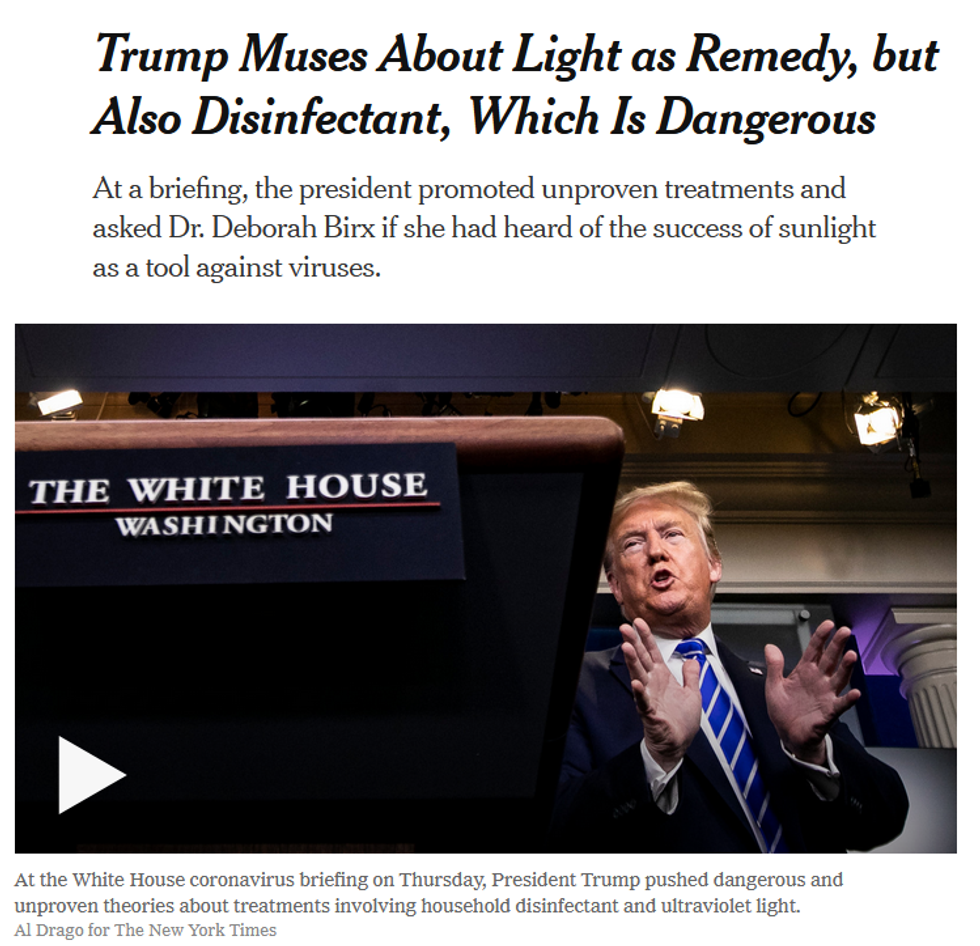
After widespread pushback on social media, the Times amended the offending paragraph, but, if anything, made it worse, changing it to Trump "eagerly theorizing about treatments involving the powers of sunlight, ultraviolet light and household disinfectant that could be harmful if they were used to try to kill the coronavirus." Injecting bleach "could" be harmful under certain circumstances, but who knows? Certainly not us at the New York Times.
This sort of reporting would be absurd beyond belief in other circumstances involving people without serious power. For example, there were no Times reports stating that, "at the Jonestown camp in Guyana, Rev. Jones eagerly theorized about the benefits of cyanide-laced Kool-Aid that could be harmful in certain circumstances."
Even CNN's Anderson Cooper (4/23/20), who has emerged as one of Trump's most visible and aggressive critics, was anxious not to give an opinion, so strong is the culture of supposed "neutrality" in journalism. He asked his guest, "Is there any evidence about taking a disinfectant that's used on the table where I'm sitting, and using it internally? That doesn't seem like a good idea. Am I wrong?"
Cooper, like any adult, knows full well that it is a bad idea, but the spectacle of a CNN anchor asking a doctor about drinking bleach is a bizarre example of what can happen when you combine practices of deference to authority, both-sidesism, and a pretense of neutrality.
The failure of corporate media to call a spade a spade for fear of losing their status as objective arbiters of news has, of late, led to clearly racist actions and statements being laundered as "racially charged" or "racially tinged" or even just "race-related" (FAIR.org, 4/5/19, 11/1/19; CounterSpin, 7/23/19). Likewise, ICE concentration camps are described as "detention centers" (CounterSpin, 1/5/20), which has the effect of making them sound like places unruly school kids who fail to do their homework are sent.
To corporate media: It is OK. Facts are facts, even when the president of the United States disagrees. You don't have to both-sides this one. Injecting bleach is bad.
My partner and I have been fighting about politics since we met in 1965. I was 13. She was 18 and my summer camp counselor. (It was another 14 years before we became a couple.) We spent that first summer arguing about the Vietnam War. I was convinced that the U.S. never should have gotten involved there. Though she agreed, she was more concerned that the growth of an antiwar movement would distract people from what she considered far more crucial to this country: the Civil Rights movement. As it happened, we were both right.
She took off that fall for college at the University of California, Berkeley, where, as she says, she majored in history with a minor in rioting. I went back to junior high school. And we've been arguing about politics ever since.
So maybe it's no surprise that, since the coronavirus pandemic exploded, we've been fighting about the president. Not about his character (vile and infantile, we both agree) or his job performance (beyond dismal), but about whether anyone with a conscience should watch his never-ending television performances. Since 2016, she's done her best not to expose herself to either his voice or his image, and she's complained regularly about the mainstream media's willingness to broadcast his self-evident lies, to cover any misconceived or idiotic thing he might decide to say at rally after rally as if it were actual news. More recently, she's said the media should send their interns to cover his Covid-19 "news" conferences. (Of course, MSNBC and CNN now no longer always broadcast those events, whose ratings the president so treasures, in full. In fact, by April 13th, CNN appeared to have let their chyron writer off the leash to run legends below that day's news conference like "Angry Trump turns briefing into propaganda session" and "Breaking news: Trump refuses to acknowledge any mistakes.")
For a couple of weeks now, I've been watching each live broadcast of the Trump Follies, otherwise known as the White House daily coronavirus task force briefings. Readers who, like me, remember the Vietnam War may also recall the infamous "Five O'Clock Follies," the U.S. military's mendacious daily briefings from the South Vietnamese capital, Saigon, during that endless conflict. There, its spokesmen regularly offered evidence, including grimly inflated "body counts" of enemy dead, that allowed them to claim they were winning a losing war. The question today, of course, is whether the present pandemic version of those follies offers at least a small glimmer of hope that the president may now be mired in his own Covid-19 version of Vietnam.
After I've spent a couple of irretrievable hours of my life gaping at the muddled mind of Donald Trump, I always feel a sickening sensation, as if I'd kept eating Oreo cookies long after they stopped tasting good. But it doesn't matter. The next day, I just turn it on again. I wonder if it's people like me who are responsible for that TV ratings bump of his?
It took my partner a while to catch on to what I've been doing. The reason: like an alcoholic whose bottles are stuffed away in secret corners, I've been hiding this perverse habit by sneaking down to the basement and watching while working on my loom. Or I would catch my Trump fix while she was out on the streets of San Francisco taking photographs for her 10-year project to both walk and record every voting precinct in the city.
But one evening, returning a little early, she walked in on me before I had time to slam the laptop cover down. "Nobody should be watching those press conferences!" she said emphatically, when she twigged to what I'd been up to. "How can you sit there and listen to lies? Why are you exposing yourself to that crap? Anything you actually need to know you can read in newspaper summaries the next day."
What's the Appeal?
And I have to admit that those were fair questions. Why am I exposing myself to such a pure, unmediated stream of falsehoods, ignorance, and preening self-congratulation day after day? Why, though I loathe his lies as much as she does, do I keep listening to them in real time? As he typically said at the Centers for Disease Control and Prevention on March 6th, "Anybody that wants a [coronavirus] test can get a test"; "The tests are all perfect. Like the letter was perfect. The transcription was perfect, right?... This was not as perfect as that, but pretty good." (No one knows what "letter" he was referring to, though he probably meant the summary transcript of his phone call to Ukrainian president Volodymyr Zelensky.)
Why don't I switch the press conferences off when he begins to praise and congratulate himself as he always does? ("I've felt it was a pandemic long before it was called a pandemic"; "Every one of these [CDC] doctors said, 'How do you know so much about this?' Maybe I have a natural ability. Maybe I should've done that instead of running for president.")
Why am I fascinated by the way just about everyone on the podium fawns all over him, starting with Vice President Mike Pence, the titular head of "the president's" Coronavirus Task Force (unless, this week, it's Jared Kushner)? Why do I keep listening to Pence intoning, "The president has directed that..." or referring to "President Trump's 15-day coronavirus guidelines," as if Trump himself had written them and designed the oversized postcard outlining them, which arrived in people's mail at the end of March? Why am I mesmerized as assorted business "leaders" like MyPillow CEO Mike Lindell trip over themselves outdoing each another in praising the president? Lindell, in fact, used his minute and a half of fame to tell the world that God had essentially elected Donald Trump in 2016. (I guess that explains it! I knew I hadn't voted for him.)
I think what provides me (and so many others) with that nightly hit of dopamine is the sheer brazenness of the president's lies on show for all to see. Not for him the mealy-mouthed half-truth, the small evasion. No, his are, like the rest of his persona, grandiose in a way that should be beyond belief, but remains stubbornly real.
Here he is, for instance, in mid-March, speaking of Americans flying back from Europe: "If an American is coming back or anybody is coming back, we're testing. We have a tremendous testing setup where people coming in have to be tested... We're not putting them on planes if it shows positive, but if they do come here, we're quarantining." Anyone who saw the photos of weary travelers crammed together in U.S. airports then knows that none of this was faintly accurate. But no matter.
Then there's Trump's use of those television performances and the audiences they garner as the ultimate measure of presidential achievement. By now, who isn't familiar with his delight in the ratings the coronavirus press briefings have attracted? As he tweeted on March 29th:
"Because the 'Ratings' of my News Conferences etc. are so high, 'Bachelor finale, Monday Night Football type numbers' according to the @nytimes, the Lamestream Media is going CRAZY. 'Trump is reaching too many people, we must stop him,' said one lunatic. See you at 5:00 P.M.!"
So it's no surprise that he also uses media ratings as the metric by which he judges the performance of everyone working to slow down the spread of the coronavirus. For him, governing is nothing but a performance. At his March 29th briefing, for example, he gave himself credit for the media attention being paid to New York Governor Andrew Cuomo and someone he called "the General" (whose name he seemed to have forgotten). After observing that the Washington Post, like my partner, thinks Americans should shun his pressers, he pointed out that he'd inaugurated other people's TV careers:
"We're getting the word out. We're getting the accurate word out. And a lot of people are happy about it, and a lot of people aren't. But they should be happy. When I have the General, when I have Seema [Verma, head of Medicare and Medicaid Services], and when I have Tony [Fauci], and when I have our -- our incred- -- these are, like, people that have become big stars, okay?"
Then there's the astonishing ignorance he's so happy to put on display regularly, as at the April 10th task force briefing. Asked whether "reopening" the country would depend on having enough Covid-19 tests available to make it possible to do surveillance and contact tracing, he replied that such tests would be unnecessary in "vast areas of the country" because they don't (yet) have outbreaks. Given that no state by then lacked coronavirus cases, it was yet one more display of his inability to grasp the basics of the potential for exponential growth in a highly contagious disease.
Finally, there's the eternal assumption in just about everything he says that no one could possibly know more about any subject than he instantly grasps. In a terrifying exchange on April 10th, a reporter asked what metrics he would use in deciding when and how to reopen the country, a decision he had just falsely claimed he has "absolute authority" to enforce.
"The metrics right here," he replied, pointing to his temple and, presumably, the brain behind it. "That's my metrics. That's all I can do. I can listen to 35 people. At the end, I got to make a decision." He went on to explain that he had just figured out how big a decision it was. "And I didn't think of it until yesterday. I said, 'You know, this is a big decision.'" Who could possibly have known how big a decision it was until that very moment when the president claimed to have grasped that reality?
Strange Attractors
In the end, maybe what truly draws me to those news conferences and keeps me hooked is the cognitive dissonance of it all. I've never been a fan of reality TV, partly because I don't like watching people be mean to one another, but mainly because what happens on such shows is anything but "real." Mean (or "nasty") as he may be, Trump's press conferences are real. And isn't that the contradiction, the eerie fascination, of it all -- that the unbelievable is actually true? Donald Trump is, in fact, the president of the United States, even if watching each of those televised events is like encountering a creature from another dimension, a being who simply doesn't conform to earthly reality. And that, in a terrifying way, is fascinating. I can't look away.
The field of mathematics called chaos theory, which deals with extremely complex, dynamic systems like the movements of liquids or gasses, has a concept called "strange attractors." An attractor is a point that a graph of the system keeps cycling around and returning to over time. (Not being a mathematician, that's the best I can do.) Strange attractors are fractal, meaning that each part of one of them will display the same pattern no matter how much you magnify it, no matter how deep you go -- in other words, very much like the mind of Trump.
Some strange attractors are part of chaotic systems that don't repeat at any regular interval and will vary greatly over time. The weather is like that; a small difference in temperature or pressure at a given moment can affect whether a local change becomes a hurricane. But if a chaotic system has strange attractors, then, over many years, the same initial conditions will most often settle into one of two results, the equivalents of a clear day or a bad storm. You can't say what will happen in any given year, but you can say what is most likely to happen over 100 years. As Wikipedia puts it, "Thus a dynamic system with a chaotic [strange] attractor is locally unstable yet globally stable."
Should -- the gods and statistics forbid -- Trump win reelection this November, we'll have a real-life example of a system that is locally unstable, but globally horribly stable for the next four years. In his case, of course, we're talking about how a "very stable genius" will be able to spin the chaos he creates into an ever more authoritarian regime.
Oh, and as that Wikipedia article adds, "Strange attractors may also be found in the presence of noise..." Let me apologize instantly for perverting some poor mathematician's meaning, but how can I not point out that our presidential Strange Attractor is indeed surrounded by the constant noise of the media, fake and otherwise, cycling around and feeding off the one constant point that is Trump in the chaos of his universe.
So who's right, my girlfriend or me? Just as was true years ago, I suspect we're both right. No one should engage with that chaotic noise and the strange attractor at its center. All of us should deprive Donald Trump of attention of every sort, which is the oxygen that sustains him. And yet, someone has to watch, because strange as it is, our lives depend on it.
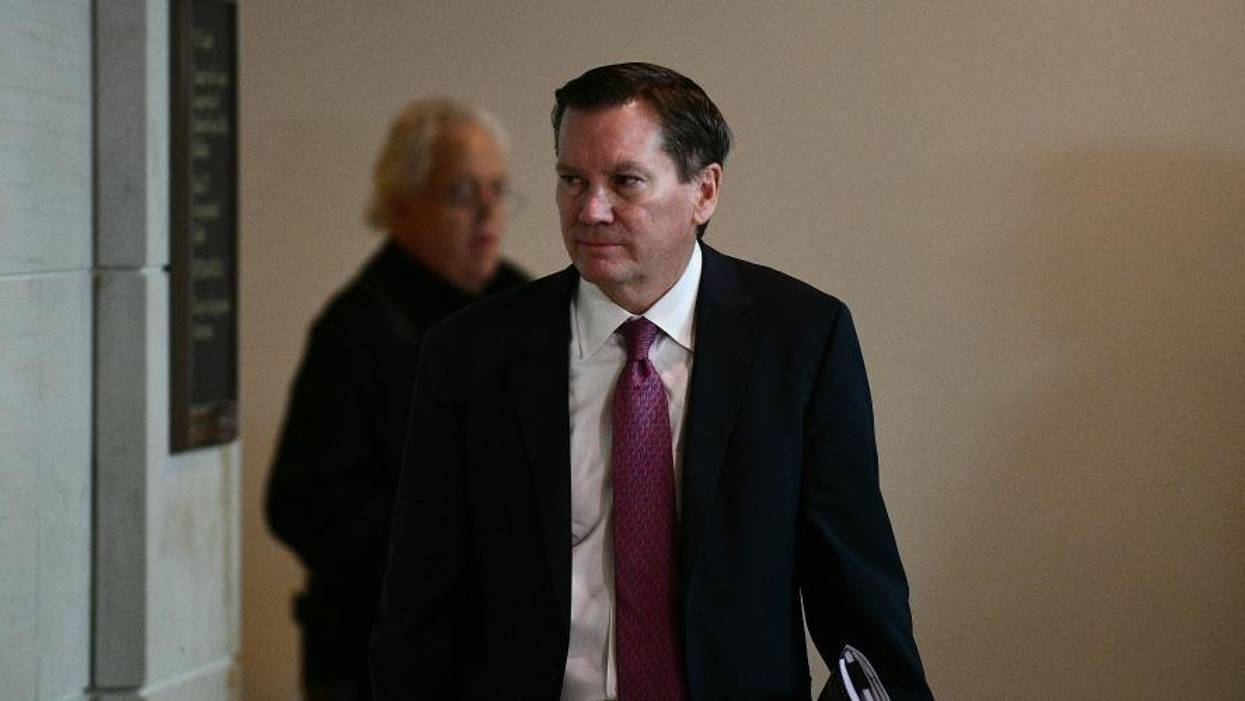
Democratic lawmakers and government watchdogs on Saturday condemned President Donald Trump's abrupt dismissal of Michael Atkinson, the intelligence community inspector general who informed Congress last year of the whistleblower complaint which kicked off Trump's eventual impeachment proceedings.
Two months after being acquitted by the Senate, Trump on Friday night told lawmakers in a letter to the House and Senate Intelligence Committees that he no longer had confidence in Atkinson.
"It is vital that I have the fullest confidence in the appointees serving as inspectors general," the president wrote (pdf). "That is no longer the case with regard to this inspector general."
Atkinson's firing will be in effect in early May, 30 days from Trump's announcement.
Rep. Adam Schiff (D-Calif.), chair of the House Intelligence Committee, condemned Trump's decision, which he viewed as retaliation against Atkinson for informing Congress of the White House communications with Ukraine last year which were at the center of the impeachment hearings.
Disagreeing with then-acting Director of National Intelligence Joseph Maguire's decision to take the whistleblower complaint to Trump's Justice Department, Atkinson alerted Congress about the complaint regarding Trump's conversations with Ukrainian President Volodymyr Zelensky, in which he asked Zelensky to publicly launch a corruption investigation into former Vice President Joe Biden and his son, Hunter.
Daniel Goldman, who served as counsel to the House Democrats during the impeachment hearings, said Atkinson "followed the law with the utmost integrity" and accused Trump of seeking "pure retaliation, retribution, and reprisal."
Trump was also rebuked by the Council of the Inspectors General on Integrity and Efficiency.
"Inspector General Atkinson is known throughout the Inspector General community for his integrity, professionalism, and commitment to the rule of law and independent oversight," said council chairman Michael Horowitz. "That includes his actions in handling the Ukraine whistleblower complaint, which the then Acting Director of National Intelligence stated in congressional testimony was done 'by the book' and consistent with the law."
National security analyst Clint Watts wrote that Trump chose to fire Atkinson while Americans are focused on the coronavirus pandemic, which has spread to more than 278,000 Americans and has killed more than 7,000.
"While the world is rightly distracted by COVID19, we see leaders around the world with authoritarian tendencies subverting democracy. U.S. is no different," Watts tweeted, suggesting a comparison between Trump and far-right Hungarian Prime Minister Viktor Orban, who secured dictatorial powers this week through an emergency law passed by Parliament.
At the Center for Responsibility and Ethics in Washington (CREW), deputy director Donald K. Sherman suggested the American public could soon learn that Atkinson's firing may have been brought about by actions unrelated to last year's whistleblower complaint and Trump's impeachment.
"The question we need to ask right now is what investigations or audits did Atkinson start in the last few months," Sherman wrote. "Were any related to intelligence failures around coronavirus? Why would he be fired so abruptly AND placed on administrative leave?"