SUBSCRIBE TO OUR FREE NEWSLETTER
Daily news & progressive opinion—funded by the people, not the corporations—delivered straight to your inbox.
5
#000000
#FFFFFF
To donate by check, phone, or other method, see our More Ways to Give page.
The headline, from the Los Angeles Times, hit me like a sucker punch: "Voters' 'Bernie or Bust' efforts persist despite Sanders' vow not to be another Ralph Nader."
Actually, it was worse than that. When my brain cleared, I realized I was, once again, caught in a media straitjacket.
"The extraordinary Sanders campaign has demonstrated that small money -- affordable donations from millions of people who aren't simply frustrated by the status quo but envision a future that is environmentally sustainable, compassionate and fair to everyone -- is the antidote to Big Money, which cares primarily about perpetuating its own interests."
In just over a dozen words, the paper managed not only to trivialize everything two presidential candidates stood for, and not only to reference the myth that Nader caused Al Gore to lose an election he didn't in fact lose, but also, my God, to obliterate the last six months of a presidential campaign that had permanently shaken up the political status quo and return progressive voters to a place of permanent irrelevance to the national future.
In light of his recent primary losses, Sanders will almost certainly lose the Democratic presidential nomination, and he has said he would support Hillary Clinton if that's the case, the story explains. However: "Some of his supporters remain so steadfast, however, that a #BernieOrBust movement has picked up momentum on Twitter. So has an online pledge for supporters who vow to vote for Sanders as a write-in candidate if he loses the nomination."
Don't they know how American democracy works? Real change isn't part of the game. The mainstream media looks on in fascination at those (mostly young people) who don't get this yet and seem to think that something more is at stake than which preselected big-money candidate wins the election.
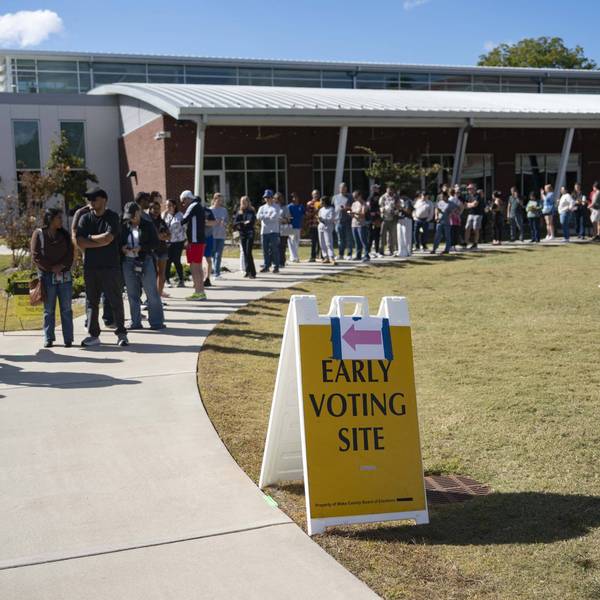
Hamid Dabashi, writing at Al-Jazeera English, described the Democratic and Republican parties as "competing Orwellian Ministries of Truth." He noted that Clinton's decisive victory in New York state last week occurred not only amid election chaos (126,000 registered Democrats purged from the voting list in Brooklyn), but that it was a closed primary. Independents were not allowed to vote, neatly stiffing much of the Sanders base.
"Clinton has won every state so far that's held a closed primary," he pointed out, adding darkly:
"These 'closed primaries' are the bottlenecks of a closed political culture, preventing the possibility of any liberating breakthrough into a foreclosed political system."
This is serious. The political culture has been in the process of closing throughout my lifetime, locking the American empire into place. Dabashi writes: "At the heart of this imperial republic that effectively rules the world with its military might (not with any moral courage or political legitimacy), we have an electoral process that systematically bars any critical judgment of its own citizens to disrupt its mindless militarism. American citizens are as much trapped inside this corrupt system as people around the globe are at the mercy of its fighter jets and drone attacks."
Money and militarism rule and the American experiment in democracy, at least as defined by the mainstream media, shrugs in acquiescence. The game of meaningless winning and losing is pretty much all that's left of it. The military budget is not up for discussion, let alone debate. Neither is the political budget.
"At their core," writes Geoff Gilbert at Truthout, "political parties are fundraising and marketing mechanisms. Over the years, the Democrats and Republicans have achieved fundraising economies of scale that have effectively barred the entry of any would-be competitors. Their collective fundraising monopoly -- combined, they spent $7 billion during the 2012 election cycle -- has allowed them to dominate the political discourse by financing campaigns, reaping brand recognition from the political advertising that accompanies campaigns, and thereby establishing their legitimacy as the parties who run candidates and do the governing of our country."
Gilbert goes on to make an extraordinary suggestion. The Sanders campaign has been called a revolution. Maybe there's a less amorphous term for what it really is, whether he wins or loses the 2016 presidential nomination: the foundation of a new political party, which would bring a progressive voice back into American politics at every level and, at the same time, help unify "our currently fragmented movement cultures."
Gilbert writes: "By exploiting the Democratic Party's name recognition, Sanders appears to have escaped the third party catch-22: He has achieved widespread name recognition without first having to raise money from the usual big donor suspects."
He adds that "Sanders' fundraising throughout the primary process, completely independent of the two-party fundraising channels, has been nothing short of historic. In effect, the campaign has already created the skeletal fundraising infrastructure that is the backbone of any political party."
Gilbert also suggests that the campaign -- that this newly emerging political party -- "deliberately bypass the corporate mass media as a mechanism for spreading its ideas" and create its own permanent voice via the Internet, e.g., a 24-hour YouTube channel or something equivalent.
In short, the extraordinary Sanders campaign has demonstrated that small money -- affordable donations from millions of people who aren't simply frustrated by the status quo but envision a future that is environmentally sustainable, compassionate and fair to everyone -- is the antidote to Big Money, which cares primarily about perpetuating its own interests.
Small money, flowing from millions of sources, may be the way to force open a closed and cynical political culture. This is the value of Bernie's ongoing campaign. And it's why the corporate status quo and its media spokespeople are so scared of it and keep announcing that it's over.