SUBSCRIBE TO OUR FREE NEWSLETTER
Daily news & progressive opinion—funded by the people, not the corporations—delivered straight to your inbox.
5
#000000
#FFFFFF
To donate by check, phone, or other method, see our More Ways to Give page.
Daily news & progressive opinion—funded by the people, not the corporations—delivered straight to your inbox.
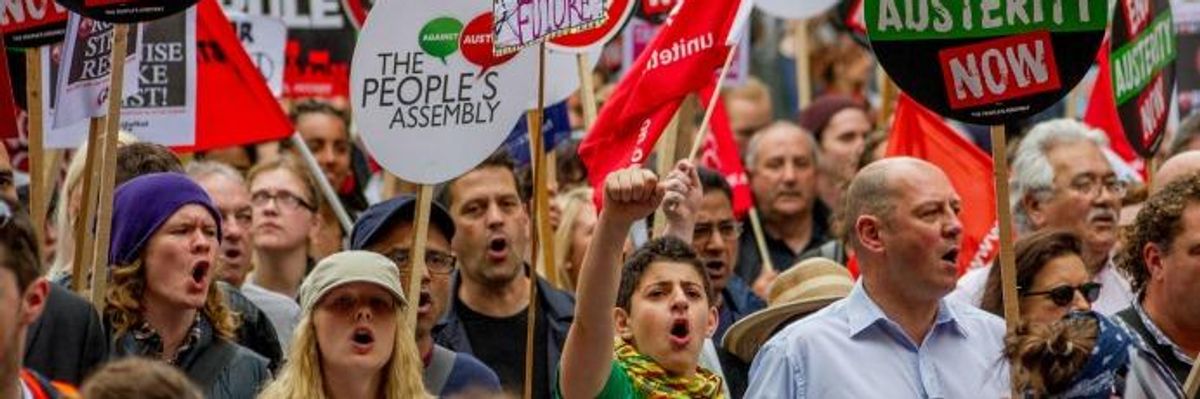
Anti-austerity demonstrator march in London in 2015. (Photo: Michael Candelori/flickr/cc)
The poet Fernando Pessoa taught us that no stupid idea can gain general acceptance unless some intelligence is mixed in with it. So how can it be that austerity appears to have been generally accepted? Objectively it is a bankrupt policy - the data is clear on this - and yet it continues to be part and parcel of our daily lives.
It happens that we now know what was already obvious for a while: that austerity is not only inadequate as a policy method to exit economic crises but that its continuation depends almost entirely on the inability of politicians to abandon the political capital thus far invested in advocating for it. It was true in Greece, in Portugal and it is true today everywhere in Europe. While the International Monetary Fund [IMF] now publicly condemns the austerity policies that the Troika of lenders - which incidentally included the IMF - forced down the throat of peripheral Eurozone economies, almost nothing has been done to turn away from them. Instead, we hear our leaders proclaim the end of the crisis as if we live in a black and white world which offers us simple binary options like: crisis/no crisis as if we were able to turn it on and off as we pleased.
Isn't today's tragedy precisely that we are all very well aware of the cost of austerity, but nonetheless cannot bring our liberal establishments to admit that it was plain wrong? The Greek case shows that the political capital spent on pursuing austerity policies is - at least in part - the reason why such political investment cannot be renounced so easily. It would be like admitting that all the work that you've done was in fact a lie. And with elections around the corner, we all know that no political figure will admit to such blunders when power is up for grabs.
We seem to be living in Guy Debord's 'society of the spectacle' - except that in this case it is not that we are slaves to technological advancements alone and therefore act like we are doing - but also to our own political system whose functionaries operate within a framework of power struggles.
We could talk about the real issues of our time, like lack of investment, poverty, climate change and so on, but the ruling liberal establishment prefers instead to extend and pretend the lie of austerity in order to convince voters that it was indeed a correct policy to pursue - no matter what the evidence actually says. The outcome of such extend and pretend politics is what we are seeing emerge everywhere in the world today: a widespread resentment towards the ruling liberal establishment embodied by populist monsters whose racist, authoritarian and xenophobic politics are finding a voice in our communities.
So what is the answer amidst this failed politics? The answer can only be a Progressive International whose narrative deeply penetrates this warped version of reality. We must talk about this, endlessly. We must repeat it ad nauseum to dismantle the layers of propaganda that we are fed day in - day out. If we don't do this we will fail miserably in our quest to change Europe and the world. There's no time to lose.
This country and this world are at a monumental crossroads. US voters have an opportunity to beat back the forces of fascism and confront the billionaires who are rigging the economy, our media system, and our democracy, making it increasingly impossible for ordinary people to get by. We’re not just talking about the election. We’re talking about what must be done once these fascist elements are vanquished from power. We need a bolder set of solutions than what either major party has so far been willing to offer and a working-class movement ready to fight like hell for it. Trump didn't emerge from nowhere. The conditions that fueled MAGA authoritarianism were created by decades of radical neoliberal economic policies and a corrupt political system dominated by corporate interests. They slashed taxes on the super-rich, promising that the benefits would trickle down. They said giveaways to the corporate titans would make life more affordable for the rest of us. It was all bullshit. And when a bitter, betrayed populace searches for someone to blame, right-wing demagogues have little trouble finding scapegoats. People know when they're being lied to, but you won't hear any of this from the corporate media. Only independent journalism—powered and funded by people who believe in building a better world—can deliver truly trustworthy daily news. If you share our vision, please contribute whatever you can to sustain our work. |
The poet Fernando Pessoa taught us that no stupid idea can gain general acceptance unless some intelligence is mixed in with it. So how can it be that austerity appears to have been generally accepted? Objectively it is a bankrupt policy - the data is clear on this - and yet it continues to be part and parcel of our daily lives.
It happens that we now know what was already obvious for a while: that austerity is not only inadequate as a policy method to exit economic crises but that its continuation depends almost entirely on the inability of politicians to abandon the political capital thus far invested in advocating for it. It was true in Greece, in Portugal and it is true today everywhere in Europe. While the International Monetary Fund [IMF] now publicly condemns the austerity policies that the Troika of lenders - which incidentally included the IMF - forced down the throat of peripheral Eurozone economies, almost nothing has been done to turn away from them. Instead, we hear our leaders proclaim the end of the crisis as if we live in a black and white world which offers us simple binary options like: crisis/no crisis as if we were able to turn it on and off as we pleased.
Isn't today's tragedy precisely that we are all very well aware of the cost of austerity, but nonetheless cannot bring our liberal establishments to admit that it was plain wrong? The Greek case shows that the political capital spent on pursuing austerity policies is - at least in part - the reason why such political investment cannot be renounced so easily. It would be like admitting that all the work that you've done was in fact a lie. And with elections around the corner, we all know that no political figure will admit to such blunders when power is up for grabs.
We seem to be living in Guy Debord's 'society of the spectacle' - except that in this case it is not that we are slaves to technological advancements alone and therefore act like we are doing - but also to our own political system whose functionaries operate within a framework of power struggles.
We could talk about the real issues of our time, like lack of investment, poverty, climate change and so on, but the ruling liberal establishment prefers instead to extend and pretend the lie of austerity in order to convince voters that it was indeed a correct policy to pursue - no matter what the evidence actually says. The outcome of such extend and pretend politics is what we are seeing emerge everywhere in the world today: a widespread resentment towards the ruling liberal establishment embodied by populist monsters whose racist, authoritarian and xenophobic politics are finding a voice in our communities.
So what is the answer amidst this failed politics? The answer can only be a Progressive International whose narrative deeply penetrates this warped version of reality. We must talk about this, endlessly. We must repeat it ad nauseum to dismantle the layers of propaganda that we are fed day in - day out. If we don't do this we will fail miserably in our quest to change Europe and the world. There's no time to lose.