SUBSCRIBE TO OUR FREE NEWSLETTER
Daily news & progressive opinion—funded by the people, not the corporations—delivered straight to your inbox.
5
#000000
#FFFFFF
To donate by check, phone, or other method, see our More Ways to Give page.
Daily news & progressive opinion—funded by the people, not the corporations—delivered straight to your inbox.
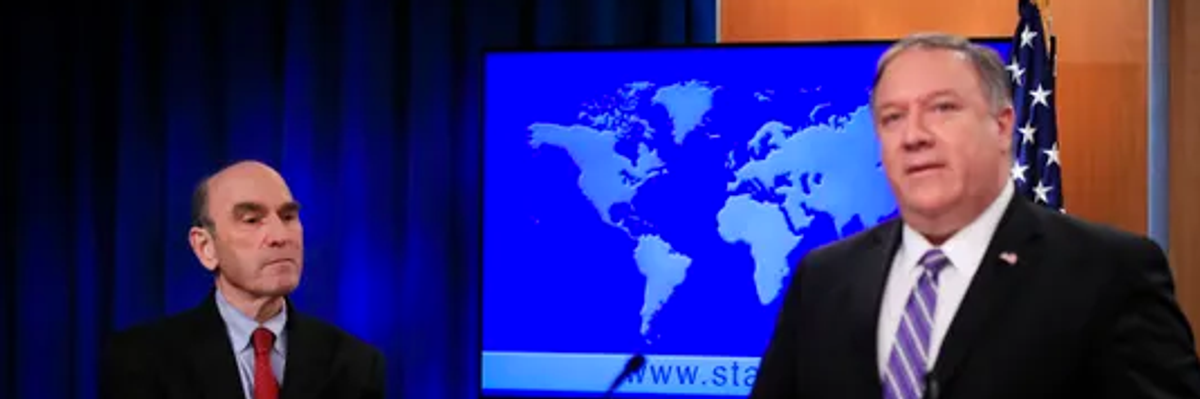
Elliott Abrams, left, listens to Secretary of State Mike Pompeo talk about Venezuela at the State Department in Washington, Friday, Jan. 25, 2019. (Photo: Manuel Balce Ceneta, AP)
The Trump administration is currently working to overthrow Venezuelan President Nicolas Maduro in the name of freedom and democracy. Yet Washington's efforts will only lead to bloodshed and a worsening of the country's crisis and polarization.
Just take a look at who is leading the coup efforts from Washington.
U.S. national security advisor John Bolton has been pounding the war drums against Venezuela since the US recognized Juan Guiado as self-declared "Interim President" of the country last week.
At a news conference on Monday, Bolton raised eyebrows with a notepad he was holding that said "5,000 troops to Colombia." While this may or may not signal that the U.S. is seeking to invade Venezuela from its neighboring country, it does highlight the implications of the Trump White House keeping "all options on the table" when it comes to Venezuela.
Bolton is no stranger to violent, intractable regime change. Back in the lead up to the Iraq War, he was a key figure in the Bush administration who helped dupe the public into believing Saddam Hussein had weapons of mass destruction. The result was one of the most catastrophic and far-reaching conflicts in modern history.
Meanwhile, Elliot Abrams has been tapped as a special envoy to handle the current U.S. involvement in Venezuela. Abrams is an infamous hawk who oversaw horrific massacres in El Salvador in the 1980s and led and covered up the Iran-Contra scandal under Reagan.
"This crisis in Venezuela is deep and difficult and dangerous," Abrams said after his appointment. "And I can't wait to get to work on it."
These men are not clear-headed diplomats capable of working for peace and democracy. They are war criminals and should be behind bars.
As other U.S. regime change efforts in Latin America and around the world have shown, intervention in Venezuela will likely result in a political and social disaster. One case in point is the US enabling of the Honduran coup in 2009, which helped create the culture of violence and impunity that so many are fleeing today through the migrant caravan.
The sanctions the U.S. put in place this week against Venezuela will certainly pressure the Maduro government, but the people who will suffer the most from them are the poorest sectors of society.
Regardless of Maduro's authoritarian tendencies, U.S. support for a coup, severe sanctions, and a possible military intervention will only deepen and extend the crisis. Instead, Washington should back Mexico and Uruguay in calling for peaceful negotiations between Maduro and the opposition - negotiations which Maduro has agreed to.
A negotiated settlement could be a viable, peaceful way forward in the midst of the current impasse.
"The worst option is war," ex-Uruguayan President and former leftist guerrilla Jose Mujica said about the need for peaceful negotiations in Venezuela. In war, he said, those who die and suffer the most are "those who have no responsibility" for the crisis.
Dear Common Dreams reader, It’s been nearly 30 years since I co-founded Common Dreams with my late wife, Lina Newhouser. We had the radical notion that journalism should serve the public good, not corporate profits. It was clear to us from the outset what it would take to build such a project. No paid advertisements. No corporate sponsors. No millionaire publisher telling us what to think or do. Many people said we wouldn't last a year, but we proved those doubters wrong. Together with a tremendous team of journalists and dedicated staff, we built an independent media outlet free from the constraints of profits and corporate control. Our mission has always been simple: To inform. To inspire. To ignite change for the common good. Building Common Dreams was not easy. Our survival was never guaranteed. When you take on the most powerful forces—Wall Street greed, fossil fuel industry destruction, Big Tech lobbyists, and uber-rich oligarchs who have spent billions upon billions rigging the economy and democracy in their favor—the only bulwark you have is supporters who believe in your work. But here’s the urgent message from me today. It's never been this bad out there. And it's never been this hard to keep us going. At the very moment Common Dreams is most needed, the threats we face are intensifying. We need your support now more than ever. We don't accept corporate advertising and never will. We don't have a paywall because we don't think people should be blocked from critical news based on their ability to pay. Everything we do is funded by the donations of readers like you. When everyone does the little they can afford, we are strong. But if that support retreats or dries up, so do we. Will you donate now to make sure Common Dreams not only survives but thrives? —Craig Brown, Co-founder |
The Trump administration is currently working to overthrow Venezuelan President Nicolas Maduro in the name of freedom and democracy. Yet Washington's efforts will only lead to bloodshed and a worsening of the country's crisis and polarization.
Just take a look at who is leading the coup efforts from Washington.
U.S. national security advisor John Bolton has been pounding the war drums against Venezuela since the US recognized Juan Guiado as self-declared "Interim President" of the country last week.
At a news conference on Monday, Bolton raised eyebrows with a notepad he was holding that said "5,000 troops to Colombia." While this may or may not signal that the U.S. is seeking to invade Venezuela from its neighboring country, it does highlight the implications of the Trump White House keeping "all options on the table" when it comes to Venezuela.
Bolton is no stranger to violent, intractable regime change. Back in the lead up to the Iraq War, he was a key figure in the Bush administration who helped dupe the public into believing Saddam Hussein had weapons of mass destruction. The result was one of the most catastrophic and far-reaching conflicts in modern history.
Meanwhile, Elliot Abrams has been tapped as a special envoy to handle the current U.S. involvement in Venezuela. Abrams is an infamous hawk who oversaw horrific massacres in El Salvador in the 1980s and led and covered up the Iran-Contra scandal under Reagan.
"This crisis in Venezuela is deep and difficult and dangerous," Abrams said after his appointment. "And I can't wait to get to work on it."
These men are not clear-headed diplomats capable of working for peace and democracy. They are war criminals and should be behind bars.
As other U.S. regime change efforts in Latin America and around the world have shown, intervention in Venezuela will likely result in a political and social disaster. One case in point is the US enabling of the Honduran coup in 2009, which helped create the culture of violence and impunity that so many are fleeing today through the migrant caravan.
The sanctions the U.S. put in place this week against Venezuela will certainly pressure the Maduro government, but the people who will suffer the most from them are the poorest sectors of society.
Regardless of Maduro's authoritarian tendencies, U.S. support for a coup, severe sanctions, and a possible military intervention will only deepen and extend the crisis. Instead, Washington should back Mexico and Uruguay in calling for peaceful negotiations between Maduro and the opposition - negotiations which Maduro has agreed to.
A negotiated settlement could be a viable, peaceful way forward in the midst of the current impasse.
"The worst option is war," ex-Uruguayan President and former leftist guerrilla Jose Mujica said about the need for peaceful negotiations in Venezuela. In war, he said, those who die and suffer the most are "those who have no responsibility" for the crisis.
The Trump administration is currently working to overthrow Venezuelan President Nicolas Maduro in the name of freedom and democracy. Yet Washington's efforts will only lead to bloodshed and a worsening of the country's crisis and polarization.
Just take a look at who is leading the coup efforts from Washington.
U.S. national security advisor John Bolton has been pounding the war drums against Venezuela since the US recognized Juan Guiado as self-declared "Interim President" of the country last week.
At a news conference on Monday, Bolton raised eyebrows with a notepad he was holding that said "5,000 troops to Colombia." While this may or may not signal that the U.S. is seeking to invade Venezuela from its neighboring country, it does highlight the implications of the Trump White House keeping "all options on the table" when it comes to Venezuela.
Bolton is no stranger to violent, intractable regime change. Back in the lead up to the Iraq War, he was a key figure in the Bush administration who helped dupe the public into believing Saddam Hussein had weapons of mass destruction. The result was one of the most catastrophic and far-reaching conflicts in modern history.
Meanwhile, Elliot Abrams has been tapped as a special envoy to handle the current U.S. involvement in Venezuela. Abrams is an infamous hawk who oversaw horrific massacres in El Salvador in the 1980s and led and covered up the Iran-Contra scandal under Reagan.
"This crisis in Venezuela is deep and difficult and dangerous," Abrams said after his appointment. "And I can't wait to get to work on it."
These men are not clear-headed diplomats capable of working for peace and democracy. They are war criminals and should be behind bars.
As other U.S. regime change efforts in Latin America and around the world have shown, intervention in Venezuela will likely result in a political and social disaster. One case in point is the US enabling of the Honduran coup in 2009, which helped create the culture of violence and impunity that so many are fleeing today through the migrant caravan.
The sanctions the U.S. put in place this week against Venezuela will certainly pressure the Maduro government, but the people who will suffer the most from them are the poorest sectors of society.
Regardless of Maduro's authoritarian tendencies, U.S. support for a coup, severe sanctions, and a possible military intervention will only deepen and extend the crisis. Instead, Washington should back Mexico and Uruguay in calling for peaceful negotiations between Maduro and the opposition - negotiations which Maduro has agreed to.
A negotiated settlement could be a viable, peaceful way forward in the midst of the current impasse.
"The worst option is war," ex-Uruguayan President and former leftist guerrilla Jose Mujica said about the need for peaceful negotiations in Venezuela. In war, he said, those who die and suffer the most are "those who have no responsibility" for the crisis.