SUBSCRIBE TO OUR FREE NEWSLETTER
Daily news & progressive opinion—funded by the people, not the corporations—delivered straight to your inbox.
5
#000000
#FFFFFF
To donate by check, phone, or other method, see our More Ways to Give page.
Daily news & progressive opinion—funded by the people, not the corporations—delivered straight to your inbox.
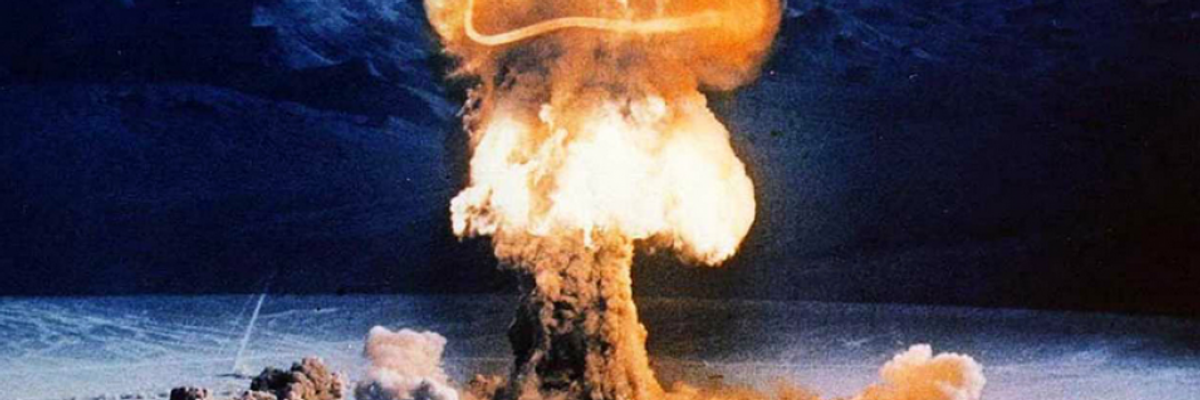
"By dismantling accords that limit nuclear weapons, we bring the explosion steadily closer."
Last month two nuclear-armed countries, India and Pakistan, came to the brink of war. Their border skirmish was a scary message from the future. If controls on nuclear weapons continue to weaken, more countries will probably develop those weapons. Each time one does, its rivals are likely to do the same. Local conflicts will suddenly have the potential to explode into nuclear war.
Like more than a few neighbors, India and Pakistan have a property dispute. Theirs is over Jammu and Kashmir, a former princely state nestled against the Himalayas. India is in control and Pakistan sponsors militant raids under a fig leaf of deniability. Conflicts like these exist around the world. They are a natural consequence of geography and politics. If contending parties arm themselves with nuclear weapons, these regional quarrels will suddenly have apocalyptic potential.
That was chillingly clear along the India-Pakistan border last month. The crisis erupted after a suicide bomber drove a car packed with explosives into an Indian military convoy, killing more than 40 soldiers. India blamed Pakistan, which has a long history of supporting such attacks. In retaliation, it sent a dozen planes to bomb what it said were terrorist camps inside Pakistan. One plane was shot down and its pilot captured. Then the crisis, which might have raced out of control, unexpectedly eased. It turned out that India's air raids had been just for show and may not have killed a soul. The downed pilot was released and called his captors "thorough gentlemen."
It's easy to imagine even more dangerous faceoffs elsewhere in the world. The most terrifying new nuclear powers would be Iran and Saudi Arabia. Iran has enough scientific talent to develop a bomb, and Saudi Arabia could buy what it needs. Hearing the leaders of those countries snarl at each other is scary enough today. If both had nuclear weapons -- not a far-fetched scenario if present trends continue -- war between them could be devastating. So could a war over Taiwan, if Taiwan were to build a nuclear arsenal to compete with China's. Serbia and Kosovo are in bitter conflict over disputed territory. So are Armenia and Azerbaijan.
Once while waiting for a flight at an airport in Ecuador, I stared at a giant map of the country that was painted on the terminal wall. It looked odd. Ecuador seemed much larger than I remembered. Finally, I realized that on this map, its borders had been drawn to include territory in the Amazon that Ecuador lost to Peru in the 19th century and still claims. A banner over the map proclaimed: "Ecuador Was, Is and Will Always Be an Amazon Nation." The dispute over this territory has set off several wars between Peru and Ecuador. The last one, in 1995, led to several hundred casualties. In a world where nuclear weapons are widely spread, political passion could turn an obscure dispute like this into global catastrophe.
That world is emerging. The Trump administration has been moving systematically to undermine accords that have kept nuclear proliferation within possibly manageable limits over the last half-century. Most recently it announced that the United States will withdraw from the 1987 Intermediate-Range Nuclear Forces Treaty with Russia, which regulates several classes of nuclear missiles. Steps like this produce little if any military gain and damage the United States in the court of world opinion.
Senior policymakers around President Trump reject the very idea of arms control. They are resuming the wrecking rampage launched by President George W. Bush, who pulled the United States out of the Anti-Ballistic Missle treaty in 2001. That move left Russia and China free to develop a new generation of hypersonic missiles. All steps away from control of nuclear arms have effects like that. They also, however, make a stark political point. By renouncing arms control, the United States declares its wish for a world without treaties; if that frees other countries to build nuclear arsenals, so be it.
Giving up on arms control increases the possibility that governments with violently irredentist ambitions could build or acquire nuclear weapons. That volatile mix -- a local conflict plus nuclear weapons -- could one day produce the explosion humanity fears. Last month's clash between India and Pakistan was a warning. Cooler heads prevailed, but that won't happen every time. By dismantling accords that limit nuclear weapons, we bring the explosion steadily closer.
This country and this world are at a monumental crossroads. US voters have an opportunity to beat back the forces of fascism and confront the billionaires who are rigging the economy, our media system, and our democracy, making it increasingly impossible for ordinary people to get by. We’re not just talking about the election. We’re talking about what must be done once these fascist elements are vanquished from power. We need a bolder set of solutions than what either major party has so far been willing to offer and a working-class movement ready to fight like hell for it. Trump didn't emerge from nowhere. The conditions that fueled MAGA authoritarianism were created by decades of radical neoliberal economic policies and a corrupt political system dominated by corporate interests. They slashed taxes on the super-rich, promising that the benefits would trickle down. They said giveaways to the corporate titans would make life more affordable for the rest of us. It was all bullshit. And when a bitter, betrayed populace searches for someone to blame, right-wing demagogues have little trouble finding scapegoats. People know when they're being lied to, but you won't hear any of this from the corporate media. Only independent journalism—powered and funded by people who believe in building a better world—can deliver truly trustworthy daily news. If you share our vision, please contribute whatever you can to sustain our work. |
Last month two nuclear-armed countries, India and Pakistan, came to the brink of war. Their border skirmish was a scary message from the future. If controls on nuclear weapons continue to weaken, more countries will probably develop those weapons. Each time one does, its rivals are likely to do the same. Local conflicts will suddenly have the potential to explode into nuclear war.
Like more than a few neighbors, India and Pakistan have a property dispute. Theirs is over Jammu and Kashmir, a former princely state nestled against the Himalayas. India is in control and Pakistan sponsors militant raids under a fig leaf of deniability. Conflicts like these exist around the world. They are a natural consequence of geography and politics. If contending parties arm themselves with nuclear weapons, these regional quarrels will suddenly have apocalyptic potential.
That was chillingly clear along the India-Pakistan border last month. The crisis erupted after a suicide bomber drove a car packed with explosives into an Indian military convoy, killing more than 40 soldiers. India blamed Pakistan, which has a long history of supporting such attacks. In retaliation, it sent a dozen planes to bomb what it said were terrorist camps inside Pakistan. One plane was shot down and its pilot captured. Then the crisis, which might have raced out of control, unexpectedly eased. It turned out that India's air raids had been just for show and may not have killed a soul. The downed pilot was released and called his captors "thorough gentlemen."
It's easy to imagine even more dangerous faceoffs elsewhere in the world. The most terrifying new nuclear powers would be Iran and Saudi Arabia. Iran has enough scientific talent to develop a bomb, and Saudi Arabia could buy what it needs. Hearing the leaders of those countries snarl at each other is scary enough today. If both had nuclear weapons -- not a far-fetched scenario if present trends continue -- war between them could be devastating. So could a war over Taiwan, if Taiwan were to build a nuclear arsenal to compete with China's. Serbia and Kosovo are in bitter conflict over disputed territory. So are Armenia and Azerbaijan.
Once while waiting for a flight at an airport in Ecuador, I stared at a giant map of the country that was painted on the terminal wall. It looked odd. Ecuador seemed much larger than I remembered. Finally, I realized that on this map, its borders had been drawn to include territory in the Amazon that Ecuador lost to Peru in the 19th century and still claims. A banner over the map proclaimed: "Ecuador Was, Is and Will Always Be an Amazon Nation." The dispute over this territory has set off several wars between Peru and Ecuador. The last one, in 1995, led to several hundred casualties. In a world where nuclear weapons are widely spread, political passion could turn an obscure dispute like this into global catastrophe.
That world is emerging. The Trump administration has been moving systematically to undermine accords that have kept nuclear proliferation within possibly manageable limits over the last half-century. Most recently it announced that the United States will withdraw from the 1987 Intermediate-Range Nuclear Forces Treaty with Russia, which regulates several classes of nuclear missiles. Steps like this produce little if any military gain and damage the United States in the court of world opinion.
Senior policymakers around President Trump reject the very idea of arms control. They are resuming the wrecking rampage launched by President George W. Bush, who pulled the United States out of the Anti-Ballistic Missle treaty in 2001. That move left Russia and China free to develop a new generation of hypersonic missiles. All steps away from control of nuclear arms have effects like that. They also, however, make a stark political point. By renouncing arms control, the United States declares its wish for a world without treaties; if that frees other countries to build nuclear arsenals, so be it.
Giving up on arms control increases the possibility that governments with violently irredentist ambitions could build or acquire nuclear weapons. That volatile mix -- a local conflict plus nuclear weapons -- could one day produce the explosion humanity fears. Last month's clash between India and Pakistan was a warning. Cooler heads prevailed, but that won't happen every time. By dismantling accords that limit nuclear weapons, we bring the explosion steadily closer.