SUBSCRIBE TO OUR FREE NEWSLETTER
Daily news & progressive opinion—funded by the people, not the corporations—delivered straight to your inbox.
5
#000000
#FFFFFF
To donate by check, phone, or other method, see our More Ways to Give page.
Daily news & progressive opinion—funded by the people, not the corporations—delivered straight to your inbox.
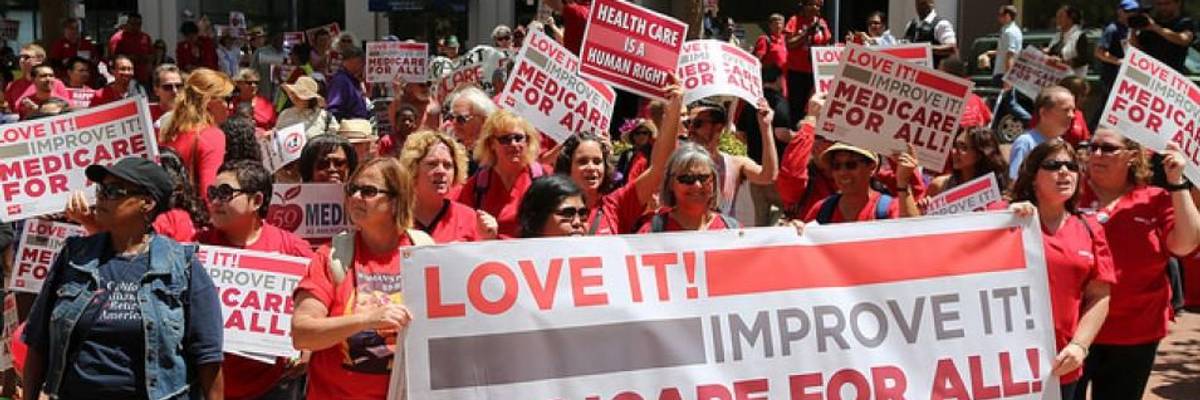
Medicare for All would mean that the proverbial "pigs at the trough" of the $3.5 trillion health care system each have something (in the form of stock prices and paychecks) to lose. (Photo: National Nurses United/Flickr/cc)
The most important question about Medicare for All is a simple one: If other industrialized countries can afford to offer high-quality universal health care to their citizens, why can't the United States?
We've been fooled to believe that the USA requires a uniquely expensive, fragmented and administratively complex system of health care coverage. But that's just plain wrong. In a seminal paper published in 2003, Uwe Reinhardt and Gerard Anderson found "it's the prices, stupid" that set the U.S. health care system apart. It's not that care in the United States is higher quality. Nor is it that we use more of it than other countries. This finding has been replicated in study after study.
We have a more expensive health care system because many of our political leaders across party lines are not serving us, but rather the health care industry. Medicare for All would mean that the proverbial "pigs at the trough" of the $3.5 trillion health care system each have something (in the form of stock prices and paychecks) to lose.
The political narrative invariably focuses on "the price tag" of Medicare for All. But, the question is never asked: Why can't our political leaders negotiate American taxpayers a better deal? We are being ripped off. We pay more than any other economically developed countries pay for a night in the hospital. Our medications are so expensive that Canadian pharmacies have a side business in selling us our own U.S.-manufactured drugs at lower prices.
There are still 27 million uninsured people in the United States, and the numbers are rising. Many others have high-priced insurance with little coverage. Yet too many politicians continue to side with corporations over the people they represent. In 2003, when legislators were given the chance to cover prescription drugs under Medicare, they included language in the legislation prohibiting Medicare from negotiating with the pharmaceutical industry.
Many political leaders, in collaboration with the health care industry, sow false narratives. They claim that "Medicare for All" means rationed care and limited choice of physicians. Actually, that's what we have today! Medicare for All really means an administratively simpler coverage system that supports free market enterprise, choice of doctors and hospitals, affordable access to care, and innovation in the delivery system.
As a physician, I have seen how fragmentation in our commercial health insurance system leads to waste and poor health care delivery. I have seen how commercial insurers ration care by denying coverage. I recall many instances in which "prior approvals" were so cumbersome that it made it impossible for my patient to get needed care. I once received paperwork from an insurance company asking me to document when my patient received their cancer diagnosis--in order to block that patient from getting necessary care by declaring that the cancer was a "pre-existing condition." The Medicare program does not deny coverage of medically necessary care and doesn't care about the date when you were diagnosed with cancer. It is insurance that provides real health security when you need it.
I have also experienced the consequences of our fragmented coverage system firsthand as a patient. I recall when my doctor joined another physician group. He was just a few blocks away, but his new medical group wasn't "in-network." Most physicians accept Medicare. If I had Medicare, I wouldn't have had to change my doctor. We have become "the frogs in the frying pan," tolerating increasing prices, changing coverage and more barriers to care. The solution is in front of us. Our parents and grandparents have it and they love it. It is called Medicare.
We need leaders who represent us and not the for-profit health care industry. Our leaders (Republicans and Democrats alike) are not negotiating us a fair deal, and we need to call them out. After all, it is our health on the line.
This article was produced by Economy for All, a project of the Independent Media Institute.
Dear Common Dreams reader, It’s been nearly 30 years since I co-founded Common Dreams with my late wife, Lina Newhouser. We had the radical notion that journalism should serve the public good, not corporate profits. It was clear to us from the outset what it would take to build such a project. No paid advertisements. No corporate sponsors. No millionaire publisher telling us what to think or do. Many people said we wouldn't last a year, but we proved those doubters wrong. Together with a tremendous team of journalists and dedicated staff, we built an independent media outlet free from the constraints of profits and corporate control. Our mission has always been simple: To inform. To inspire. To ignite change for the common good. Building Common Dreams was not easy. Our survival was never guaranteed. When you take on the most powerful forces—Wall Street greed, fossil fuel industry destruction, Big Tech lobbyists, and uber-rich oligarchs who have spent billions upon billions rigging the economy and democracy in their favor—the only bulwark you have is supporters who believe in your work. But here’s the urgent message from me today. It's never been this bad out there. And it's never been this hard to keep us going. At the very moment Common Dreams is most needed, the threats we face are intensifying. We need your support now more than ever. We don't accept corporate advertising and never will. We don't have a paywall because we don't think people should be blocked from critical news based on their ability to pay. Everything we do is funded by the donations of readers like you. When everyone does the little they can afford, we are strong. But if that support retreats or dries up, so do we. Will you donate now to make sure Common Dreams not only survives but thrives? —Craig Brown, Co-founder |
The most important question about Medicare for All is a simple one: If other industrialized countries can afford to offer high-quality universal health care to their citizens, why can't the United States?
We've been fooled to believe that the USA requires a uniquely expensive, fragmented and administratively complex system of health care coverage. But that's just plain wrong. In a seminal paper published in 2003, Uwe Reinhardt and Gerard Anderson found "it's the prices, stupid" that set the U.S. health care system apart. It's not that care in the United States is higher quality. Nor is it that we use more of it than other countries. This finding has been replicated in study after study.
We have a more expensive health care system because many of our political leaders across party lines are not serving us, but rather the health care industry. Medicare for All would mean that the proverbial "pigs at the trough" of the $3.5 trillion health care system each have something (in the form of stock prices and paychecks) to lose.
The political narrative invariably focuses on "the price tag" of Medicare for All. But, the question is never asked: Why can't our political leaders negotiate American taxpayers a better deal? We are being ripped off. We pay more than any other economically developed countries pay for a night in the hospital. Our medications are so expensive that Canadian pharmacies have a side business in selling us our own U.S.-manufactured drugs at lower prices.
There are still 27 million uninsured people in the United States, and the numbers are rising. Many others have high-priced insurance with little coverage. Yet too many politicians continue to side with corporations over the people they represent. In 2003, when legislators were given the chance to cover prescription drugs under Medicare, they included language in the legislation prohibiting Medicare from negotiating with the pharmaceutical industry.
Many political leaders, in collaboration with the health care industry, sow false narratives. They claim that "Medicare for All" means rationed care and limited choice of physicians. Actually, that's what we have today! Medicare for All really means an administratively simpler coverage system that supports free market enterprise, choice of doctors and hospitals, affordable access to care, and innovation in the delivery system.
As a physician, I have seen how fragmentation in our commercial health insurance system leads to waste and poor health care delivery. I have seen how commercial insurers ration care by denying coverage. I recall many instances in which "prior approvals" were so cumbersome that it made it impossible for my patient to get needed care. I once received paperwork from an insurance company asking me to document when my patient received their cancer diagnosis--in order to block that patient from getting necessary care by declaring that the cancer was a "pre-existing condition." The Medicare program does not deny coverage of medically necessary care and doesn't care about the date when you were diagnosed with cancer. It is insurance that provides real health security when you need it.
I have also experienced the consequences of our fragmented coverage system firsthand as a patient. I recall when my doctor joined another physician group. He was just a few blocks away, but his new medical group wasn't "in-network." Most physicians accept Medicare. If I had Medicare, I wouldn't have had to change my doctor. We have become "the frogs in the frying pan," tolerating increasing prices, changing coverage and more barriers to care. The solution is in front of us. Our parents and grandparents have it and they love it. It is called Medicare.
We need leaders who represent us and not the for-profit health care industry. Our leaders (Republicans and Democrats alike) are not negotiating us a fair deal, and we need to call them out. After all, it is our health on the line.
This article was produced by Economy for All, a project of the Independent Media Institute.
The most important question about Medicare for All is a simple one: If other industrialized countries can afford to offer high-quality universal health care to their citizens, why can't the United States?
We've been fooled to believe that the USA requires a uniquely expensive, fragmented and administratively complex system of health care coverage. But that's just plain wrong. In a seminal paper published in 2003, Uwe Reinhardt and Gerard Anderson found "it's the prices, stupid" that set the U.S. health care system apart. It's not that care in the United States is higher quality. Nor is it that we use more of it than other countries. This finding has been replicated in study after study.
We have a more expensive health care system because many of our political leaders across party lines are not serving us, but rather the health care industry. Medicare for All would mean that the proverbial "pigs at the trough" of the $3.5 trillion health care system each have something (in the form of stock prices and paychecks) to lose.
The political narrative invariably focuses on "the price tag" of Medicare for All. But, the question is never asked: Why can't our political leaders negotiate American taxpayers a better deal? We are being ripped off. We pay more than any other economically developed countries pay for a night in the hospital. Our medications are so expensive that Canadian pharmacies have a side business in selling us our own U.S.-manufactured drugs at lower prices.
There are still 27 million uninsured people in the United States, and the numbers are rising. Many others have high-priced insurance with little coverage. Yet too many politicians continue to side with corporations over the people they represent. In 2003, when legislators were given the chance to cover prescription drugs under Medicare, they included language in the legislation prohibiting Medicare from negotiating with the pharmaceutical industry.
Many political leaders, in collaboration with the health care industry, sow false narratives. They claim that "Medicare for All" means rationed care and limited choice of physicians. Actually, that's what we have today! Medicare for All really means an administratively simpler coverage system that supports free market enterprise, choice of doctors and hospitals, affordable access to care, and innovation in the delivery system.
As a physician, I have seen how fragmentation in our commercial health insurance system leads to waste and poor health care delivery. I have seen how commercial insurers ration care by denying coverage. I recall many instances in which "prior approvals" were so cumbersome that it made it impossible for my patient to get needed care. I once received paperwork from an insurance company asking me to document when my patient received their cancer diagnosis--in order to block that patient from getting necessary care by declaring that the cancer was a "pre-existing condition." The Medicare program does not deny coverage of medically necessary care and doesn't care about the date when you were diagnosed with cancer. It is insurance that provides real health security when you need it.
I have also experienced the consequences of our fragmented coverage system firsthand as a patient. I recall when my doctor joined another physician group. He was just a few blocks away, but his new medical group wasn't "in-network." Most physicians accept Medicare. If I had Medicare, I wouldn't have had to change my doctor. We have become "the frogs in the frying pan," tolerating increasing prices, changing coverage and more barriers to care. The solution is in front of us. Our parents and grandparents have it and they love it. It is called Medicare.
We need leaders who represent us and not the for-profit health care industry. Our leaders (Republicans and Democrats alike) are not negotiating us a fair deal, and we need to call them out. After all, it is our health on the line.
This article was produced by Economy for All, a project of the Independent Media Institute.