SUBSCRIBE TO OUR FREE NEWSLETTER
Daily news & progressive opinion—funded by the people, not the corporations—delivered straight to your inbox.
5
#000000
#FFFFFF
To donate by check, phone, or other method, see our More Ways to Give page.
Daily news & progressive opinion—funded by the people, not the corporations—delivered straight to your inbox.
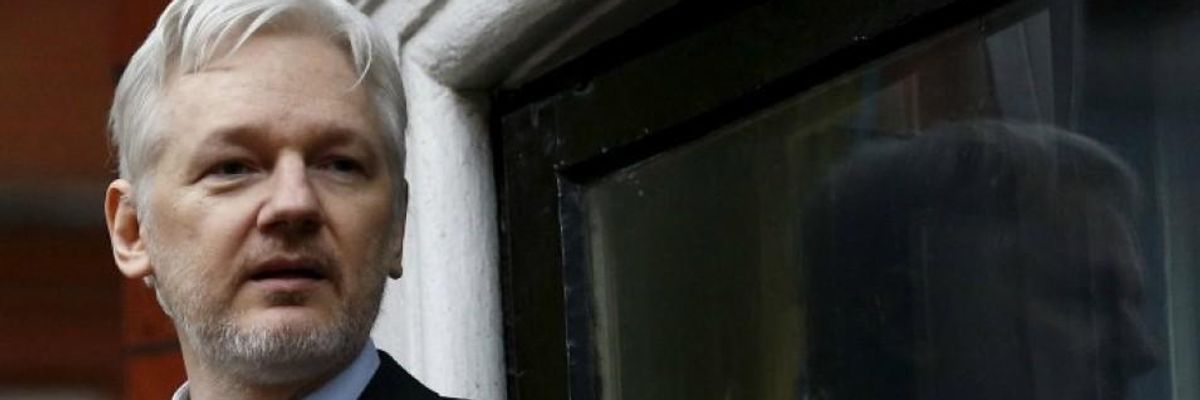
Thursday's arrest of Assange is clearly the culmination of a two-year effort by the U.S. government to coerce Ecuador--under its new and submissive president, Lenin Moreno. (Photo: Reuters)
The indictment of Julian Assange unsealed today by the Trump Justice Department poses grave threats to press freedoms, not only in the U.S. but around the world. The charging document and accompanying extradition request from the U.S. government, used by the U.K. police to arrest Assange once Ecuador officially withdrew its asylum protection, seeks to criminalize numerous activities at the core of investigative journalism.
So much of what has been reported today about this indictment has been false. Two facts in particular have been utterly distorted by the DOJ and then misreported by numerous media organizations.
The first crucial fact about the indictment is that its key allegation -- that Assange did not merely receive classified documents from Chelsea Manning but tried to help her crack a password in order to cover her tracks -- is not new. It was long known by the Obama DOJ and was explicitly part of Manning's trial, yet the Obama DOJ -- not exactly renowned for being stalwart guardians of press freedoms -- concluded that it could not and should not prosecute Assange because indicting him would pose serious threats to press freedom. In sum, today's indictment contains no new evidence or facts about Assange's actions; all of it has been known for years.
The Obama DOJ tried for years to find evidence to justify a claim that Assange did more than act as a journalist -- that he, for instance, illegally worked with Manning to steal the documents -- but found nothing to justify that accusation and thus, never indicted Assange.
The other key fact being widely misreported is that the indictment accuses Assange of trying to help Manning obtain access to document databases to which she had no valid access: i.e., hacking rather than journalism. But the indictment alleges no such thing. Rather, it simply accuses Assange of trying to help Manning log into the Defense Department's computers using a different username so that she could maintain her anonymity while downloading documents in the public interest and then furnish them to WikiLeaks to publish.
In other words, the indictment seeks to criminalize what journalists are not only permitted but ethically required to do: take steps to help their sources maintain their anonymity. As longtime Assange lawyer Barry Pollack put it: "The factual allegations ... boil down to encouraging a source to provide him information and taking efforts to protect the identity of that source. Journalists around the world should be deeply troubled by these unprecedented criminal charges."
That's why the indictment poses such a grave threat to press freedom. It characterizes as a felony many actions that journalists are not just permitted but required to take in order to conduct sensitive reporting in the digital age.
Read the full article, with possible updates, at The Intercept.
Dear Common Dreams reader, It’s been nearly 30 years since I co-founded Common Dreams with my late wife, Lina Newhouser. We had the radical notion that journalism should serve the public good, not corporate profits. It was clear to us from the outset what it would take to build such a project. No paid advertisements. No corporate sponsors. No millionaire publisher telling us what to think or do. Many people said we wouldn't last a year, but we proved those doubters wrong. Together with a tremendous team of journalists and dedicated staff, we built an independent media outlet free from the constraints of profits and corporate control. Our mission has always been simple: To inform. To inspire. To ignite change for the common good. Building Common Dreams was not easy. Our survival was never guaranteed. When you take on the most powerful forces—Wall Street greed, fossil fuel industry destruction, Big Tech lobbyists, and uber-rich oligarchs who have spent billions upon billions rigging the economy and democracy in their favor—the only bulwark you have is supporters who believe in your work. But here’s the urgent message from me today. It's never been this bad out there. And it's never been this hard to keep us going. At the very moment Common Dreams is most needed, the threats we face are intensifying. We need your support now more than ever. We don't accept corporate advertising and never will. We don't have a paywall because we don't think people should be blocked from critical news based on their ability to pay. Everything we do is funded by the donations of readers like you. When everyone does the little they can afford, we are strong. But if that support retreats or dries up, so do we. Will you donate now to make sure Common Dreams not only survives but thrives? —Craig Brown, Co-founder |
The indictment of Julian Assange unsealed today by the Trump Justice Department poses grave threats to press freedoms, not only in the U.S. but around the world. The charging document and accompanying extradition request from the U.S. government, used by the U.K. police to arrest Assange once Ecuador officially withdrew its asylum protection, seeks to criminalize numerous activities at the core of investigative journalism.
So much of what has been reported today about this indictment has been false. Two facts in particular have been utterly distorted by the DOJ and then misreported by numerous media organizations.
The first crucial fact about the indictment is that its key allegation -- that Assange did not merely receive classified documents from Chelsea Manning but tried to help her crack a password in order to cover her tracks -- is not new. It was long known by the Obama DOJ and was explicitly part of Manning's trial, yet the Obama DOJ -- not exactly renowned for being stalwart guardians of press freedoms -- concluded that it could not and should not prosecute Assange because indicting him would pose serious threats to press freedom. In sum, today's indictment contains no new evidence or facts about Assange's actions; all of it has been known for years.
The Obama DOJ tried for years to find evidence to justify a claim that Assange did more than act as a journalist -- that he, for instance, illegally worked with Manning to steal the documents -- but found nothing to justify that accusation and thus, never indicted Assange.
The other key fact being widely misreported is that the indictment accuses Assange of trying to help Manning obtain access to document databases to which she had no valid access: i.e., hacking rather than journalism. But the indictment alleges no such thing. Rather, it simply accuses Assange of trying to help Manning log into the Defense Department's computers using a different username so that she could maintain her anonymity while downloading documents in the public interest and then furnish them to WikiLeaks to publish.
In other words, the indictment seeks to criminalize what journalists are not only permitted but ethically required to do: take steps to help their sources maintain their anonymity. As longtime Assange lawyer Barry Pollack put it: "The factual allegations ... boil down to encouraging a source to provide him information and taking efforts to protect the identity of that source. Journalists around the world should be deeply troubled by these unprecedented criminal charges."
That's why the indictment poses such a grave threat to press freedom. It characterizes as a felony many actions that journalists are not just permitted but required to take in order to conduct sensitive reporting in the digital age.
Read the full article, with possible updates, at The Intercept.
The indictment of Julian Assange unsealed today by the Trump Justice Department poses grave threats to press freedoms, not only in the U.S. but around the world. The charging document and accompanying extradition request from the U.S. government, used by the U.K. police to arrest Assange once Ecuador officially withdrew its asylum protection, seeks to criminalize numerous activities at the core of investigative journalism.
So much of what has been reported today about this indictment has been false. Two facts in particular have been utterly distorted by the DOJ and then misreported by numerous media organizations.
The first crucial fact about the indictment is that its key allegation -- that Assange did not merely receive classified documents from Chelsea Manning but tried to help her crack a password in order to cover her tracks -- is not new. It was long known by the Obama DOJ and was explicitly part of Manning's trial, yet the Obama DOJ -- not exactly renowned for being stalwart guardians of press freedoms -- concluded that it could not and should not prosecute Assange because indicting him would pose serious threats to press freedom. In sum, today's indictment contains no new evidence or facts about Assange's actions; all of it has been known for years.
The Obama DOJ tried for years to find evidence to justify a claim that Assange did more than act as a journalist -- that he, for instance, illegally worked with Manning to steal the documents -- but found nothing to justify that accusation and thus, never indicted Assange.
The other key fact being widely misreported is that the indictment accuses Assange of trying to help Manning obtain access to document databases to which she had no valid access: i.e., hacking rather than journalism. But the indictment alleges no such thing. Rather, it simply accuses Assange of trying to help Manning log into the Defense Department's computers using a different username so that she could maintain her anonymity while downloading documents in the public interest and then furnish them to WikiLeaks to publish.
In other words, the indictment seeks to criminalize what journalists are not only permitted but ethically required to do: take steps to help their sources maintain their anonymity. As longtime Assange lawyer Barry Pollack put it: "The factual allegations ... boil down to encouraging a source to provide him information and taking efforts to protect the identity of that source. Journalists around the world should be deeply troubled by these unprecedented criminal charges."
That's why the indictment poses such a grave threat to press freedom. It characterizes as a felony many actions that journalists are not just permitted but required to take in order to conduct sensitive reporting in the digital age.
Read the full article, with possible updates, at The Intercept.