SUBSCRIBE TO OUR FREE NEWSLETTER
Daily news & progressive opinion—funded by the people, not the corporations—delivered straight to your inbox.
5
#000000
#FFFFFF
To donate by check, phone, or other method, see our More Ways to Give page.
Daily news & progressive opinion—funded by the people, not the corporations—delivered straight to your inbox.
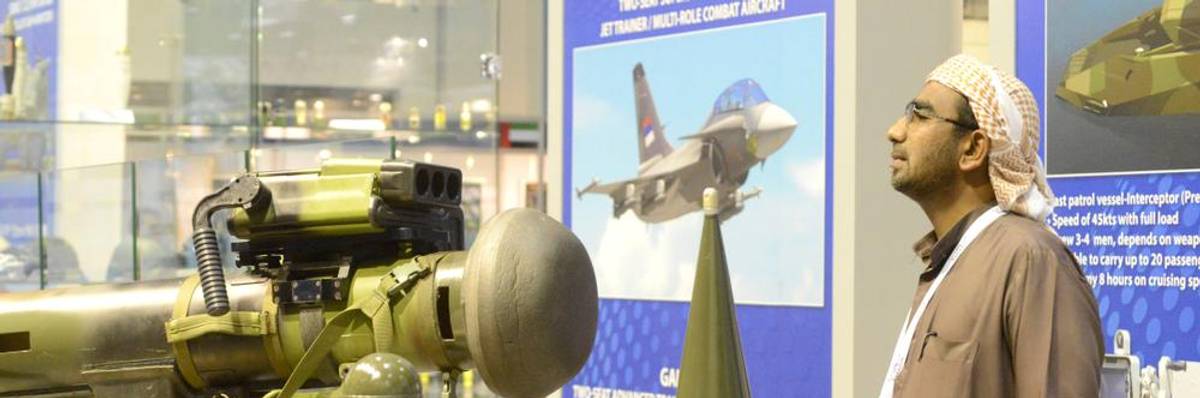
Arms exhibition in Abu Dhabi (Photo: z.o.y.a via Shutterstock)
The Senate's failure to override President Trump's veto of its effort to end U.S. military support for the Saudi-led war in Yemen is not the end of the story. A way can and must be found to stop U.S. assistance in refueling, targeting, and other activities that bolster the Saudi/United Arab Emirats (UAE) war effort, which has killed tens of thousands of civilians and left millions of Yemenis at risk of famine and fatal, war-induced diseases.
For starters, Congress should work to close off the other main avenue of U.S. support for the Saudi-led coalition--the sale of bombs, combat aircraft, armored vehicles, attack helicopters, and other equipment to Saudi Arabia and the UAE, the two primary perpetrators of the humanitarian crisis in Yemen. According to statistics from the Security Assistance Monitor, the United States has offered over $68 billion in weaponry to those two nations since the start of the current Yemen conflict in March 2015. As Bruce Riedel of the Brookings Institution has noted, these U.S.-supplied systems are the backbone of the Saudi military, and without those weapons and related maintenance and support they could not sustain their intervention in Yemen.
The Trump administration, the U.S. arms industry, and the Saudi and UAE lobbies have made numerous arguments in favor of keeping U.S. weapons flowing to its Gulf allies, but none of them holds up to scrutiny.
The Trump administration, the U.S. arms industry, and the Saudi and UAE lobbies have made numerous arguments in favor of keeping U.S. weapons flowing to its Gulf allies, but none of them holds up to scrutiny.
With respect to the sales of precision-guided bombs--whose use has been documented in the widespread killings of civilians--the argument of choice has been that even more civilians would die in Saudi/UAE air strikes if the coalition were limited to "dumb" bombs that could not be targeted as accurately. This assertion is premised on the idea that Saudi Arabia and the UAE are making good faith efforts to avoid hitting civilians. The sheer volume of strikes on targets like hospitals, a school bus, funerals, factories, water treatment plants, and other civilian infrastructure puts the lie to this argument. Air strikes on civilians are not "mistakes." They are part and parcel of the Saudi/UAE strategy to bomb Yemenis into submission and end the war on terms favorable to their coalition.
Another popular argument for continuing arms sales to Saudi Arabia and the UAE is "if we don't do it, somebody else will." But the United States and its European allies supply the Saudi air force and the majority of the arsenals of both Saudi Arabia and the UAE. The Saudi and UAE militaries could not turn on a dime and seek Russian or Chinese systems to substitute for any cutoff of U.S. weaponry and support. It would take a decade or more for these nations to end their dependence on U.S. arms. A few deals with Moscow or Beijing would have limited impact on Saudi and UAE military capabilities, if Russia and China were even willing to supply arms to two nations that are responsible for the world's worst humanitarian catastrophe, with the international opprobrium that would accompany any decision to do so.
President Trump's favorite argument for keeping the weapons trade going is jobs, jobs, jobs. His claims of U.S. jobs tied to Saudi arms sales and related deals have fluctuated widely, from 40,000 to as many as one million. But an analysis of actual deals concluded over the past two years suggests a figure that is a fraction of the president's claims. And many of these jobs will be created in Saudi Arabia as part of that nation's goal of having 50 percent of the value of its arms purchases produced in the kingdom by 2030.
Last but not least is the claim that stopping arms sales to the Saudi/UAE coalition will aid Iran. But the Houthi-led opposition is by no means a proxy for Tehran. They have longstanding grievances that have nothing to do with Iran's limited military support and would be fighting no matter what posture Iran takes towards the conflict. If anything, the brutal Saudi/UAE intervention is driving the Houthi coalition closer to Tehran. The best way to undercut Iranian influence in Yemen is to support UN efforts to end the war.
There are several congressional initiatives to cut off U.S. arms to the Saudi/UAE coalition, including a bipartisan bill co-sponsored by Senators Robert Menendez (D-NJ), Todd Young (R-IN), Jeanne Shaheen (D-NH), Lindsey Graham (R-SC), Susan Collins (R-ME), Jack Reed (D-RI), and Chris Murphy (D-CT). That measure would, among other things, stop sales of precision-guided bombs to Saudi Arabia and the UAE for two years and condition other sales of offensive weapons on an end to the targeting of civilians and assurances that Saudi Arabia and the UAE will support the free passage of humanitarian aid. And a bill sponsored by Rep Jim McGovern (D-MA) would immediately end all U.S. arms sales and military aid to Saudi Arabia. It's time for Congress to move on this and other initiatives that would once and for all end U.S. support for the slaughter in Yemen.
Dear Common Dreams reader, It’s been nearly 30 years since I co-founded Common Dreams with my late wife, Lina Newhouser. We had the radical notion that journalism should serve the public good, not corporate profits. It was clear to us from the outset what it would take to build such a project. No paid advertisements. No corporate sponsors. No millionaire publisher telling us what to think or do. Many people said we wouldn't last a year, but we proved those doubters wrong. Together with a tremendous team of journalists and dedicated staff, we built an independent media outlet free from the constraints of profits and corporate control. Our mission has always been simple: To inform. To inspire. To ignite change for the common good. Building Common Dreams was not easy. Our survival was never guaranteed. When you take on the most powerful forces—Wall Street greed, fossil fuel industry destruction, Big Tech lobbyists, and uber-rich oligarchs who have spent billions upon billions rigging the economy and democracy in their favor—the only bulwark you have is supporters who believe in your work. But here’s the urgent message from me today. It's never been this bad out there. And it's never been this hard to keep us going. At the very moment Common Dreams is most needed, the threats we face are intensifying. We need your support now more than ever. We don't accept corporate advertising and never will. We don't have a paywall because we don't think people should be blocked from critical news based on their ability to pay. Everything we do is funded by the donations of readers like you. When everyone does the little they can afford, we are strong. But if that support retreats or dries up, so do we. Will you donate now to make sure Common Dreams not only survives but thrives? —Craig Brown, Co-founder |
The Senate's failure to override President Trump's veto of its effort to end U.S. military support for the Saudi-led war in Yemen is not the end of the story. A way can and must be found to stop U.S. assistance in refueling, targeting, and other activities that bolster the Saudi/United Arab Emirats (UAE) war effort, which has killed tens of thousands of civilians and left millions of Yemenis at risk of famine and fatal, war-induced diseases.
For starters, Congress should work to close off the other main avenue of U.S. support for the Saudi-led coalition--the sale of bombs, combat aircraft, armored vehicles, attack helicopters, and other equipment to Saudi Arabia and the UAE, the two primary perpetrators of the humanitarian crisis in Yemen. According to statistics from the Security Assistance Monitor, the United States has offered over $68 billion in weaponry to those two nations since the start of the current Yemen conflict in March 2015. As Bruce Riedel of the Brookings Institution has noted, these U.S.-supplied systems are the backbone of the Saudi military, and without those weapons and related maintenance and support they could not sustain their intervention in Yemen.
The Trump administration, the U.S. arms industry, and the Saudi and UAE lobbies have made numerous arguments in favor of keeping U.S. weapons flowing to its Gulf allies, but none of them holds up to scrutiny.
The Trump administration, the U.S. arms industry, and the Saudi and UAE lobbies have made numerous arguments in favor of keeping U.S. weapons flowing to its Gulf allies, but none of them holds up to scrutiny.
With respect to the sales of precision-guided bombs--whose use has been documented in the widespread killings of civilians--the argument of choice has been that even more civilians would die in Saudi/UAE air strikes if the coalition were limited to "dumb" bombs that could not be targeted as accurately. This assertion is premised on the idea that Saudi Arabia and the UAE are making good faith efforts to avoid hitting civilians. The sheer volume of strikes on targets like hospitals, a school bus, funerals, factories, water treatment plants, and other civilian infrastructure puts the lie to this argument. Air strikes on civilians are not "mistakes." They are part and parcel of the Saudi/UAE strategy to bomb Yemenis into submission and end the war on terms favorable to their coalition.
Another popular argument for continuing arms sales to Saudi Arabia and the UAE is "if we don't do it, somebody else will." But the United States and its European allies supply the Saudi air force and the majority of the arsenals of both Saudi Arabia and the UAE. The Saudi and UAE militaries could not turn on a dime and seek Russian or Chinese systems to substitute for any cutoff of U.S. weaponry and support. It would take a decade or more for these nations to end their dependence on U.S. arms. A few deals with Moscow or Beijing would have limited impact on Saudi and UAE military capabilities, if Russia and China were even willing to supply arms to two nations that are responsible for the world's worst humanitarian catastrophe, with the international opprobrium that would accompany any decision to do so.
President Trump's favorite argument for keeping the weapons trade going is jobs, jobs, jobs. His claims of U.S. jobs tied to Saudi arms sales and related deals have fluctuated widely, from 40,000 to as many as one million. But an analysis of actual deals concluded over the past two years suggests a figure that is a fraction of the president's claims. And many of these jobs will be created in Saudi Arabia as part of that nation's goal of having 50 percent of the value of its arms purchases produced in the kingdom by 2030.
Last but not least is the claim that stopping arms sales to the Saudi/UAE coalition will aid Iran. But the Houthi-led opposition is by no means a proxy for Tehran. They have longstanding grievances that have nothing to do with Iran's limited military support and would be fighting no matter what posture Iran takes towards the conflict. If anything, the brutal Saudi/UAE intervention is driving the Houthi coalition closer to Tehran. The best way to undercut Iranian influence in Yemen is to support UN efforts to end the war.
There are several congressional initiatives to cut off U.S. arms to the Saudi/UAE coalition, including a bipartisan bill co-sponsored by Senators Robert Menendez (D-NJ), Todd Young (R-IN), Jeanne Shaheen (D-NH), Lindsey Graham (R-SC), Susan Collins (R-ME), Jack Reed (D-RI), and Chris Murphy (D-CT). That measure would, among other things, stop sales of precision-guided bombs to Saudi Arabia and the UAE for two years and condition other sales of offensive weapons on an end to the targeting of civilians and assurances that Saudi Arabia and the UAE will support the free passage of humanitarian aid. And a bill sponsored by Rep Jim McGovern (D-MA) would immediately end all U.S. arms sales and military aid to Saudi Arabia. It's time for Congress to move on this and other initiatives that would once and for all end U.S. support for the slaughter in Yemen.
The Senate's failure to override President Trump's veto of its effort to end U.S. military support for the Saudi-led war in Yemen is not the end of the story. A way can and must be found to stop U.S. assistance in refueling, targeting, and other activities that bolster the Saudi/United Arab Emirats (UAE) war effort, which has killed tens of thousands of civilians and left millions of Yemenis at risk of famine and fatal, war-induced diseases.
For starters, Congress should work to close off the other main avenue of U.S. support for the Saudi-led coalition--the sale of bombs, combat aircraft, armored vehicles, attack helicopters, and other equipment to Saudi Arabia and the UAE, the two primary perpetrators of the humanitarian crisis in Yemen. According to statistics from the Security Assistance Monitor, the United States has offered over $68 billion in weaponry to those two nations since the start of the current Yemen conflict in March 2015. As Bruce Riedel of the Brookings Institution has noted, these U.S.-supplied systems are the backbone of the Saudi military, and without those weapons and related maintenance and support they could not sustain their intervention in Yemen.
The Trump administration, the U.S. arms industry, and the Saudi and UAE lobbies have made numerous arguments in favor of keeping U.S. weapons flowing to its Gulf allies, but none of them holds up to scrutiny.
The Trump administration, the U.S. arms industry, and the Saudi and UAE lobbies have made numerous arguments in favor of keeping U.S. weapons flowing to its Gulf allies, but none of them holds up to scrutiny.
With respect to the sales of precision-guided bombs--whose use has been documented in the widespread killings of civilians--the argument of choice has been that even more civilians would die in Saudi/UAE air strikes if the coalition were limited to "dumb" bombs that could not be targeted as accurately. This assertion is premised on the idea that Saudi Arabia and the UAE are making good faith efforts to avoid hitting civilians. The sheer volume of strikes on targets like hospitals, a school bus, funerals, factories, water treatment plants, and other civilian infrastructure puts the lie to this argument. Air strikes on civilians are not "mistakes." They are part and parcel of the Saudi/UAE strategy to bomb Yemenis into submission and end the war on terms favorable to their coalition.
Another popular argument for continuing arms sales to Saudi Arabia and the UAE is "if we don't do it, somebody else will." But the United States and its European allies supply the Saudi air force and the majority of the arsenals of both Saudi Arabia and the UAE. The Saudi and UAE militaries could not turn on a dime and seek Russian or Chinese systems to substitute for any cutoff of U.S. weaponry and support. It would take a decade or more for these nations to end their dependence on U.S. arms. A few deals with Moscow or Beijing would have limited impact on Saudi and UAE military capabilities, if Russia and China were even willing to supply arms to two nations that are responsible for the world's worst humanitarian catastrophe, with the international opprobrium that would accompany any decision to do so.
President Trump's favorite argument for keeping the weapons trade going is jobs, jobs, jobs. His claims of U.S. jobs tied to Saudi arms sales and related deals have fluctuated widely, from 40,000 to as many as one million. But an analysis of actual deals concluded over the past two years suggests a figure that is a fraction of the president's claims. And many of these jobs will be created in Saudi Arabia as part of that nation's goal of having 50 percent of the value of its arms purchases produced in the kingdom by 2030.
Last but not least is the claim that stopping arms sales to the Saudi/UAE coalition will aid Iran. But the Houthi-led opposition is by no means a proxy for Tehran. They have longstanding grievances that have nothing to do with Iran's limited military support and would be fighting no matter what posture Iran takes towards the conflict. If anything, the brutal Saudi/UAE intervention is driving the Houthi coalition closer to Tehran. The best way to undercut Iranian influence in Yemen is to support UN efforts to end the war.
There are several congressional initiatives to cut off U.S. arms to the Saudi/UAE coalition, including a bipartisan bill co-sponsored by Senators Robert Menendez (D-NJ), Todd Young (R-IN), Jeanne Shaheen (D-NH), Lindsey Graham (R-SC), Susan Collins (R-ME), Jack Reed (D-RI), and Chris Murphy (D-CT). That measure would, among other things, stop sales of precision-guided bombs to Saudi Arabia and the UAE for two years and condition other sales of offensive weapons on an end to the targeting of civilians and assurances that Saudi Arabia and the UAE will support the free passage of humanitarian aid. And a bill sponsored by Rep Jim McGovern (D-MA) would immediately end all U.S. arms sales and military aid to Saudi Arabia. It's time for Congress to move on this and other initiatives that would once and for all end U.S. support for the slaughter in Yemen.