SUBSCRIBE TO OUR FREE NEWSLETTER
Daily news & progressive opinion—funded by the people, not the corporations—delivered straight to your inbox.
5
#000000
#FFFFFF
To donate by check, phone, or other method, see our More Ways to Give page.


Daily news & progressive opinion—funded by the people, not the corporations—delivered straight to your inbox.

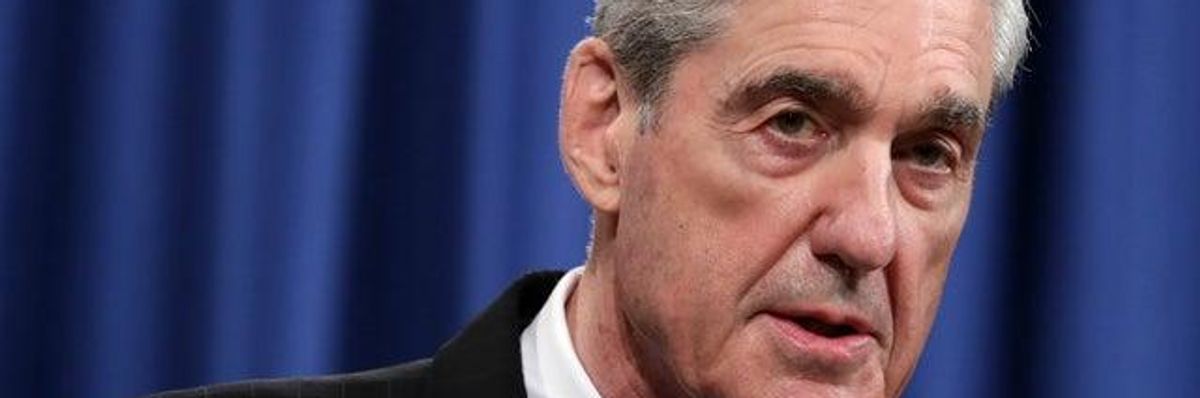
Even if Mueller does nothing more than read the most damaging parts of his report out loud, on national television, he would still have made the strongest case yet against Trump. (Photo: Bill Press)
The Sphinx speaks! In one of the most surreal moments in recent Washington history, special counsel Robert Mueller, who never spoke to reporters once in two years, suddenly held a news conference last Wednesday.
Nine minutes later, Americans knew what Mueller sounded like -- we'd never heard his voice before -- but we still weren't completely sure what the hell he said. Mueller spoke in such turgid prose, legal scholars will be parsing his words long after President Trump is gone, still trying to figure out exactly why Mueller called his news conference and what he was trying to say.
Still, through his fog of legalese, it's clear Mueller made several important points. One, Russia engaged in a massive, systematic effort to help Donald Trump get elected in 2016 -- which Trump has yet to acknowledge, let alone condemn. Two, despite Trump's denials, members of his team engaged on many occasions with Russian officials -- just not overtly enough to prove a criminal conspiracy. Three, at least 10 times Donald Trump attempted to obstruct justice (which is a crime!) by interfering with or trying to block the FBI investigation -- for which, Mueller all but acknowledged, he would have filed charges against Trump if a long-standing Department of Justice rule had not prevented his doing so.
In effect, Mueller said that both Trump and Attorney General William Barr were lying when they claimed that his report concluded with the finding of "No Collusion, No Obstruction." In fact, Mueller said he found evidence of both. And, in the "money shot" of his statement, he all but expressed regret that he was blocked by that obscure Justice Department rule from tagging Trump with a crime: "If we had confidence that the president clearly did not commit a crime, we would have said so."
At that point, however, having refused to exonerate Trump, Mueller drew the line. That was it. His final statement on the matter. I have nothing more to say, he insisted. It's all in the report. If you want to know more, read it. I hope members of Congress won't call me to testify. But, if they do, I won't say anything more than I said this morning.
And, with that, Mueller rode off into the sunset, never to be heard from again. Or so he hopes. But Democrats in Congress should not let him off the hook so easily. Of course, Mueller must testify. And the sooner, the better.
Will he say anything new? Maybe not. He says he won't say anything beyond what appears in his final report? He doesn't have to. We are, after all, a visual nation. Even if Mueller does nothing more than read the most damaging parts of his report out loud, on national television, he would still have made the strongest case yet against Trump.
Mueller should be pressed to do more than that, of course. Having been assigned, on behalf of the American people, to investigate possible wrongdoing by Trump, he should be asked under oath: Did members of the Trump campaign collude with Russia? Yes or No? Did Donald Trump obstruct justice? Yes or no? In your opinion, did the president break the law? Yes or No? Did the president commit impeachable offenses? Yes or No?
Until he appears before Congress and answers those questions -- even after an investigation lasting 675 days, employing 19 lawyers, interviewing 500 witnesses, issuing 34 indictments and 2,800 subpoenas, costing $25 million, and releasing a 448-page report -- Robert Mueller's work is not done.
Dear Common Dreams reader, It’s been nearly 30 years since I co-founded Common Dreams with my late wife, Lina Newhouser. We had the radical notion that journalism should serve the public good, not corporate profits. It was clear to us from the outset what it would take to build such a project. No paid advertisements. No corporate sponsors. No millionaire publisher telling us what to think or do. Many people said we wouldn't last a year, but we proved those doubters wrong. Together with a tremendous team of journalists and dedicated staff, we built an independent media outlet free from the constraints of profits and corporate control. Our mission has always been simple: To inform. To inspire. To ignite change for the common good. Building Common Dreams was not easy. Our survival was never guaranteed. When you take on the most powerful forces—Wall Street greed, fossil fuel industry destruction, Big Tech lobbyists, and uber-rich oligarchs who have spent billions upon billions rigging the economy and democracy in their favor—the only bulwark you have is supporters who believe in your work. But here’s the urgent message from me today. It's never been this bad out there. And it's never been this hard to keep us going. At the very moment Common Dreams is most needed, the threats we face are intensifying. We need your support now more than ever. We don't accept corporate advertising and never will. We don't have a paywall because we don't think people should be blocked from critical news based on their ability to pay. Everything we do is funded by the donations of readers like you. When everyone does the little they can afford, we are strong. But if that support retreats or dries up, so do we. Will you donate now to make sure Common Dreams not only survives but thrives? —Craig Brown, Co-founder |
The Sphinx speaks! In one of the most surreal moments in recent Washington history, special counsel Robert Mueller, who never spoke to reporters once in two years, suddenly held a news conference last Wednesday.
Nine minutes later, Americans knew what Mueller sounded like -- we'd never heard his voice before -- but we still weren't completely sure what the hell he said. Mueller spoke in such turgid prose, legal scholars will be parsing his words long after President Trump is gone, still trying to figure out exactly why Mueller called his news conference and what he was trying to say.
Still, through his fog of legalese, it's clear Mueller made several important points. One, Russia engaged in a massive, systematic effort to help Donald Trump get elected in 2016 -- which Trump has yet to acknowledge, let alone condemn. Two, despite Trump's denials, members of his team engaged on many occasions with Russian officials -- just not overtly enough to prove a criminal conspiracy. Three, at least 10 times Donald Trump attempted to obstruct justice (which is a crime!) by interfering with or trying to block the FBI investigation -- for which, Mueller all but acknowledged, he would have filed charges against Trump if a long-standing Department of Justice rule had not prevented his doing so.
In effect, Mueller said that both Trump and Attorney General William Barr were lying when they claimed that his report concluded with the finding of "No Collusion, No Obstruction." In fact, Mueller said he found evidence of both. And, in the "money shot" of his statement, he all but expressed regret that he was blocked by that obscure Justice Department rule from tagging Trump with a crime: "If we had confidence that the president clearly did not commit a crime, we would have said so."
At that point, however, having refused to exonerate Trump, Mueller drew the line. That was it. His final statement on the matter. I have nothing more to say, he insisted. It's all in the report. If you want to know more, read it. I hope members of Congress won't call me to testify. But, if they do, I won't say anything more than I said this morning.
And, with that, Mueller rode off into the sunset, never to be heard from again. Or so he hopes. But Democrats in Congress should not let him off the hook so easily. Of course, Mueller must testify. And the sooner, the better.
Will he say anything new? Maybe not. He says he won't say anything beyond what appears in his final report? He doesn't have to. We are, after all, a visual nation. Even if Mueller does nothing more than read the most damaging parts of his report out loud, on national television, he would still have made the strongest case yet against Trump.
Mueller should be pressed to do more than that, of course. Having been assigned, on behalf of the American people, to investigate possible wrongdoing by Trump, he should be asked under oath: Did members of the Trump campaign collude with Russia? Yes or No? Did Donald Trump obstruct justice? Yes or no? In your opinion, did the president break the law? Yes or No? Did the president commit impeachable offenses? Yes or No?
Until he appears before Congress and answers those questions -- even after an investigation lasting 675 days, employing 19 lawyers, interviewing 500 witnesses, issuing 34 indictments and 2,800 subpoenas, costing $25 million, and releasing a 448-page report -- Robert Mueller's work is not done.
The Sphinx speaks! In one of the most surreal moments in recent Washington history, special counsel Robert Mueller, who never spoke to reporters once in two years, suddenly held a news conference last Wednesday.
Nine minutes later, Americans knew what Mueller sounded like -- we'd never heard his voice before -- but we still weren't completely sure what the hell he said. Mueller spoke in such turgid prose, legal scholars will be parsing his words long after President Trump is gone, still trying to figure out exactly why Mueller called his news conference and what he was trying to say.
Still, through his fog of legalese, it's clear Mueller made several important points. One, Russia engaged in a massive, systematic effort to help Donald Trump get elected in 2016 -- which Trump has yet to acknowledge, let alone condemn. Two, despite Trump's denials, members of his team engaged on many occasions with Russian officials -- just not overtly enough to prove a criminal conspiracy. Three, at least 10 times Donald Trump attempted to obstruct justice (which is a crime!) by interfering with or trying to block the FBI investigation -- for which, Mueller all but acknowledged, he would have filed charges against Trump if a long-standing Department of Justice rule had not prevented his doing so.
In effect, Mueller said that both Trump and Attorney General William Barr were lying when they claimed that his report concluded with the finding of "No Collusion, No Obstruction." In fact, Mueller said he found evidence of both. And, in the "money shot" of his statement, he all but expressed regret that he was blocked by that obscure Justice Department rule from tagging Trump with a crime: "If we had confidence that the president clearly did not commit a crime, we would have said so."
At that point, however, having refused to exonerate Trump, Mueller drew the line. That was it. His final statement on the matter. I have nothing more to say, he insisted. It's all in the report. If you want to know more, read it. I hope members of Congress won't call me to testify. But, if they do, I won't say anything more than I said this morning.
And, with that, Mueller rode off into the sunset, never to be heard from again. Or so he hopes. But Democrats in Congress should not let him off the hook so easily. Of course, Mueller must testify. And the sooner, the better.
Will he say anything new? Maybe not. He says he won't say anything beyond what appears in his final report? He doesn't have to. We are, after all, a visual nation. Even if Mueller does nothing more than read the most damaging parts of his report out loud, on national television, he would still have made the strongest case yet against Trump.
Mueller should be pressed to do more than that, of course. Having been assigned, on behalf of the American people, to investigate possible wrongdoing by Trump, he should be asked under oath: Did members of the Trump campaign collude with Russia? Yes or No? Did Donald Trump obstruct justice? Yes or no? In your opinion, did the president break the law? Yes or No? Did the president commit impeachable offenses? Yes or No?
Until he appears before Congress and answers those questions -- even after an investigation lasting 675 days, employing 19 lawyers, interviewing 500 witnesses, issuing 34 indictments and 2,800 subpoenas, costing $25 million, and releasing a 448-page report -- Robert Mueller's work is not done.