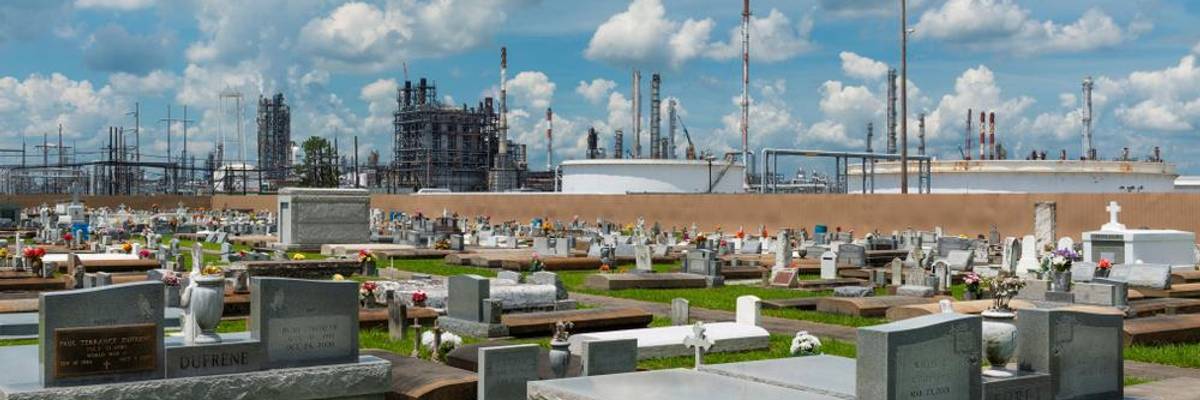
A cemetery in Taft, Louisiana, in the shadow of a petrochemical plant. The area is known as "Cancer Alley." (Photo: Shutterstock)
Climate Change Is a Poor People's Issue
Poor and working communities stand to gain the most from protections against corporations that expose them to pollution
If you've read anything about climate change over the past year, you've probably heard about the IPCC report that gives a 12-year deadline for limiting climate change catastrophe. But for many parts of the world, climate change already is a catastrophe.
Recently in Bihar, one of the poorest states in India, more than 40 people were killed by a severe heat wave in just one day. A study by UNICEF suggests that "in the next decade, 175 million children will be hit by climate-related disasters in South Asia and Africa alone." Closer to home, Miami's steady sinking is depleting useable drinking water at an alarming rate.
The truth is, vulnerable communities have been dealing with the effects of climate change and environmental pollution for decades now.
The 85-mile stretch between Baton Rouge and New Orleans -- aptly nicknamed Cancer Alley -- is a stark example. Thanks to petrochemical pollution there, Louisiana at one point suffered the second-highest death rate from cancer in the United States, with some localities near chemical plants getting cancer from air pollution at 700 times the national average.
This is no accident: Corporations deliberately target places like Cancer Alley because they're home to socially and economically disadvantaged people whom the corporations assume can't fight back.
There's even a name for it: "least resistant personality profiles." Sociologist Arlie Hochschild discovered this term in a 1984 study done by a consulting firm to determine where a waste board could build a plant without local communities complaining.
According to the study, the people least likely to protest having their health put at risk were typically "longtime residents of small towns in the South or Midwest, high school educated only, Catholic, uninvolved in social issues, and without a history of activism, involved in mining, farming, ranching, conservative, Republican, advocates of the free market."
While this study only tells part of the story, it does a lot to explain why poor communities face the worst consequences of climate change and pollution. These inequities cut across racial lines: As Hochschild's study shows, "least resistant personalities" include small town, working-class white communities in the South and Midwest, as well as poor black people in places like Cancer Alley.
The problem isn't just corporations, but government at all levels.
After Hurricane Maria hit Puerto Rico in 2017, the federal government did next to nothing. The comparison between the responses to 9/11 and Hurricane Maria -- whose death tolls were almost exactly the same -- highlights just how overlooked the suffering caused to marginalized communities by climate change is.
The idea that environmentalism is an "elite" concern is a lie. Those who stand to gain the most from sweeping environmental protections are the marginalized people corporations assume can be put in toxic environments without fear of backlash.
That's the best reason yet to support a Green New Deal, which would not only curb climate change, but also revitalize the U.S. economy, create millions of jobs, and create alternatives to harmful, unsustainable industries like the petrochemical industry in Cancer Alley that have harmed people for years.
That could make poor communities a lot less poor -- and a lot more resilient.
The only way to move forward is to fight back against corporations that deliberately target the people they think can't fight back -- and against a government seemingly unconcerned about the effects of pollution and climate change. The catastrophe is happening now, but so it the movement to combat it.
We are at a crossroads
This country and this world are at a monumental crossroads. In a few short weeks, US voters will have an opportunity to beat back the forces of fascism and confront the billionaires who are rigging the economy, our media system, and our democracy, making it increasingly impossible for ordinary people to get by. We’re not just talking about the election. We’re talking about what must be done once these fascist elements are vanquished from power. We need a bolder set of solutions than what either major party has so far been willing to offer and a working-class movement ready to fight like hell for it. Trump didn't emerge from nowhere. The conditions that fueled MAGA authoritarianism were created by decades of radical neoliberal economic policies and a corrupt political system dominated by corporate interests. They slashed taxes on the super-rich, promising that the benefits would trickle down. They said giveaways to the corporate titans would make life more affordable for the rest of us. It was all bullshit. And when a bitter, betrayed populace searches for someone to blame, right-wing demagogues have little trouble finding scapegoats. People know when they're being lied to, but you won't hear any of this from the corporate media. Only independent journalism—powered and funded by people who believe in building a better world—can deliver truly trustworthy daily news. Our Fall Campaign is underway, and we need your help. To power our newsroom through the rest of the year, we need to raise $125,000 by midnight on October 31. So if you share our vision, please contribute whatever you can to sustain our work. |
If you've read anything about climate change over the past year, you've probably heard about the IPCC report that gives a 12-year deadline for limiting climate change catastrophe. But for many parts of the world, climate change already is a catastrophe.
Recently in Bihar, one of the poorest states in India, more than 40 people were killed by a severe heat wave in just one day. A study by UNICEF suggests that "in the next decade, 175 million children will be hit by climate-related disasters in South Asia and Africa alone." Closer to home, Miami's steady sinking is depleting useable drinking water at an alarming rate.
The truth is, vulnerable communities have been dealing with the effects of climate change and environmental pollution for decades now.
The 85-mile stretch between Baton Rouge and New Orleans -- aptly nicknamed Cancer Alley -- is a stark example. Thanks to petrochemical pollution there, Louisiana at one point suffered the second-highest death rate from cancer in the United States, with some localities near chemical plants getting cancer from air pollution at 700 times the national average.
This is no accident: Corporations deliberately target places like Cancer Alley because they're home to socially and economically disadvantaged people whom the corporations assume can't fight back.
There's even a name for it: "least resistant personality profiles." Sociologist Arlie Hochschild discovered this term in a 1984 study done by a consulting firm to determine where a waste board could build a plant without local communities complaining.
According to the study, the people least likely to protest having their health put at risk were typically "longtime residents of small towns in the South or Midwest, high school educated only, Catholic, uninvolved in social issues, and without a history of activism, involved in mining, farming, ranching, conservative, Republican, advocates of the free market."
While this study only tells part of the story, it does a lot to explain why poor communities face the worst consequences of climate change and pollution. These inequities cut across racial lines: As Hochschild's study shows, "least resistant personalities" include small town, working-class white communities in the South and Midwest, as well as poor black people in places like Cancer Alley.
The problem isn't just corporations, but government at all levels.
After Hurricane Maria hit Puerto Rico in 2017, the federal government did next to nothing. The comparison between the responses to 9/11 and Hurricane Maria -- whose death tolls were almost exactly the same -- highlights just how overlooked the suffering caused to marginalized communities by climate change is.
The idea that environmentalism is an "elite" concern is a lie. Those who stand to gain the most from sweeping environmental protections are the marginalized people corporations assume can be put in toxic environments without fear of backlash.
That's the best reason yet to support a Green New Deal, which would not only curb climate change, but also revitalize the U.S. economy, create millions of jobs, and create alternatives to harmful, unsustainable industries like the petrochemical industry in Cancer Alley that have harmed people for years.
That could make poor communities a lot less poor -- and a lot more resilient.
The only way to move forward is to fight back against corporations that deliberately target the people they think can't fight back -- and against a government seemingly unconcerned about the effects of pollution and climate change. The catastrophe is happening now, but so it the movement to combat it.