SUBSCRIBE TO OUR FREE NEWSLETTER
Daily news & progressive opinion—funded by the people, not the corporations—delivered straight to your inbox.
5
#000000
#FFFFFF
To donate by check, phone, or other method, see our More Ways to Give page.
Daily news & progressive opinion—funded by the people, not the corporations—delivered straight to your inbox.
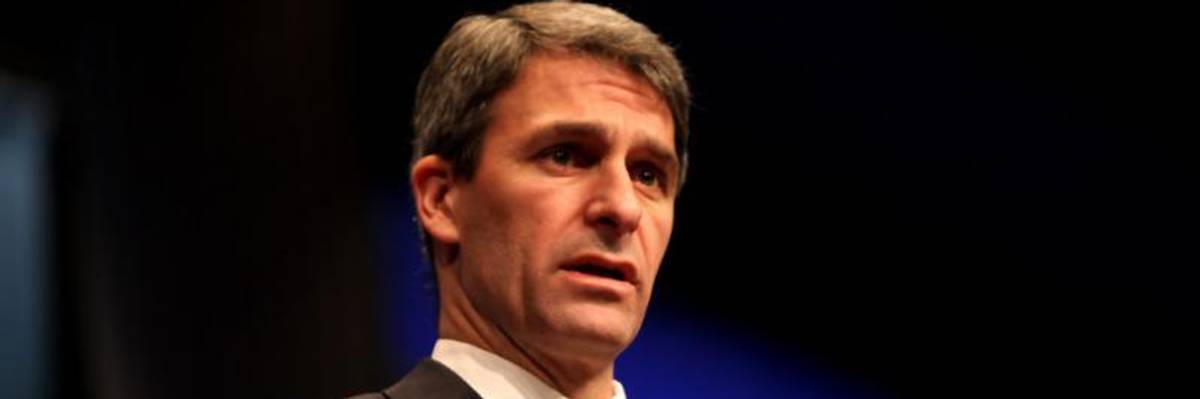
This week, Ken Cuccinelli, acting director of U.S. Citizenship and Immigration Services, announced updates to the public charge rule that would bar immigrants who use safety-net programs including Medicaid and food stamps from obtaining green cards. (Photo: Gage Skidmore via Flickr.)
Two weeks ago, a 21-year-old white man from Dallas drove 10 hours to El Paso, Texas -- a city where a majority of families have Mexican roots -- and shot and killed 22 people and injured 24 others at a Walmart. It was the worst terrorist attack on Latino people in U.S. history. In a manifesto released shortly before the attack, the man said he was inspired to kill because of the "invasion of Hispanics" entering the United States, a phrase often deployed by President Trump to promote harsh immigration policies
Just days later, ICE raided seven chicken processing plants in Mississippi, detaining nearly 700 undocumented workers, most of them Latinos. The record-breaking raid took place on the first day of school in the state, leaving children sobbing as they waited to learn what happened to their parents.
But the Trump administration's attacks on immigrants weren't over yet.
This week it issued a new rule that would change U.S. immigration policy to bar legal immigrants from permanent residency if they or someone in their household has benefited from public assistance programs. The so-called "public charge" rule is set to take effect on Oct. 15.
Speaking to NPR reporter Rachel Martin this week, Ken Cuccinelli -- the former attorney general of Virginia and current acting director of U.S. Citizenship and Immigration Services -- was asked about the Emma Lazarus poem etched beneath the Statue of Liberty that says, "Give me your tired, your poor, your huddled masses."
"Give me your tired, your poor, who can stand on their own two feet," Cuccinelli said. He later said the poem was only referencing European immigrants, a false claim that has been debunked.
The U.S. adopted the first public charge rule blocking prospective immigrants due to disability or lack of economic resources in the late 19th century. Besides denying entry to Chinese and Mexican immigrants, U.S. policy at the time barred from entry Southern and Eastern Europeans -- many of whom were Jewish -- if they did not have $20 cash on hand and a ticket to their destination.
Over time, the U.S. became more lenient in applying the public charge rule toward Europeans who utilized public relief programs. But it treated Mexican immigrants who did the same harshly, and ultimately expelled residents of Mexican descent en masse during the Great Depression.
Harkening back to these xenophobic policies, Trump's public charge rule represents a significant change from the guidelines in place since 1999. Under the current policy, only cash assistance programs like Temporary Assistance for Needy Families and Supplemental Security Income are considered, but the new guidelines also count Medicaid, Section 8 housing assistance, and the Supplemental Nutrition Assistance Program (SNAP) as potentially disqualifying benefits.
The rule could have a particularly devastating effect on immigrant communities in the South, the nation's poorest region. There, programs like housing assistance and SNAP have helped to lift millions out of poverty. And of the 15 states with the most SNAP beneficiaries, eight are in the South: Alabama, Florida, Georgia, Kentucky, Louisiana, Mississippi, Tennessee, and West Virginia.
There have already been reports of immigrants withdrawing from safety-net programs out of fear that their immigration status could be in jeopardy. Meanwhile, advocacy groups like the National Law Center on Homelessness & Poverty point to what they believe to be the real problem for immigrants and non-immigrants alike: lack of resources.
"We all share the concern that millions of U.S. households struggle to find affordable housing in the ongoing nationwide housing crisis," Eric Tars, the group's legal director, said in a press release. "But blaming struggling immigrant families will not fix the problem."
Lawsuits have already been filed to block the new rule. One was filed on Tuesday by California's Santa Clara County and the city of San Francisco, while another was filed on Wednesday by 13 states -- including Cuccinelli's home state of Virginia.
Current Virginia Attorney General Mark Herring, a Democrat, called the rule change "shameful and unlawful."
"The Trump administration's overhaul could expose thousands of lawful immigrants and green card holders to deportation, and force them to make an inhumane choice of whether to protect their lawful immigration status or risk it by accessing health care, food, or housing assistance for which they are already eligible," Herring wrote. "In fact, the Department of Homeland Security has admitted that the rule would 'deter legally present visa holders from using important assistance programs.'"
Dear Common Dreams reader, It’s been nearly 30 years since I co-founded Common Dreams with my late wife, Lina Newhouser. We had the radical notion that journalism should serve the public good, not corporate profits. It was clear to us from the outset what it would take to build such a project. No paid advertisements. No corporate sponsors. No millionaire publisher telling us what to think or do. Many people said we wouldn't last a year, but we proved those doubters wrong. Together with a tremendous team of journalists and dedicated staff, we built an independent media outlet free from the constraints of profits and corporate control. Our mission has always been simple: To inform. To inspire. To ignite change for the common good. Building Common Dreams was not easy. Our survival was never guaranteed. When you take on the most powerful forces—Wall Street greed, fossil fuel industry destruction, Big Tech lobbyists, and uber-rich oligarchs who have spent billions upon billions rigging the economy and democracy in their favor—the only bulwark you have is supporters who believe in your work. But here’s the urgent message from me today. It's never been this bad out there. And it's never been this hard to keep us going. At the very moment Common Dreams is most needed, the threats we face are intensifying. We need your support now more than ever. We don't accept corporate advertising and never will. We don't have a paywall because we don't think people should be blocked from critical news based on their ability to pay. Everything we do is funded by the donations of readers like you. When everyone does the little they can afford, we are strong. But if that support retreats or dries up, so do we. Will you donate now to make sure Common Dreams not only survives but thrives? —Craig Brown, Co-founder |
Two weeks ago, a 21-year-old white man from Dallas drove 10 hours to El Paso, Texas -- a city where a majority of families have Mexican roots -- and shot and killed 22 people and injured 24 others at a Walmart. It was the worst terrorist attack on Latino people in U.S. history. In a manifesto released shortly before the attack, the man said he was inspired to kill because of the "invasion of Hispanics" entering the United States, a phrase often deployed by President Trump to promote harsh immigration policies
Just days later, ICE raided seven chicken processing plants in Mississippi, detaining nearly 700 undocumented workers, most of them Latinos. The record-breaking raid took place on the first day of school in the state, leaving children sobbing as they waited to learn what happened to their parents.
But the Trump administration's attacks on immigrants weren't over yet.
This week it issued a new rule that would change U.S. immigration policy to bar legal immigrants from permanent residency if they or someone in their household has benefited from public assistance programs. The so-called "public charge" rule is set to take effect on Oct. 15.
Speaking to NPR reporter Rachel Martin this week, Ken Cuccinelli -- the former attorney general of Virginia and current acting director of U.S. Citizenship and Immigration Services -- was asked about the Emma Lazarus poem etched beneath the Statue of Liberty that says, "Give me your tired, your poor, your huddled masses."
"Give me your tired, your poor, who can stand on their own two feet," Cuccinelli said. He later said the poem was only referencing European immigrants, a false claim that has been debunked.
The U.S. adopted the first public charge rule blocking prospective immigrants due to disability or lack of economic resources in the late 19th century. Besides denying entry to Chinese and Mexican immigrants, U.S. policy at the time barred from entry Southern and Eastern Europeans -- many of whom were Jewish -- if they did not have $20 cash on hand and a ticket to their destination.
Over time, the U.S. became more lenient in applying the public charge rule toward Europeans who utilized public relief programs. But it treated Mexican immigrants who did the same harshly, and ultimately expelled residents of Mexican descent en masse during the Great Depression.
Harkening back to these xenophobic policies, Trump's public charge rule represents a significant change from the guidelines in place since 1999. Under the current policy, only cash assistance programs like Temporary Assistance for Needy Families and Supplemental Security Income are considered, but the new guidelines also count Medicaid, Section 8 housing assistance, and the Supplemental Nutrition Assistance Program (SNAP) as potentially disqualifying benefits.
The rule could have a particularly devastating effect on immigrant communities in the South, the nation's poorest region. There, programs like housing assistance and SNAP have helped to lift millions out of poverty. And of the 15 states with the most SNAP beneficiaries, eight are in the South: Alabama, Florida, Georgia, Kentucky, Louisiana, Mississippi, Tennessee, and West Virginia.
There have already been reports of immigrants withdrawing from safety-net programs out of fear that their immigration status could be in jeopardy. Meanwhile, advocacy groups like the National Law Center on Homelessness & Poverty point to what they believe to be the real problem for immigrants and non-immigrants alike: lack of resources.
"We all share the concern that millions of U.S. households struggle to find affordable housing in the ongoing nationwide housing crisis," Eric Tars, the group's legal director, said in a press release. "But blaming struggling immigrant families will not fix the problem."
Lawsuits have already been filed to block the new rule. One was filed on Tuesday by California's Santa Clara County and the city of San Francisco, while another was filed on Wednesday by 13 states -- including Cuccinelli's home state of Virginia.
Current Virginia Attorney General Mark Herring, a Democrat, called the rule change "shameful and unlawful."
"The Trump administration's overhaul could expose thousands of lawful immigrants and green card holders to deportation, and force them to make an inhumane choice of whether to protect their lawful immigration status or risk it by accessing health care, food, or housing assistance for which they are already eligible," Herring wrote. "In fact, the Department of Homeland Security has admitted that the rule would 'deter legally present visa holders from using important assistance programs.'"
Two weeks ago, a 21-year-old white man from Dallas drove 10 hours to El Paso, Texas -- a city where a majority of families have Mexican roots -- and shot and killed 22 people and injured 24 others at a Walmart. It was the worst terrorist attack on Latino people in U.S. history. In a manifesto released shortly before the attack, the man said he was inspired to kill because of the "invasion of Hispanics" entering the United States, a phrase often deployed by President Trump to promote harsh immigration policies
Just days later, ICE raided seven chicken processing plants in Mississippi, detaining nearly 700 undocumented workers, most of them Latinos. The record-breaking raid took place on the first day of school in the state, leaving children sobbing as they waited to learn what happened to their parents.
But the Trump administration's attacks on immigrants weren't over yet.
This week it issued a new rule that would change U.S. immigration policy to bar legal immigrants from permanent residency if they or someone in their household has benefited from public assistance programs. The so-called "public charge" rule is set to take effect on Oct. 15.
Speaking to NPR reporter Rachel Martin this week, Ken Cuccinelli -- the former attorney general of Virginia and current acting director of U.S. Citizenship and Immigration Services -- was asked about the Emma Lazarus poem etched beneath the Statue of Liberty that says, "Give me your tired, your poor, your huddled masses."
"Give me your tired, your poor, who can stand on their own two feet," Cuccinelli said. He later said the poem was only referencing European immigrants, a false claim that has been debunked.
The U.S. adopted the first public charge rule blocking prospective immigrants due to disability or lack of economic resources in the late 19th century. Besides denying entry to Chinese and Mexican immigrants, U.S. policy at the time barred from entry Southern and Eastern Europeans -- many of whom were Jewish -- if they did not have $20 cash on hand and a ticket to their destination.
Over time, the U.S. became more lenient in applying the public charge rule toward Europeans who utilized public relief programs. But it treated Mexican immigrants who did the same harshly, and ultimately expelled residents of Mexican descent en masse during the Great Depression.
Harkening back to these xenophobic policies, Trump's public charge rule represents a significant change from the guidelines in place since 1999. Under the current policy, only cash assistance programs like Temporary Assistance for Needy Families and Supplemental Security Income are considered, but the new guidelines also count Medicaid, Section 8 housing assistance, and the Supplemental Nutrition Assistance Program (SNAP) as potentially disqualifying benefits.
The rule could have a particularly devastating effect on immigrant communities in the South, the nation's poorest region. There, programs like housing assistance and SNAP have helped to lift millions out of poverty. And of the 15 states with the most SNAP beneficiaries, eight are in the South: Alabama, Florida, Georgia, Kentucky, Louisiana, Mississippi, Tennessee, and West Virginia.
There have already been reports of immigrants withdrawing from safety-net programs out of fear that their immigration status could be in jeopardy. Meanwhile, advocacy groups like the National Law Center on Homelessness & Poverty point to what they believe to be the real problem for immigrants and non-immigrants alike: lack of resources.
"We all share the concern that millions of U.S. households struggle to find affordable housing in the ongoing nationwide housing crisis," Eric Tars, the group's legal director, said in a press release. "But blaming struggling immigrant families will not fix the problem."
Lawsuits have already been filed to block the new rule. One was filed on Tuesday by California's Santa Clara County and the city of San Francisco, while another was filed on Wednesday by 13 states -- including Cuccinelli's home state of Virginia.
Current Virginia Attorney General Mark Herring, a Democrat, called the rule change "shameful and unlawful."
"The Trump administration's overhaul could expose thousands of lawful immigrants and green card holders to deportation, and force them to make an inhumane choice of whether to protect their lawful immigration status or risk it by accessing health care, food, or housing assistance for which they are already eligible," Herring wrote. "In fact, the Department of Homeland Security has admitted that the rule would 'deter legally present visa holders from using important assistance programs.'"