SUBSCRIBE TO OUR FREE NEWSLETTER
Daily news & progressive opinion—funded by the people, not the corporations—delivered straight to your inbox.
5
#000000
#FFFFFF
To donate by check, phone, or other method, see our More Ways to Give page.
Daily news & progressive opinion—funded by the people, not the corporations—delivered straight to your inbox.
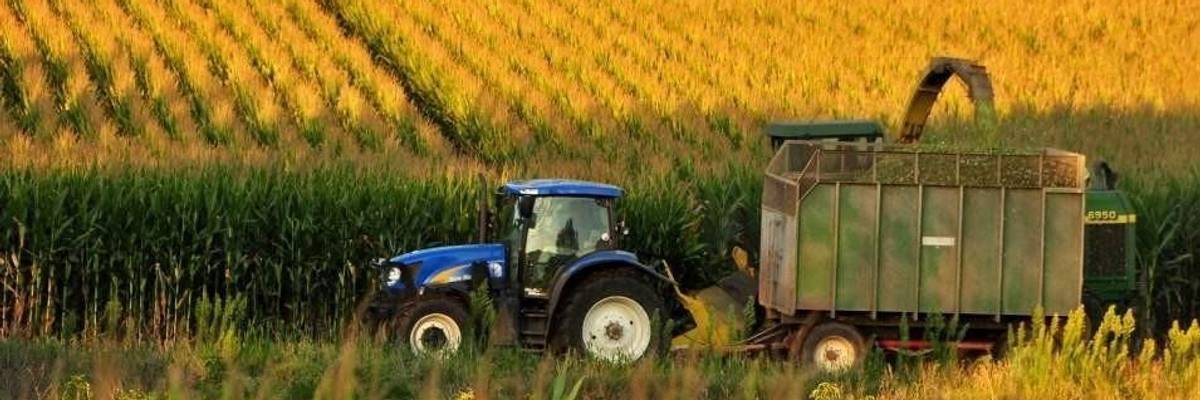
Kudos to Senator Warren for endorsing the Farmers Bill of Rights, and to Senator Sanders for seriously mentioning the farm crisis. (Photo: TumblingRun/flickr/cc)
On January 11, 1944 in his annual State of the Union Address, President Roosevelt noted that while the Constitution guaranteed a set of political rights, they were in some respects inadequate. To ensure equality, Roosevelt proposed an Economic Bill of Rights that would guarantee:
Many items from the Economic Bill of Rights have emerged in the 2020 presidential campaigns, such as the call for free post-secondary education, affordable housing, anti-trust enforcement, Medicare for all, and a living wage. Yet, only Senators Warren and Sanders have mentioned fair incomes for farmers. Senator Warren, particularly, expressed her support for rural people by endorsing the "Farmers Bill of Rights" - of which fair income is a part - while attending Family Farm Action's Rally and The Heartland Forum in Storm Lake, Iowa.
Now, unlike 1921, the marketplace is a global one that pits farmers against farmers worldwide.
Besides a fair income, just like other workers, the Farmers Bill of Rights seeks to guarantee farmers fair and open markets that are not dominated by a handful of corporations. It also promotes access to local supply stores, mechanics, and processing facilities. The proposal also intends to assure the provision of credit to women, beginning, immigrant, and minority farmers, while pushing for reasonable environmental standards for all rural people. Moreover, the proposition includes the right to transparent and accurate enforcement of production practices, including organic and country of origin labeling, as well as the right to repair our own equipment rather than being forced to pay corporations that feel they still "own" the rights to what we purchase.
Rural people are entitled to the right to live in healthy, vigorous communities that have quality schools, medical care, and opportunities for all.
Why do we need a Farmers Bill of Rights now? There used to be legal protections for farmers and consumers. The Packers and Stockyards Act of 1921, which became part of the Grain Inspection, Packers and Stockyards Administration (GIPSA) in 1994, was previously known as the Farmers and Ranchers Bill of Rights. Back in 1921, protection from the predatory practices of the highly consolidated meat packing industry was sorely needed. Yet, in 2017 the Trump administration decided not to finalize the Farmer Fair Practice Rules within GIPSA. The rules clarify what counts as fair trade practices, helping farmers and ranchers understand their rights in the marketplace and to impede corporate overreach. To make matters worse, GIPSA was then absorbed within the Agricultural Marketing Service, whose mission is more oriented to protecting the interests of corporate agribusiness than those of family farmers.
While corporate agribusiness continues to consolidate, with little more than a wink and a nod from government regulators, farmers must take the price offered in the marketplace. Now, unlike 1921, the marketplace is a global one that pits farmers against farmers worldwide. Buyers pay as little as possible, driving down the prices that farmers receive. According to the National Farmers Union (NFU), farmers earn less than $.15 of every food dollar. As incomes have slumped over the last few years, input costs have increased for feed, seed, fertilizer, fuel and machinery. Trump's tariffson imports from our trading partners and their retaliatory tariffs on our agricultural exports has caused even more pain in rural America. This squeezes farmers and consumers, as even in supermarkets with seemingly thousands of brands on the shelf, the reality is, most are owned by a handful of corporations.
So, in addition to all the parts of Roosevelt's Economic Bill of Rights that are currently receiving attention, those of us in farm country are in desperate need for a Farmers Bill of Rights.
Kudos to Senator Warren for endorsing the Farmers Bill of Rights, and to Senator Sanders for seriously mentioning the farm crisis. As to the other candidates, when will you get on board and come up with some serious farm policy discussion, some real solutions to the ongoing devastation of rural America?
This country and this world are at a monumental crossroads. US voters have an opportunity to beat back the forces of fascism and confront the billionaires who are rigging the economy, our media system, and our democracy, making it increasingly impossible for ordinary people to get by. We’re not just talking about the election. We’re talking about what must be done once these fascist elements are vanquished from power. We need a bolder set of solutions than what either major party has so far been willing to offer and a working-class movement ready to fight like hell for it. Trump didn't emerge from nowhere. The conditions that fueled MAGA authoritarianism were created by decades of radical neoliberal economic policies and a corrupt political system dominated by corporate interests. They slashed taxes on the super-rich, promising that the benefits would trickle down. They said giveaways to the corporate titans would make life more affordable for the rest of us. It was all bullshit. And when a bitter, betrayed populace searches for someone to blame, right-wing demagogues have little trouble finding scapegoats. People know when they're being lied to, but you won't hear any of this from the corporate media. Only independent journalism—powered and funded by people who believe in building a better world—can deliver truly trustworthy daily news. If you share our vision, please contribute whatever you can to sustain our work. |
On January 11, 1944 in his annual State of the Union Address, President Roosevelt noted that while the Constitution guaranteed a set of political rights, they were in some respects inadequate. To ensure equality, Roosevelt proposed an Economic Bill of Rights that would guarantee:
Many items from the Economic Bill of Rights have emerged in the 2020 presidential campaigns, such as the call for free post-secondary education, affordable housing, anti-trust enforcement, Medicare for all, and a living wage. Yet, only Senators Warren and Sanders have mentioned fair incomes for farmers. Senator Warren, particularly, expressed her support for rural people by endorsing the "Farmers Bill of Rights" - of which fair income is a part - while attending Family Farm Action's Rally and The Heartland Forum in Storm Lake, Iowa.
Now, unlike 1921, the marketplace is a global one that pits farmers against farmers worldwide.
Besides a fair income, just like other workers, the Farmers Bill of Rights seeks to guarantee farmers fair and open markets that are not dominated by a handful of corporations. It also promotes access to local supply stores, mechanics, and processing facilities. The proposal also intends to assure the provision of credit to women, beginning, immigrant, and minority farmers, while pushing for reasonable environmental standards for all rural people. Moreover, the proposition includes the right to transparent and accurate enforcement of production practices, including organic and country of origin labeling, as well as the right to repair our own equipment rather than being forced to pay corporations that feel they still "own" the rights to what we purchase.
Rural people are entitled to the right to live in healthy, vigorous communities that have quality schools, medical care, and opportunities for all.
Why do we need a Farmers Bill of Rights now? There used to be legal protections for farmers and consumers. The Packers and Stockyards Act of 1921, which became part of the Grain Inspection, Packers and Stockyards Administration (GIPSA) in 1994, was previously known as the Farmers and Ranchers Bill of Rights. Back in 1921, protection from the predatory practices of the highly consolidated meat packing industry was sorely needed. Yet, in 2017 the Trump administration decided not to finalize the Farmer Fair Practice Rules within GIPSA. The rules clarify what counts as fair trade practices, helping farmers and ranchers understand their rights in the marketplace and to impede corporate overreach. To make matters worse, GIPSA was then absorbed within the Agricultural Marketing Service, whose mission is more oriented to protecting the interests of corporate agribusiness than those of family farmers.
While corporate agribusiness continues to consolidate, with little more than a wink and a nod from government regulators, farmers must take the price offered in the marketplace. Now, unlike 1921, the marketplace is a global one that pits farmers against farmers worldwide. Buyers pay as little as possible, driving down the prices that farmers receive. According to the National Farmers Union (NFU), farmers earn less than $.15 of every food dollar. As incomes have slumped over the last few years, input costs have increased for feed, seed, fertilizer, fuel and machinery. Trump's tariffson imports from our trading partners and their retaliatory tariffs on our agricultural exports has caused even more pain in rural America. This squeezes farmers and consumers, as even in supermarkets with seemingly thousands of brands on the shelf, the reality is, most are owned by a handful of corporations.
So, in addition to all the parts of Roosevelt's Economic Bill of Rights that are currently receiving attention, those of us in farm country are in desperate need for a Farmers Bill of Rights.
Kudos to Senator Warren for endorsing the Farmers Bill of Rights, and to Senator Sanders for seriously mentioning the farm crisis. As to the other candidates, when will you get on board and come up with some serious farm policy discussion, some real solutions to the ongoing devastation of rural America?