
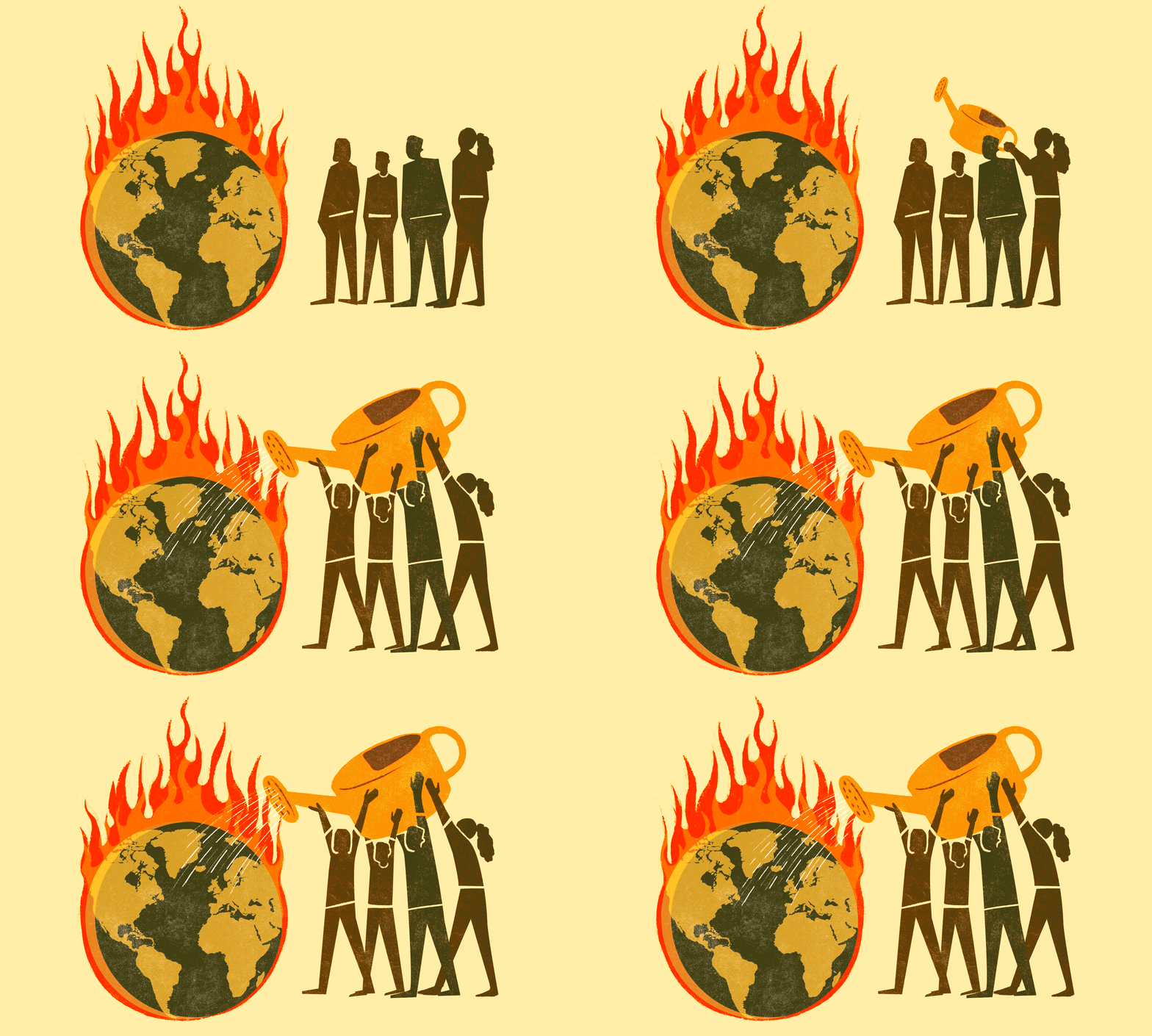
Because we burn so much coal and gas and oil, the atmosphere of our world is changing rapidly, and that atmospheric change is producing record heat. (Photo: YES! illustration by Jennifer Luxton)
Bill McKibben: This Climate Strike Is Part of the Disruption We Need
"It can’t just be young people. It needs to be all of us."
Business as usual is what's doing us in.
We live on a planet that finds itself rather suddenly in the midst of an enormous physical crisis. Because we burn so much coal and gas and oil, the atmosphere of our world is changing rapidly, and that atmospheric change is producing record heat. July was the hottest month we've ever recorded. Scientists predict with confidence that we stand on the edge of the sixth great extinction event of the last billion years. People are dying in large numbers and being left homeless; millions are already on the move because they have no choice.
Scientists predict with confidence that we stand on the edge of the sixth great extinction event of the last billion years. People are dying in large numbers and being left homeless; millions are already on the move because they have no choice. And yet we continue on with our usual patterns.
And yet we continue on with our usual patterns. We get up each morning and do pretty much what we did the day before. It's not like the last time we were in an existential crisis, when Americans signed up for the Army and crossed the Atlantic to face down fascism and when the people back home signed up for new jobs and changed their daily lives.
That's why it's such good news that the climate movement has a new tactic. Pioneered last August by Greta Thunberg of Sweden, it involves disrupting business as usual. It began, of course, in schools: Within months, millions of young people around the world were striking for days at a time from their classes. Their logic was impeccable: If the institutions of our planet can't be bothered to prepare for a world we can live in, why must we spend years preparing ourselves? If you break the social contract, why are we bound by it?
And now those young people have asked the rest of us to join in. After the last great school strike in May, they asked adults to take part next time. The date is Sept. 20, and the location is absolutely everywhere. Big trade unions in South Africa and Germany are telling workers to take the day off. Ben and Jerry's is closing down its headquarters (stock up in advance), and if you want to buy Lush cosmetics, you're going to be out of luck. The largest rally will likely be in New York City, where the U.N. General Assembly begins debating climate change that week--but there will be gatherings in every state and every country. It will almost certainly be the biggest day of climate action in the planet's history. (If you want to be a part--and you do want to be a part--go to globalclimatestrike.net.)
It's not a "strike" in the traditional sense, of course--no one is demanding better wages. But we are demanding better conditions. In the most literal sense, the world isn't working as it should (studies say that increased heat and humidity have already reduced human work capacity as much as 10%, a figure that will double by midcentury). And what we're saying is, disrupting business as usual is the way to get there.
This strike will not be the last such action. And activists are flooding into the electoral battles now underway and taking on the financial community, too. It's starting to add up: The polling shows that for young Americans, climate change is far and away the most important issue.
But it can't be just young people. It needs to be all of us--especially, perhaps, those of us who have been placidly operating on a business-as-usual basis for most of our lives, who have rarely faced truly serious disruptions in our careers and our plans. Our job is precisely to disrupt business as usual. When the planet leaves its comfort zone, we need to do the same. See you on the streets on Sept. 20!
We are at a crossroads
This country and this world are at a monumental crossroads. US voters have an opportunity to beat back the forces of fascism and confront the billionaires who are rigging the economy, our media system, and our democracy, making it increasingly impossible for ordinary people to get by. We’re not just talking about the election. We’re talking about what must be done once these fascist elements are vanquished from power. We need a bolder set of solutions than what either major party has so far been willing to offer and a working-class movement ready to fight like hell for it. Trump didn't emerge from nowhere. The conditions that fueled MAGA authoritarianism were created by decades of radical neoliberal economic policies and a corrupt political system dominated by corporate interests. They slashed taxes on the super-rich, promising that the benefits would trickle down. They said giveaways to the corporate titans would make life more affordable for the rest of us. It was all bullshit. And when a bitter, betrayed populace searches for someone to blame, right-wing demagogues have little trouble finding scapegoats. People know when they're being lied to, but you won't hear any of this from the corporate media. Only independent journalism—powered and funded by people who believe in building a better world—can deliver truly trustworthy daily news. Our Fall Campaign is underway, and we need your help. To power our newsroom through the rest of the year, we need to raise $125,000 by midnight on October 31. So if you share our vision, please contribute whatever you can to sustain our work. |
Business as usual is what's doing us in.
We live on a planet that finds itself rather suddenly in the midst of an enormous physical crisis. Because we burn so much coal and gas and oil, the atmosphere of our world is changing rapidly, and that atmospheric change is producing record heat. July was the hottest month we've ever recorded. Scientists predict with confidence that we stand on the edge of the sixth great extinction event of the last billion years. People are dying in large numbers and being left homeless; millions are already on the move because they have no choice.
Scientists predict with confidence that we stand on the edge of the sixth great extinction event of the last billion years. People are dying in large numbers and being left homeless; millions are already on the move because they have no choice. And yet we continue on with our usual patterns.
And yet we continue on with our usual patterns. We get up each morning and do pretty much what we did the day before. It's not like the last time we were in an existential crisis, when Americans signed up for the Army and crossed the Atlantic to face down fascism and when the people back home signed up for new jobs and changed their daily lives.
That's why it's such good news that the climate movement has a new tactic. Pioneered last August by Greta Thunberg of Sweden, it involves disrupting business as usual. It began, of course, in schools: Within months, millions of young people around the world were striking for days at a time from their classes. Their logic was impeccable: If the institutions of our planet can't be bothered to prepare for a world we can live in, why must we spend years preparing ourselves? If you break the social contract, why are we bound by it?
And now those young people have asked the rest of us to join in. After the last great school strike in May, they asked adults to take part next time. The date is Sept. 20, and the location is absolutely everywhere. Big trade unions in South Africa and Germany are telling workers to take the day off. Ben and Jerry's is closing down its headquarters (stock up in advance), and if you want to buy Lush cosmetics, you're going to be out of luck. The largest rally will likely be in New York City, where the U.N. General Assembly begins debating climate change that week--but there will be gatherings in every state and every country. It will almost certainly be the biggest day of climate action in the planet's history. (If you want to be a part--and you do want to be a part--go to globalclimatestrike.net.)
It's not a "strike" in the traditional sense, of course--no one is demanding better wages. But we are demanding better conditions. In the most literal sense, the world isn't working as it should (studies say that increased heat and humidity have already reduced human work capacity as much as 10%, a figure that will double by midcentury). And what we're saying is, disrupting business as usual is the way to get there.
This strike will not be the last such action. And activists are flooding into the electoral battles now underway and taking on the financial community, too. It's starting to add up: The polling shows that for young Americans, climate change is far and away the most important issue.
But it can't be just young people. It needs to be all of us--especially, perhaps, those of us who have been placidly operating on a business-as-usual basis for most of our lives, who have rarely faced truly serious disruptions in our careers and our plans. Our job is precisely to disrupt business as usual. When the planet leaves its comfort zone, we need to do the same. See you on the streets on Sept. 20!