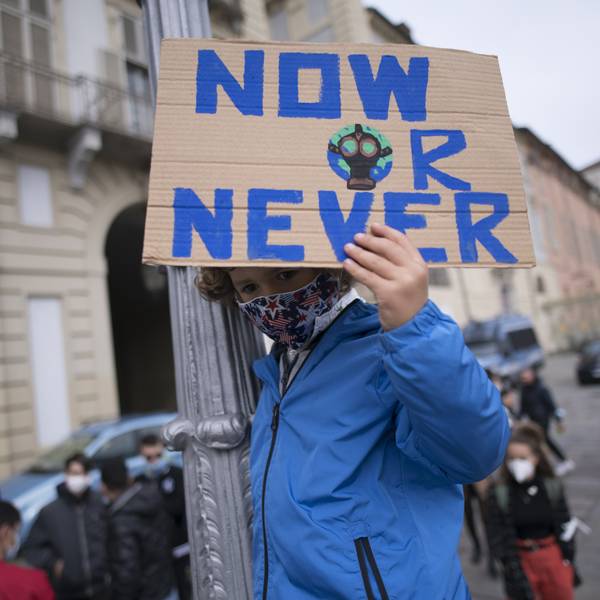


"As a global movement for environmental justice, we will not allow the pursuit of profit to restrict our collective imagination," writes Bhatnagar. "We are demanding real solutions. The climate crisis necessitates a different economic and political system altogether--one which serves to address the needs of people, not to further enrich corporations." (Photo: Friends of the Earth International)
We Have a Decision to Make. Change the System or Face Climate Catastrophe
We have a choice between a better world that will be climate-just, or a world of injustice, suffering, and species collapse.
Finally, it seems that the urgency of the climate crisis has become impossible for decision-makers--especially in the global North--to ignore. In the past few months, hundreds of local governments as well as a handful of national governments in the global North have declared a climate emergency.
Make no mistake--this is a direct result of grassroots action by groups such Fridays For Future, Extinction Rebellion, and Ende Gelande, not to mention the decades-long fights for climate justice led by movements in the global South. As we enter another intense season of strikes, summits, mobilisations and negotiations, we expect to see further declarations making headlines.
World leaders insist that they are doing their best. Unfortunately for them, we have read the terrifying findings of the landmark IPCC 1.5 degree special report, we see the cyclones and hurricanes devastating lives and livelihoods and we know just how deep and fast action on climate must be.
"Declaring a climate emergency must not be an empty gesture, it must go hand-in-hand with action at a scale and pace that matches the urgency of the crisis."
Declaring a climate emergency must not be an empty gesture, it must go hand-in-hand with action at a scale and pace that matches the urgency of the crisis. But we see rich countries continuing to fund fossil fuel infrastructure at home and abroad while the ink still dries on their emergency declarations.
Despite the new promises, governments in the global North aren't doing anywhere near their 'fair share' of climate action. Nations that have been polluting since the Industrial Revolution are most responsible for the heating we are experiencing today, and as they have grown rich in the process, they are more able to act. So what's stopping them?
These governments are acting within the boundaries of so-called 'economic feasibility'. They want to be seen to curb emissions while maintaining infinite growth on a finite planet. This explains why money is being poured into dodgy schemes such as offsetting and carbon markets; towards inefficient and dangerous energy technologies such as mega-hydro, nuclear and bioenergy; and towards developing high-risk, unproven techno-fixes such as geoengineering and carbon-capture and storage.
We call these 'false solutions'--because an alleged 'solution' that is chiefly designed to secure profit for the corporate elite is not a solution at all. False solutions allow dirty energy giants like Shell to continue exploiting fossil fuels and further expanding their operations.
As a global movement for environmental justice, we will not allow the pursuit of profit to restrict our collective imagination. We are demanding real solutions. The climate crisis necessitates a different economic and political system altogether--one which serves to address the needs of people, not to further enrich corporations.
A system change approach compels us to demand energy as a human right. Wind and sunlight--like seeds, food, our forests and ecosystems--are common goods, not commodities to be bought and sold. Such resources should be controlled by the people, not corporations, for the people, in the public interest--in such a system, we would end over-consumption and secure energy and food sufficiency for all.
"A system change approach compels us to demand energy as a human right. Wind and sunlight--like seeds, food, our forests and ecosystems--are common goods, not commodities to be bought and sold."
Demanding that nations do their fair share means ending fossil fuel and harmful extractive projects, and fast. It means removing those obstacles to progress that have suffocated a people-led energy revolution. And yes, for rich countries, it means coughing up the money required, so that countries with less capacity can take the same measures (let alone adapt to existing changes and compensate their populations for irreparable climate damage).
To achieve 100% renewable energy for all, we need to demand a just transition that protects and strengthens the rights of workers, their communities and their livelihoods. Plans for 'Green New Deals' in various countries might honour this demand, but they threaten to further exacerbate the neo-colonial scourge of resource extraction from the global South. Renewable energy is by no means unproblematic, but all the more reason to let communities--not corporations--decide where their energy comes from, and how their resources are managed.
The global environmental justice movement will answer the call of young climate justice activists. We will support the global climate strikes in September. We will keep resisting, mobilising, and transforming, through to the UN climate talks in Chile in December, and beyond. We invite everyone to do the same.
Another world is not only possible, it is inevitable. We have a choice--that 'other world' will either be climate-just, or it will be a world of injustice, suffering, and species collapse. Faced with that choice, let us reject the neoliberal mantra of 'economic feasibility', and put an end to the system it protects. Let us choose climate justice.
We are at a crossroads
This country and this world are at a monumental crossroads. US voters have an opportunity to beat back the forces of fascism and confront the billionaires who are rigging the economy, our media system, and our democracy, making it increasingly impossible for ordinary people to get by. We’re not just talking about the election. We’re talking about what must be done once these fascist elements are vanquished from power. We need a bolder set of solutions than what either major party has so far been willing to offer and a working-class movement ready to fight like hell for it. Trump didn't emerge from nowhere. The conditions that fueled MAGA authoritarianism were created by decades of radical neoliberal economic policies and a corrupt political system dominated by corporate interests. They slashed taxes on the super-rich, promising that the benefits would trickle down. They said giveaways to the corporate titans would make life more affordable for the rest of us. It was all bullshit. And when a bitter, betrayed populace searches for someone to blame, right-wing demagogues have little trouble finding scapegoats. People know when they're being lied to, but you won't hear any of this from the corporate media. Only independent journalism—powered and funded by people who believe in building a better world—can deliver truly trustworthy daily news. Our Fall Campaign is underway, and we need your help. To power our newsroom through the rest of the year, we need to raise $125,000 by midnight on October 31. So if you share our vision, please contribute whatever you can to sustain our work. |
Finally, it seems that the urgency of the climate crisis has become impossible for decision-makers--especially in the global North--to ignore. In the past few months, hundreds of local governments as well as a handful of national governments in the global North have declared a climate emergency.
Make no mistake--this is a direct result of grassroots action by groups such Fridays For Future, Extinction Rebellion, and Ende Gelande, not to mention the decades-long fights for climate justice led by movements in the global South. As we enter another intense season of strikes, summits, mobilisations and negotiations, we expect to see further declarations making headlines.
World leaders insist that they are doing their best. Unfortunately for them, we have read the terrifying findings of the landmark IPCC 1.5 degree special report, we see the cyclones and hurricanes devastating lives and livelihoods and we know just how deep and fast action on climate must be.
"Declaring a climate emergency must not be an empty gesture, it must go hand-in-hand with action at a scale and pace that matches the urgency of the crisis."
Declaring a climate emergency must not be an empty gesture, it must go hand-in-hand with action at a scale and pace that matches the urgency of the crisis. But we see rich countries continuing to fund fossil fuel infrastructure at home and abroad while the ink still dries on their emergency declarations.
Despite the new promises, governments in the global North aren't doing anywhere near their 'fair share' of climate action. Nations that have been polluting since the Industrial Revolution are most responsible for the heating we are experiencing today, and as they have grown rich in the process, they are more able to act. So what's stopping them?
These governments are acting within the boundaries of so-called 'economic feasibility'. They want to be seen to curb emissions while maintaining infinite growth on a finite planet. This explains why money is being poured into dodgy schemes such as offsetting and carbon markets; towards inefficient and dangerous energy technologies such as mega-hydro, nuclear and bioenergy; and towards developing high-risk, unproven techno-fixes such as geoengineering and carbon-capture and storage.
We call these 'false solutions'--because an alleged 'solution' that is chiefly designed to secure profit for the corporate elite is not a solution at all. False solutions allow dirty energy giants like Shell to continue exploiting fossil fuels and further expanding their operations.
As a global movement for environmental justice, we will not allow the pursuit of profit to restrict our collective imagination. We are demanding real solutions. The climate crisis necessitates a different economic and political system altogether--one which serves to address the needs of people, not to further enrich corporations.
A system change approach compels us to demand energy as a human right. Wind and sunlight--like seeds, food, our forests and ecosystems--are common goods, not commodities to be bought and sold. Such resources should be controlled by the people, not corporations, for the people, in the public interest--in such a system, we would end over-consumption and secure energy and food sufficiency for all.
"A system change approach compels us to demand energy as a human right. Wind and sunlight--like seeds, food, our forests and ecosystems--are common goods, not commodities to be bought and sold."
Demanding that nations do their fair share means ending fossil fuel and harmful extractive projects, and fast. It means removing those obstacles to progress that have suffocated a people-led energy revolution. And yes, for rich countries, it means coughing up the money required, so that countries with less capacity can take the same measures (let alone adapt to existing changes and compensate their populations for irreparable climate damage).
To achieve 100% renewable energy for all, we need to demand a just transition that protects and strengthens the rights of workers, their communities and their livelihoods. Plans for 'Green New Deals' in various countries might honour this demand, but they threaten to further exacerbate the neo-colonial scourge of resource extraction from the global South. Renewable energy is by no means unproblematic, but all the more reason to let communities--not corporations--decide where their energy comes from, and how their resources are managed.
The global environmental justice movement will answer the call of young climate justice activists. We will support the global climate strikes in September. We will keep resisting, mobilising, and transforming, through to the UN climate talks in Chile in December, and beyond. We invite everyone to do the same.
Another world is not only possible, it is inevitable. We have a choice--that 'other world' will either be climate-just, or it will be a world of injustice, suffering, and species collapse. Faced with that choice, let us reject the neoliberal mantra of 'economic feasibility', and put an end to the system it protects. Let us choose climate justice.