SUBSCRIBE TO OUR FREE NEWSLETTER
Daily news & progressive opinion—funded by the people, not the corporations—delivered straight to your inbox.
5
#000000
#FFFFFF
To donate by check, phone, or other method, see our More Ways to Give page.
Daily news & progressive opinion—funded by the people, not the corporations—delivered straight to your inbox.
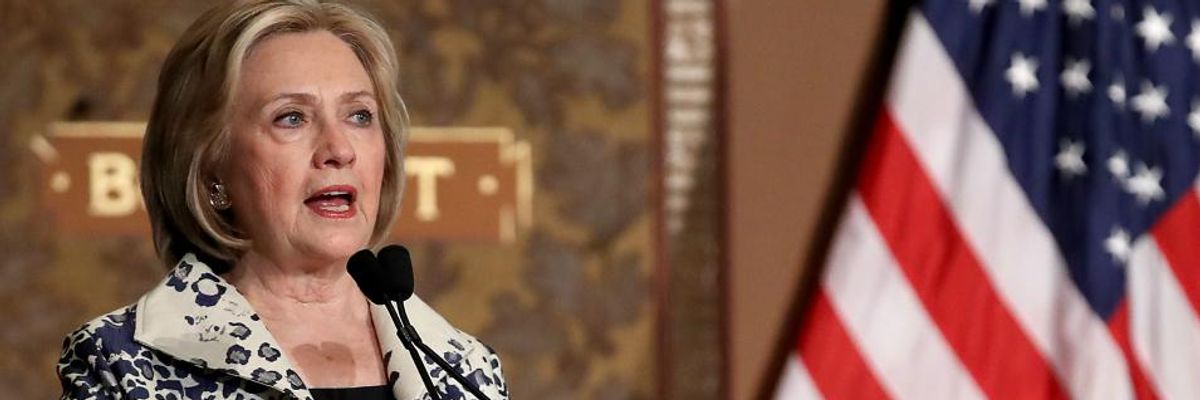
Former U.S. Secretary of State Hillary Clinton speaks at Georgetown University September 27, 2019 in Washington, DC .Clinton delivered remarks before recognizing the winners of the 2019 Hillary Rodham Clinton Awards for Advancing Women in Peace and Security. (Photo: Win McNamee/Getty Images)
Oh, how the simplistic certainty resonates.
Russsiagate, recently stoked by Hillary Clinton, comes saturated in ironies, which are usually media-invisible.
The Democrats' winning-but-nonetheless-losing presidential candidate of 2016 loosed some pent-up fury at democracy the other day, as well as annoyance with those who challenge the sacred status quo of the American governing process, when she tried to re-marginalize Tulsi Gabbard and Jill Stein, along with the generic concept of, good Lord, third parties.
Gabbard, a low-polling 2020 Democratic presidential candidate, and an outspoken critic of American militarism, is, Clinton said, likely being groomed as a third-party candidate -- you know, a spoiler, a total and utter nuisance to the official candidate -- by . . . who else? . . . the Russians! And Stein, the Green Party's presidential candidate in 2016, who therefore grabbed a small percentage of progressive votes that rightfully belonged to Clinton, was a "Russian asset."
While Clinton has mostly received negative publicity for these stupid assertions, their crowning oversimplification has remained essentially unchallenged. In case you're not aware of it, let me repeat it for you now: Russia is bad.
What also goes without saying, of course, is that we're good and do good things in the world, righting wrongs wherever they occur; and unlike Russia, we have free elections and respect the opinions of our citizens. But Russia, which, back in the Cold War era, when it was the Union of Soviet Socialist Republics, was an ever-present nuclear threat, has now embraced a new tactic to bring America down: buying ads on Facebook and unleashing social media trolls to "influence" our elections. Is there no end to its villainy?
My sarcasm isn't meant to suggest that the opposite is true: Russia good, America bad. It's simply my exasperation at the groupthink still present in so much of the news flow: the hardening of certain allegations and assumptions into "fact" at the same time that other relevant data is totally dismissed and forgotten. This results in the creation of pseudo-facts, i.e., simplistic certainties, that then turn into the building blocks of our national news. Russian election interference -- its unleashing of hackers and trolls into our social media -- is one such pseudo-fact, which, however strange to the extent that it's real, must be put into a much larger context.
Here's some of that context:
A. The evil Russian trolls who hacked the emails of the Democratic National Committee, giving those emails to WikiLeaks, which then posted some 20,000 of them online, were doing the work the of the free press. The hacked emails exposed the fact that the DNC, which was allegedly neutral about who became the party's candidate (this was the choice of Democratic primary voters), was committed to making sure Clinton was the candidate, not Bernie Sanders, whose grass-roots campaign was threatening to upend her. The U.S. media not only failed to uncover this, but fairly quickly helped turn the entire affair into a matter of Russian election interference, not the DNC's desperate attempt to make sure the party's own voters didn't select the "wrong" candidate."
B. The United States has a long-g-g-g history of interfering in its own elections and hardly needs Russia's help. Furthermore, the alleged Russian interference was fairly minimal: "an infinitesimal, barely detectable fraction of the messaging that Americans were inundated with officially by the campaigns," as Glenn Greenwald pointed out. The Russian posts had an absurdly minimal impact compared to that of the "dark money and super PACs," i.e., the corporate forces at work, making sure their interests remained in power.
C. And then there's the Electoral College, which gave the presidency to Trump without any Russian collusion. This farcical middle finger at the popular vote is part of America's legacy of racism. ". . . to protect their interests in a nation where they were being rapidly outnumbered, Southerners got an Electoral College that included a '3/5ths clause,'" Bob Fitrakis and Harvey Wasserman point out in The Strip and Flip Disaster of America's Stolen Elections. "Slaves (who could not vote themselves) were counted for 3/5ths of a vote for president and in establishing congressional districts." And of course the American racist tradition, which maintained Jim Crow laws for a century, continues to suppress votes as best it can, including minimizing the number of polling places in non-white areas. Surely all this is worth mentioning when election interference comes up.
D. The United States also has a sordid history of interfering (to put it mildly) with elections beyond its own borders. Some infamous examples, pointed out several years ago in the Washington Post, include: ousting Iranian Prime Minister Mohammed Mossadegh in 1953; the CIA's removal of Guatemalan president Jacobo Arbenz in 1954; the assassination of Prime Minister Patrice Lumumba of the Congo in 1961; and the toppling and violent death of Chilean President Salvador Allende in 1973. Not to leave the Russians out, however, the Post pointed out that the two adversaries, the good guys and the commies, "intervened in 117 elections around the world from 1946 to 2000 -- an average of once in every nine competitive elections."
We topple democratically elected leaders and wage wars well beyond "the will of the people." It's not Russian interests that are the problem here, but domestic corporate and military interests, which could easily see democracy itself as a terrible inconvenience to their plans When antiwar voices begin getting dismissed as Russian assets, this looks like an early step on a pathway to hell.
Dear Common Dreams reader, It’s been nearly 30 years since I co-founded Common Dreams with my late wife, Lina Newhouser. We had the radical notion that journalism should serve the public good, not corporate profits. It was clear to us from the outset what it would take to build such a project. No paid advertisements. No corporate sponsors. No millionaire publisher telling us what to think or do. Many people said we wouldn't last a year, but we proved those doubters wrong. Together with a tremendous team of journalists and dedicated staff, we built an independent media outlet free from the constraints of profits and corporate control. Our mission has always been simple: To inform. To inspire. To ignite change for the common good. Building Common Dreams was not easy. Our survival was never guaranteed. When you take on the most powerful forces—Wall Street greed, fossil fuel industry destruction, Big Tech lobbyists, and uber-rich oligarchs who have spent billions upon billions rigging the economy and democracy in their favor—the only bulwark you have is supporters who believe in your work. But here’s the urgent message from me today. It's never been this bad out there. And it's never been this hard to keep us going. At the very moment Common Dreams is most needed, the threats we face are intensifying. We need your support now more than ever. We don't accept corporate advertising and never will. We don't have a paywall because we don't think people should be blocked from critical news based on their ability to pay. Everything we do is funded by the donations of readers like you. When everyone does the little they can afford, we are strong. But if that support retreats or dries up, so do we. Will you donate now to make sure Common Dreams not only survives but thrives? —Craig Brown, Co-founder |
Oh, how the simplistic certainty resonates.
Russsiagate, recently stoked by Hillary Clinton, comes saturated in ironies, which are usually media-invisible.
The Democrats' winning-but-nonetheless-losing presidential candidate of 2016 loosed some pent-up fury at democracy the other day, as well as annoyance with those who challenge the sacred status quo of the American governing process, when she tried to re-marginalize Tulsi Gabbard and Jill Stein, along with the generic concept of, good Lord, third parties.
Gabbard, a low-polling 2020 Democratic presidential candidate, and an outspoken critic of American militarism, is, Clinton said, likely being groomed as a third-party candidate -- you know, a spoiler, a total and utter nuisance to the official candidate -- by . . . who else? . . . the Russians! And Stein, the Green Party's presidential candidate in 2016, who therefore grabbed a small percentage of progressive votes that rightfully belonged to Clinton, was a "Russian asset."
While Clinton has mostly received negative publicity for these stupid assertions, their crowning oversimplification has remained essentially unchallenged. In case you're not aware of it, let me repeat it for you now: Russia is bad.
What also goes without saying, of course, is that we're good and do good things in the world, righting wrongs wherever they occur; and unlike Russia, we have free elections and respect the opinions of our citizens. But Russia, which, back in the Cold War era, when it was the Union of Soviet Socialist Republics, was an ever-present nuclear threat, has now embraced a new tactic to bring America down: buying ads on Facebook and unleashing social media trolls to "influence" our elections. Is there no end to its villainy?
My sarcasm isn't meant to suggest that the opposite is true: Russia good, America bad. It's simply my exasperation at the groupthink still present in so much of the news flow: the hardening of certain allegations and assumptions into "fact" at the same time that other relevant data is totally dismissed and forgotten. This results in the creation of pseudo-facts, i.e., simplistic certainties, that then turn into the building blocks of our national news. Russian election interference -- its unleashing of hackers and trolls into our social media -- is one such pseudo-fact, which, however strange to the extent that it's real, must be put into a much larger context.
Here's some of that context:
A. The evil Russian trolls who hacked the emails of the Democratic National Committee, giving those emails to WikiLeaks, which then posted some 20,000 of them online, were doing the work the of the free press. The hacked emails exposed the fact that the DNC, which was allegedly neutral about who became the party's candidate (this was the choice of Democratic primary voters), was committed to making sure Clinton was the candidate, not Bernie Sanders, whose grass-roots campaign was threatening to upend her. The U.S. media not only failed to uncover this, but fairly quickly helped turn the entire affair into a matter of Russian election interference, not the DNC's desperate attempt to make sure the party's own voters didn't select the "wrong" candidate."
B. The United States has a long-g-g-g history of interfering in its own elections and hardly needs Russia's help. Furthermore, the alleged Russian interference was fairly minimal: "an infinitesimal, barely detectable fraction of the messaging that Americans were inundated with officially by the campaigns," as Glenn Greenwald pointed out. The Russian posts had an absurdly minimal impact compared to that of the "dark money and super PACs," i.e., the corporate forces at work, making sure their interests remained in power.
C. And then there's the Electoral College, which gave the presidency to Trump without any Russian collusion. This farcical middle finger at the popular vote is part of America's legacy of racism. ". . . to protect their interests in a nation where they were being rapidly outnumbered, Southerners got an Electoral College that included a '3/5ths clause,'" Bob Fitrakis and Harvey Wasserman point out in The Strip and Flip Disaster of America's Stolen Elections. "Slaves (who could not vote themselves) were counted for 3/5ths of a vote for president and in establishing congressional districts." And of course the American racist tradition, which maintained Jim Crow laws for a century, continues to suppress votes as best it can, including minimizing the number of polling places in non-white areas. Surely all this is worth mentioning when election interference comes up.
D. The United States also has a sordid history of interfering (to put it mildly) with elections beyond its own borders. Some infamous examples, pointed out several years ago in the Washington Post, include: ousting Iranian Prime Minister Mohammed Mossadegh in 1953; the CIA's removal of Guatemalan president Jacobo Arbenz in 1954; the assassination of Prime Minister Patrice Lumumba of the Congo in 1961; and the toppling and violent death of Chilean President Salvador Allende in 1973. Not to leave the Russians out, however, the Post pointed out that the two adversaries, the good guys and the commies, "intervened in 117 elections around the world from 1946 to 2000 -- an average of once in every nine competitive elections."
We topple democratically elected leaders and wage wars well beyond "the will of the people." It's not Russian interests that are the problem here, but domestic corporate and military interests, which could easily see democracy itself as a terrible inconvenience to their plans When antiwar voices begin getting dismissed as Russian assets, this looks like an early step on a pathway to hell.
Oh, how the simplistic certainty resonates.
Russsiagate, recently stoked by Hillary Clinton, comes saturated in ironies, which are usually media-invisible.
The Democrats' winning-but-nonetheless-losing presidential candidate of 2016 loosed some pent-up fury at democracy the other day, as well as annoyance with those who challenge the sacred status quo of the American governing process, when she tried to re-marginalize Tulsi Gabbard and Jill Stein, along with the generic concept of, good Lord, third parties.
Gabbard, a low-polling 2020 Democratic presidential candidate, and an outspoken critic of American militarism, is, Clinton said, likely being groomed as a third-party candidate -- you know, a spoiler, a total and utter nuisance to the official candidate -- by . . . who else? . . . the Russians! And Stein, the Green Party's presidential candidate in 2016, who therefore grabbed a small percentage of progressive votes that rightfully belonged to Clinton, was a "Russian asset."
While Clinton has mostly received negative publicity for these stupid assertions, their crowning oversimplification has remained essentially unchallenged. In case you're not aware of it, let me repeat it for you now: Russia is bad.
What also goes without saying, of course, is that we're good and do good things in the world, righting wrongs wherever they occur; and unlike Russia, we have free elections and respect the opinions of our citizens. But Russia, which, back in the Cold War era, when it was the Union of Soviet Socialist Republics, was an ever-present nuclear threat, has now embraced a new tactic to bring America down: buying ads on Facebook and unleashing social media trolls to "influence" our elections. Is there no end to its villainy?
My sarcasm isn't meant to suggest that the opposite is true: Russia good, America bad. It's simply my exasperation at the groupthink still present in so much of the news flow: the hardening of certain allegations and assumptions into "fact" at the same time that other relevant data is totally dismissed and forgotten. This results in the creation of pseudo-facts, i.e., simplistic certainties, that then turn into the building blocks of our national news. Russian election interference -- its unleashing of hackers and trolls into our social media -- is one such pseudo-fact, which, however strange to the extent that it's real, must be put into a much larger context.
Here's some of that context:
A. The evil Russian trolls who hacked the emails of the Democratic National Committee, giving those emails to WikiLeaks, which then posted some 20,000 of them online, were doing the work the of the free press. The hacked emails exposed the fact that the DNC, which was allegedly neutral about who became the party's candidate (this was the choice of Democratic primary voters), was committed to making sure Clinton was the candidate, not Bernie Sanders, whose grass-roots campaign was threatening to upend her. The U.S. media not only failed to uncover this, but fairly quickly helped turn the entire affair into a matter of Russian election interference, not the DNC's desperate attempt to make sure the party's own voters didn't select the "wrong" candidate."
B. The United States has a long-g-g-g history of interfering in its own elections and hardly needs Russia's help. Furthermore, the alleged Russian interference was fairly minimal: "an infinitesimal, barely detectable fraction of the messaging that Americans were inundated with officially by the campaigns," as Glenn Greenwald pointed out. The Russian posts had an absurdly minimal impact compared to that of the "dark money and super PACs," i.e., the corporate forces at work, making sure their interests remained in power.
C. And then there's the Electoral College, which gave the presidency to Trump without any Russian collusion. This farcical middle finger at the popular vote is part of America's legacy of racism. ". . . to protect their interests in a nation where they were being rapidly outnumbered, Southerners got an Electoral College that included a '3/5ths clause,'" Bob Fitrakis and Harvey Wasserman point out in The Strip and Flip Disaster of America's Stolen Elections. "Slaves (who could not vote themselves) were counted for 3/5ths of a vote for president and in establishing congressional districts." And of course the American racist tradition, which maintained Jim Crow laws for a century, continues to suppress votes as best it can, including minimizing the number of polling places in non-white areas. Surely all this is worth mentioning when election interference comes up.
D. The United States also has a sordid history of interfering (to put it mildly) with elections beyond its own borders. Some infamous examples, pointed out several years ago in the Washington Post, include: ousting Iranian Prime Minister Mohammed Mossadegh in 1953; the CIA's removal of Guatemalan president Jacobo Arbenz in 1954; the assassination of Prime Minister Patrice Lumumba of the Congo in 1961; and the toppling and violent death of Chilean President Salvador Allende in 1973. Not to leave the Russians out, however, the Post pointed out that the two adversaries, the good guys and the commies, "intervened in 117 elections around the world from 1946 to 2000 -- an average of once in every nine competitive elections."
We topple democratically elected leaders and wage wars well beyond "the will of the people." It's not Russian interests that are the problem here, but domestic corporate and military interests, which could easily see democracy itself as a terrible inconvenience to their plans When antiwar voices begin getting dismissed as Russian assets, this looks like an early step on a pathway to hell.