SUBSCRIBE TO OUR FREE NEWSLETTER
Daily news & progressive opinion—funded by the people, not the corporations—delivered straight to your inbox.
5
#000000
#FFFFFF
To donate by check, phone, or other method, see our More Ways to Give page.
Daily news & progressive opinion—funded by the people, not the corporations—delivered straight to your inbox.
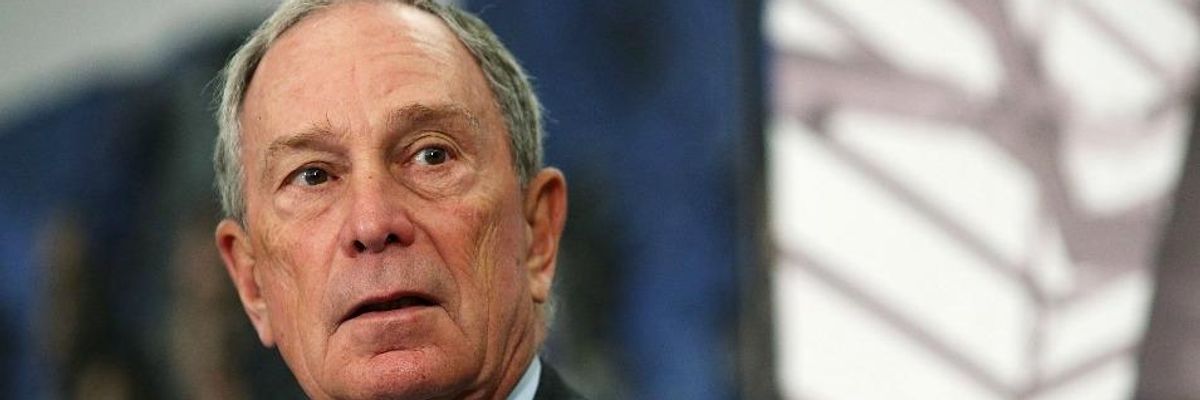
When Bloomberg spoke to an assembly of fellow executives in 2018, an observer noted that he said we need to 'go back to how things were done in Clinton days, when he'd get three Democrats, three Republicans and take them golfing, then go lock themselves in a room, close the door, smoke cigars and make all the decisions.'" (Photo: Spencer Platt/Getty Images)
Michael Bloomberg, the billionaire who bought himself a mayoralty, now has his sights set on higher office. This is the same Michael Bloomberg who became mayor of New York City by outspending his opponent five to one. Could the same arithmetic apply to the presidential race? If so, it would cost him $12 billion to buy the Oval Office. That is, of course, a disturbing and absurd notion to anyone with even a vestigial attachment to democratic principle.
Here's something even more disturbing: Bloomberg can easily afford it. Bloomberg has become a living illustration of runaway inequality and an irretrievably corrupted democracy.
Bloomberg was a Democrat, became a Republican, and is now a Democrat again. Party affiliation is, however, a trivial thing in his world. The ultra-wealthy change party affiliations and contributions on a whim, or for expedience,, much as a gentleman might wear a tan linen suit in the summer and switch to darker wool blends as the autumn chill sets in.
Let's do the math. As the New York Times reported in 2009, Bloomberg spent $74 million to win the mayoralty in 2001. He spent $85 million to win re-election in 2005. He then managed to void the two-term limit for New York City mayors and went on to spend $102 million winning his third term.
As the Times notes, that means Bloomberg spent $185 for every vote he received. Additional calculations by this writer show that he spent a total of $88 for every vote cast in his races for any candidate.
How much would it cost Bloomberg to become president, if we assume that every vote in the country "costs" as much as a New Yorker's? 136,700,000 people voted in the 2016 election. If turnout is unchanged, and if the election could be purchased for $88 per vote, the cost of buying the United States presidency would come to $12 billion.
The total cost of the last presidential election was estimated at $2.6 billion. Bloomberg could spend five times as much as all the presidential campaigns spent together last time around, and he'd still be one of the richest people in the world.
Not that it would be easy. Despite his wealth, Bloomberg retains his deeply dislikable public persona. I have never seen him in person, but I have observed him as most voters would, through the media lens. Even the highest-paid consultants - the one who told the officious Bloomberg to call himself "Mike," even though he is never addressed that way - have not figured out how to alter his self-presentation as a scowling, self-righteous martinet.
If beating Trump is your top priority, Bloomberg's not your guy, even in our broken simulacrum of democracy. His nomination would almost certainly depress turnout among core Democratic voters. Some say he would win some votes among "persuadable" Republicans, but Republicans have proven far more attached to Trump than insiders and pundits expected. And if impeachment results in a different GOP candidate for 2020 - not likely, but not impossible - the entire rationale for a Bloomberg candidacy disappears.
Still, if anybody can buy this election with personal funds, "Mike" can. He is one of the richest people in the world. According to Forbes, a source that is hardly hostile to the wealthy, Bloomberg currently has a net worth of $52.3 billion. (The use of the word "worth" in this context is, of course, is meant in a fiscal context, not a human one.)
Bloomberg may have certain restrictions on his investments and assets, but borrowing against them would be easy. He would be worth $40 billion after the election - enough to buy several more races.
What would a Bloomberg presidency look like? True, he's good on guns, but his imperious presentation of policy is likely to win few convert in Congresss. His environmental rhetoric is good, but he's unwilling to make the sweeping changes needed to address climate change. His views on the economy are the retrograde ravings of an isolated oligarch.. Inequality soared in Bloomberg's New York City, which quickly became unaffordable for working people and extremely lucrative for others.
When Bloomberg spoke to an assembly of fellow executives in 2018, he reportedly said that we need to "go back to how things were done in Clinton days, when he'd get three Democrats, three Republicans and take them golfing, then go lock themselves in a room, close the door, smoke cigars and make all the decisions."
Clinton's deal-making elitism led to the financial crisis of 2008. Obama's similarly "centrist" policies cost the Democrats the House, the Senate, the presidency, and 1,000 state seats. If that's the outcome you want, Bloomberg's your guy.
Billionaires like Bloomberg already dictate public expenditures, at a level few people understand. Take the "Giving Pledge," which Bloomberg and some other billionaires have signed. Their giving affects public policy at all levels. It also drains the public coffers.
Here's how that works: Forbes notes that Bloomberg "pledged $1.8 billion to Johns Hopkins University, his undergraduate alma mater, adding to $1.5 billion he had already given the school." Bloomberg then made his reasoning public in an op-ed that offered a sharply delimited view of support for higher education.
His gift was generous, I suppose. But Bloomberg wasn't just spending his own money. Assuming he takes the usual tax advantages that come with such gifts, he could also be "spending" (in tax expenditures) a billion dollars or more of the people's money. Why is a private citizen able to redirect so much public money for personal reasons?
Bloomberg's wealth would have been unimaginable to the wealthiest and most powerful emperors of old. He didn't "earn" it. His $52 billion is the product of a long chain of policy decisions -- in areas that range from taxation to the use of publicly-funded technologies and networks by private enterprise. His extreme wealth, and its ability to undermine democracy, reflects a long chain of policy failures. It is we who pay the price: in loss of democracy, in loss of economic rights, and in a future that may well be for sale to the likes of Michael Bloomberg.
This country and this world are at a monumental crossroads. US voters have an opportunity to beat back the forces of fascism and confront the billionaires who are rigging the economy, our media system, and our democracy, making it increasingly impossible for ordinary people to get by. We’re not just talking about the election. We’re talking about what must be done once these fascist elements are vanquished from power. We need a bolder set of solutions than what either major party has so far been willing to offer and a working-class movement ready to fight like hell for it. Trump didn't emerge from nowhere. The conditions that fueled MAGA authoritarianism were created by decades of radical neoliberal economic policies and a corrupt political system dominated by corporate interests. They slashed taxes on the super-rich, promising that the benefits would trickle down. They said giveaways to the corporate titans would make life more affordable for the rest of us. It was all bullshit. And when a bitter, betrayed populace searches for someone to blame, right-wing demagogues have little trouble finding scapegoats. People know when they're being lied to, but you won't hear any of this from the corporate media. Only independent journalism—powered and funded by people who believe in building a better world—can deliver truly trustworthy daily news. If you share our vision, please contribute whatever you can to sustain our work. |
Richard (RJ) Eskow is a journalist who has written for a number of major publications. His weekly program, The Zero Hour, can be found on cable television, radio, Spotify, and podcast media.
Michael Bloomberg, the billionaire who bought himself a mayoralty, now has his sights set on higher office. This is the same Michael Bloomberg who became mayor of New York City by outspending his opponent five to one. Could the same arithmetic apply to the presidential race? If so, it would cost him $12 billion to buy the Oval Office. That is, of course, a disturbing and absurd notion to anyone with even a vestigial attachment to democratic principle.
Here's something even more disturbing: Bloomberg can easily afford it. Bloomberg has become a living illustration of runaway inequality and an irretrievably corrupted democracy.
Bloomberg was a Democrat, became a Republican, and is now a Democrat again. Party affiliation is, however, a trivial thing in his world. The ultra-wealthy change party affiliations and contributions on a whim, or for expedience,, much as a gentleman might wear a tan linen suit in the summer and switch to darker wool blends as the autumn chill sets in.
Let's do the math. As the New York Times reported in 2009, Bloomberg spent $74 million to win the mayoralty in 2001. He spent $85 million to win re-election in 2005. He then managed to void the two-term limit for New York City mayors and went on to spend $102 million winning his third term.
As the Times notes, that means Bloomberg spent $185 for every vote he received. Additional calculations by this writer show that he spent a total of $88 for every vote cast in his races for any candidate.
How much would it cost Bloomberg to become president, if we assume that every vote in the country "costs" as much as a New Yorker's? 136,700,000 people voted in the 2016 election. If turnout is unchanged, and if the election could be purchased for $88 per vote, the cost of buying the United States presidency would come to $12 billion.
The total cost of the last presidential election was estimated at $2.6 billion. Bloomberg could spend five times as much as all the presidential campaigns spent together last time around, and he'd still be one of the richest people in the world.
Not that it would be easy. Despite his wealth, Bloomberg retains his deeply dislikable public persona. I have never seen him in person, but I have observed him as most voters would, through the media lens. Even the highest-paid consultants - the one who told the officious Bloomberg to call himself "Mike," even though he is never addressed that way - have not figured out how to alter his self-presentation as a scowling, self-righteous martinet.
If beating Trump is your top priority, Bloomberg's not your guy, even in our broken simulacrum of democracy. His nomination would almost certainly depress turnout among core Democratic voters. Some say he would win some votes among "persuadable" Republicans, but Republicans have proven far more attached to Trump than insiders and pundits expected. And if impeachment results in a different GOP candidate for 2020 - not likely, but not impossible - the entire rationale for a Bloomberg candidacy disappears.
Still, if anybody can buy this election with personal funds, "Mike" can. He is one of the richest people in the world. According to Forbes, a source that is hardly hostile to the wealthy, Bloomberg currently has a net worth of $52.3 billion. (The use of the word "worth" in this context is, of course, is meant in a fiscal context, not a human one.)
Bloomberg may have certain restrictions on his investments and assets, but borrowing against them would be easy. He would be worth $40 billion after the election - enough to buy several more races.
What would a Bloomberg presidency look like? True, he's good on guns, but his imperious presentation of policy is likely to win few convert in Congresss. His environmental rhetoric is good, but he's unwilling to make the sweeping changes needed to address climate change. His views on the economy are the retrograde ravings of an isolated oligarch.. Inequality soared in Bloomberg's New York City, which quickly became unaffordable for working people and extremely lucrative for others.
When Bloomberg spoke to an assembly of fellow executives in 2018, he reportedly said that we need to "go back to how things were done in Clinton days, when he'd get three Democrats, three Republicans and take them golfing, then go lock themselves in a room, close the door, smoke cigars and make all the decisions."
Clinton's deal-making elitism led to the financial crisis of 2008. Obama's similarly "centrist" policies cost the Democrats the House, the Senate, the presidency, and 1,000 state seats. If that's the outcome you want, Bloomberg's your guy.
Billionaires like Bloomberg already dictate public expenditures, at a level few people understand. Take the "Giving Pledge," which Bloomberg and some other billionaires have signed. Their giving affects public policy at all levels. It also drains the public coffers.
Here's how that works: Forbes notes that Bloomberg "pledged $1.8 billion to Johns Hopkins University, his undergraduate alma mater, adding to $1.5 billion he had already given the school." Bloomberg then made his reasoning public in an op-ed that offered a sharply delimited view of support for higher education.
His gift was generous, I suppose. But Bloomberg wasn't just spending his own money. Assuming he takes the usual tax advantages that come with such gifts, he could also be "spending" (in tax expenditures) a billion dollars or more of the people's money. Why is a private citizen able to redirect so much public money for personal reasons?
Bloomberg's wealth would have been unimaginable to the wealthiest and most powerful emperors of old. He didn't "earn" it. His $52 billion is the product of a long chain of policy decisions -- in areas that range from taxation to the use of publicly-funded technologies and networks by private enterprise. His extreme wealth, and its ability to undermine democracy, reflects a long chain of policy failures. It is we who pay the price: in loss of democracy, in loss of economic rights, and in a future that may well be for sale to the likes of Michael Bloomberg.