SUBSCRIBE TO OUR FREE NEWSLETTER
Daily news & progressive opinion—funded by the people, not the corporations—delivered straight to your inbox.
5
#000000
#FFFFFF
To donate by check, phone, or other method, see our More Ways to Give page.
Daily news & progressive opinion—funded by the people, not the corporations—delivered straight to your inbox.
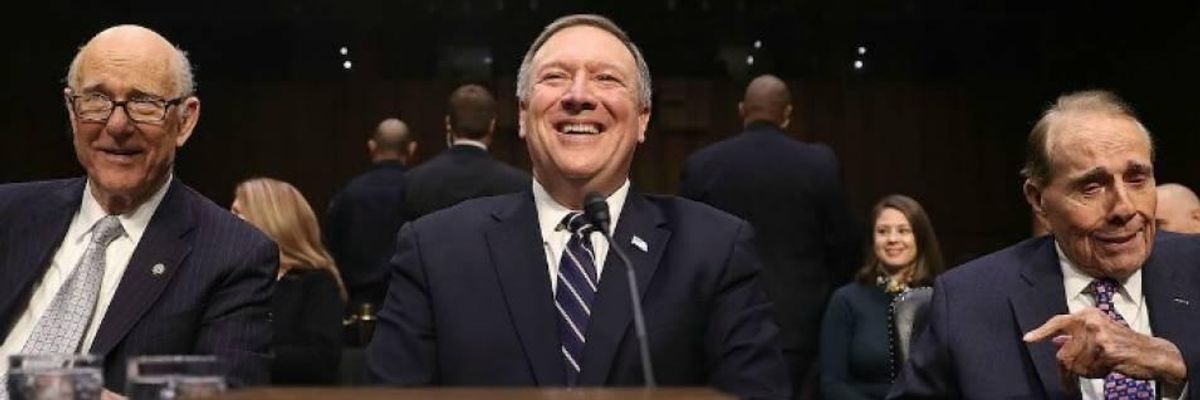
"This is an administration that has lied over matters big and small, and thinks it can get away with lying Americans into war while repeating the George W. Bush playbook that led to the 2003 invasion of Iraq," Costello writes. (Photo: Joe Raedle/Getty Images)
President Trump ordering the killing of Qassem Soleimani is troubling on several fronts. The assassination has been treated as an act of war in Iran, uniting disparate political factions after a brutal crackdown on protesters in November. Now, U.S. forces are on a state of high alert across the region, with many anticipating potential Iranian counter reprisals that risk further deepening the escalation spiral from which there could be no escape.
But there's another troubling aspect to this decision -- Congress was left in the dark, and the administration appears to be lying about the intelligence they used to justify the strike.
The official administration line -- that this disrupted an imminent attack, saving lives -- was somewhat dubious from the start. Soleimani was a commander of the Islamic Revolutionary Guard Corps' Quds Force, and thus gave orders to associates to carry out various operations. Killing him would be unlikely to stop an imminent attack, as many observers have pointed out. As former intelligence analyst Jon Bateman said, killing Soleimani "would be neither necessary nor sufficient to disrupt the operational progression of an imminent plot. What it might do instead is shock Iran's decision calculus."
If anything, killing a senior Iranian military commander could guarantee the action it is purported to have forestalled.Moreover, while Congressional leaders were kept out of the loop about the strike, Trump had reportedly been boasting about it for days to guests at Mar-a-Lago. As reported by The Daily Beast, Trump told several different guests at Mar-a-Lago in the days leading up to the strike that he was "working on a 'big' response to the Iranian regime that they would be hearing or reading about very 'soon,'" with Trump claiming that he'd been in touch with his national security team "gaming out options for an aggressive action that could quickly materialize."
"The American people don't want a war with Iran. Avoiding such a disaster will require Congress to step up, cut through the administration's lies, and pass legislation that reins the administration in and removes American forces from hostilities against Iran."
If true, it would beggar belief that there was a specific and imminent threat emerging from Iran that could be eliminated with Soleimani's death. Instead, this was a calculated provocation and reckless ratcheting up of tension that Trump couldn't wait to crow about.
Subsequent reporting confirms that the strike was contemplated for days, calling into question the administration's narrative and its legality. According to the Los Angeles Times, President Trump surprised his national security team when he chose a strike on Soleimani from a list of follow-on actions after clashes with Iraqi Shiite militias that left one civilian contractor dead as well as dozens of militia members. The decision was "spurred on in part by Iran hawks among his advisors," and set off a furious effort to locate Soleimani and carry out the order.
Similarly, The Washington Post reports that the decision to strike was made Sunday, with officials reminding Trump that he had not responded to earlier provocations including Iran's downing of a U.S. drone, egging on the reckless decision. Trump was reportedly swayed by their arguments, as he was "frustrated that the details of his internal deliberations had leaked out and felt he looked weak," according to officials.
Lastly, the actual evidence behind the intelligence appears to be "razor thin," according to two U.S. officials who have been briefed. As reported by the New York Times' Rukmini Callimanchi, the intelligence includes Soleimani's travel pattern, a purported conversation with the Supreme Leader, and heightened hostilities between the U.S. and Iran. Or, as one intelligence official described, it is "hardly evidence of an imminent attack that could kill hundreds," with the administration's conclusion being an "illogical leap."
Add it all up, and you have an administration that ignored Congress while planning an assassination of a foreign general that risks a disastrous war without any plausible argument that doing so was authorized by Congress. This is an administration that has lied over matters bigand small, and thinks it can get away with lying Americans into war while repeating the George W. Bush playbook that led to the 2003 invasion of Iraq. Hence, the warnings of an imminent terror threat that doesn't appear to have existed as well as the bizarre lie from Vice President Mike Pence attempting to link Soleimani to the September 11 attacks. And, just like the George W. Bush administration had delusions about what would come after the invasion of Iraq, many members of Trump's team are apparently deluded about what comes next. As one senior State Department official claimed, they don't expect additional retaliation from Iran because the U.S. is "speaking in a language the regime understands."
The American people don't want a war with Iran. Avoiding such a disaster will require Congress to step up, cut through the administration's lies, and pass legislation that reins the administration in and removes American forces from hostilities against Iran. Failing to do so will only empower a reckless administration that appears to be lying us into a war.
Dear Common Dreams reader, It’s been nearly 30 years since I co-founded Common Dreams with my late wife, Lina Newhouser. We had the radical notion that journalism should serve the public good, not corporate profits. It was clear to us from the outset what it would take to build such a project. No paid advertisements. No corporate sponsors. No millionaire publisher telling us what to think or do. Many people said we wouldn't last a year, but we proved those doubters wrong. Together with a tremendous team of journalists and dedicated staff, we built an independent media outlet free from the constraints of profits and corporate control. Our mission has always been simple: To inform. To inspire. To ignite change for the common good. Building Common Dreams was not easy. Our survival was never guaranteed. When you take on the most powerful forces—Wall Street greed, fossil fuel industry destruction, Big Tech lobbyists, and uber-rich oligarchs who have spent billions upon billions rigging the economy and democracy in their favor—the only bulwark you have is supporters who believe in your work. But here’s the urgent message from me today. It's never been this bad out there. And it's never been this hard to keep us going. At the very moment Common Dreams is most needed, the threats we face are intensifying. We need your support now more than ever. We don't accept corporate advertising and never will. We don't have a paywall because we don't think people should be blocked from critical news based on their ability to pay. Everything we do is funded by the donations of readers like you. When everyone does the little they can afford, we are strong. But if that support retreats or dries up, so do we. Will you donate now to make sure Common Dreams not only survives but thrives? —Craig Brown, Co-founder |
President Trump ordering the killing of Qassem Soleimani is troubling on several fronts. The assassination has been treated as an act of war in Iran, uniting disparate political factions after a brutal crackdown on protesters in November. Now, U.S. forces are on a state of high alert across the region, with many anticipating potential Iranian counter reprisals that risk further deepening the escalation spiral from which there could be no escape.
But there's another troubling aspect to this decision -- Congress was left in the dark, and the administration appears to be lying about the intelligence they used to justify the strike.
The official administration line -- that this disrupted an imminent attack, saving lives -- was somewhat dubious from the start. Soleimani was a commander of the Islamic Revolutionary Guard Corps' Quds Force, and thus gave orders to associates to carry out various operations. Killing him would be unlikely to stop an imminent attack, as many observers have pointed out. As former intelligence analyst Jon Bateman said, killing Soleimani "would be neither necessary nor sufficient to disrupt the operational progression of an imminent plot. What it might do instead is shock Iran's decision calculus."
If anything, killing a senior Iranian military commander could guarantee the action it is purported to have forestalled.Moreover, while Congressional leaders were kept out of the loop about the strike, Trump had reportedly been boasting about it for days to guests at Mar-a-Lago. As reported by The Daily Beast, Trump told several different guests at Mar-a-Lago in the days leading up to the strike that he was "working on a 'big' response to the Iranian regime that they would be hearing or reading about very 'soon,'" with Trump claiming that he'd been in touch with his national security team "gaming out options for an aggressive action that could quickly materialize."
"The American people don't want a war with Iran. Avoiding such a disaster will require Congress to step up, cut through the administration's lies, and pass legislation that reins the administration in and removes American forces from hostilities against Iran."
If true, it would beggar belief that there was a specific and imminent threat emerging from Iran that could be eliminated with Soleimani's death. Instead, this was a calculated provocation and reckless ratcheting up of tension that Trump couldn't wait to crow about.
Subsequent reporting confirms that the strike was contemplated for days, calling into question the administration's narrative and its legality. According to the Los Angeles Times, President Trump surprised his national security team when he chose a strike on Soleimani from a list of follow-on actions after clashes with Iraqi Shiite militias that left one civilian contractor dead as well as dozens of militia members. The decision was "spurred on in part by Iran hawks among his advisors," and set off a furious effort to locate Soleimani and carry out the order.
Similarly, The Washington Post reports that the decision to strike was made Sunday, with officials reminding Trump that he had not responded to earlier provocations including Iran's downing of a U.S. drone, egging on the reckless decision. Trump was reportedly swayed by their arguments, as he was "frustrated that the details of his internal deliberations had leaked out and felt he looked weak," according to officials.
Lastly, the actual evidence behind the intelligence appears to be "razor thin," according to two U.S. officials who have been briefed. As reported by the New York Times' Rukmini Callimanchi, the intelligence includes Soleimani's travel pattern, a purported conversation with the Supreme Leader, and heightened hostilities between the U.S. and Iran. Or, as one intelligence official described, it is "hardly evidence of an imminent attack that could kill hundreds," with the administration's conclusion being an "illogical leap."
Add it all up, and you have an administration that ignored Congress while planning an assassination of a foreign general that risks a disastrous war without any plausible argument that doing so was authorized by Congress. This is an administration that has lied over matters bigand small, and thinks it can get away with lying Americans into war while repeating the George W. Bush playbook that led to the 2003 invasion of Iraq. Hence, the warnings of an imminent terror threat that doesn't appear to have existed as well as the bizarre lie from Vice President Mike Pence attempting to link Soleimani to the September 11 attacks. And, just like the George W. Bush administration had delusions about what would come after the invasion of Iraq, many members of Trump's team are apparently deluded about what comes next. As one senior State Department official claimed, they don't expect additional retaliation from Iran because the U.S. is "speaking in a language the regime understands."
The American people don't want a war with Iran. Avoiding such a disaster will require Congress to step up, cut through the administration's lies, and pass legislation that reins the administration in and removes American forces from hostilities against Iran. Failing to do so will only empower a reckless administration that appears to be lying us into a war.
President Trump ordering the killing of Qassem Soleimani is troubling on several fronts. The assassination has been treated as an act of war in Iran, uniting disparate political factions after a brutal crackdown on protesters in November. Now, U.S. forces are on a state of high alert across the region, with many anticipating potential Iranian counter reprisals that risk further deepening the escalation spiral from which there could be no escape.
But there's another troubling aspect to this decision -- Congress was left in the dark, and the administration appears to be lying about the intelligence they used to justify the strike.
The official administration line -- that this disrupted an imminent attack, saving lives -- was somewhat dubious from the start. Soleimani was a commander of the Islamic Revolutionary Guard Corps' Quds Force, and thus gave orders to associates to carry out various operations. Killing him would be unlikely to stop an imminent attack, as many observers have pointed out. As former intelligence analyst Jon Bateman said, killing Soleimani "would be neither necessary nor sufficient to disrupt the operational progression of an imminent plot. What it might do instead is shock Iran's decision calculus."
If anything, killing a senior Iranian military commander could guarantee the action it is purported to have forestalled.Moreover, while Congressional leaders were kept out of the loop about the strike, Trump had reportedly been boasting about it for days to guests at Mar-a-Lago. As reported by The Daily Beast, Trump told several different guests at Mar-a-Lago in the days leading up to the strike that he was "working on a 'big' response to the Iranian regime that they would be hearing or reading about very 'soon,'" with Trump claiming that he'd been in touch with his national security team "gaming out options for an aggressive action that could quickly materialize."
"The American people don't want a war with Iran. Avoiding such a disaster will require Congress to step up, cut through the administration's lies, and pass legislation that reins the administration in and removes American forces from hostilities against Iran."
If true, it would beggar belief that there was a specific and imminent threat emerging from Iran that could be eliminated with Soleimani's death. Instead, this was a calculated provocation and reckless ratcheting up of tension that Trump couldn't wait to crow about.
Subsequent reporting confirms that the strike was contemplated for days, calling into question the administration's narrative and its legality. According to the Los Angeles Times, President Trump surprised his national security team when he chose a strike on Soleimani from a list of follow-on actions after clashes with Iraqi Shiite militias that left one civilian contractor dead as well as dozens of militia members. The decision was "spurred on in part by Iran hawks among his advisors," and set off a furious effort to locate Soleimani and carry out the order.
Similarly, The Washington Post reports that the decision to strike was made Sunday, with officials reminding Trump that he had not responded to earlier provocations including Iran's downing of a U.S. drone, egging on the reckless decision. Trump was reportedly swayed by their arguments, as he was "frustrated that the details of his internal deliberations had leaked out and felt he looked weak," according to officials.
Lastly, the actual evidence behind the intelligence appears to be "razor thin," according to two U.S. officials who have been briefed. As reported by the New York Times' Rukmini Callimanchi, the intelligence includes Soleimani's travel pattern, a purported conversation with the Supreme Leader, and heightened hostilities between the U.S. and Iran. Or, as one intelligence official described, it is "hardly evidence of an imminent attack that could kill hundreds," with the administration's conclusion being an "illogical leap."
Add it all up, and you have an administration that ignored Congress while planning an assassination of a foreign general that risks a disastrous war without any plausible argument that doing so was authorized by Congress. This is an administration that has lied over matters bigand small, and thinks it can get away with lying Americans into war while repeating the George W. Bush playbook that led to the 2003 invasion of Iraq. Hence, the warnings of an imminent terror threat that doesn't appear to have existed as well as the bizarre lie from Vice President Mike Pence attempting to link Soleimani to the September 11 attacks. And, just like the George W. Bush administration had delusions about what would come after the invasion of Iraq, many members of Trump's team are apparently deluded about what comes next. As one senior State Department official claimed, they don't expect additional retaliation from Iran because the U.S. is "speaking in a language the regime understands."
The American people don't want a war with Iran. Avoiding such a disaster will require Congress to step up, cut through the administration's lies, and pass legislation that reins the administration in and removes American forces from hostilities against Iran. Failing to do so will only empower a reckless administration that appears to be lying us into a war.