
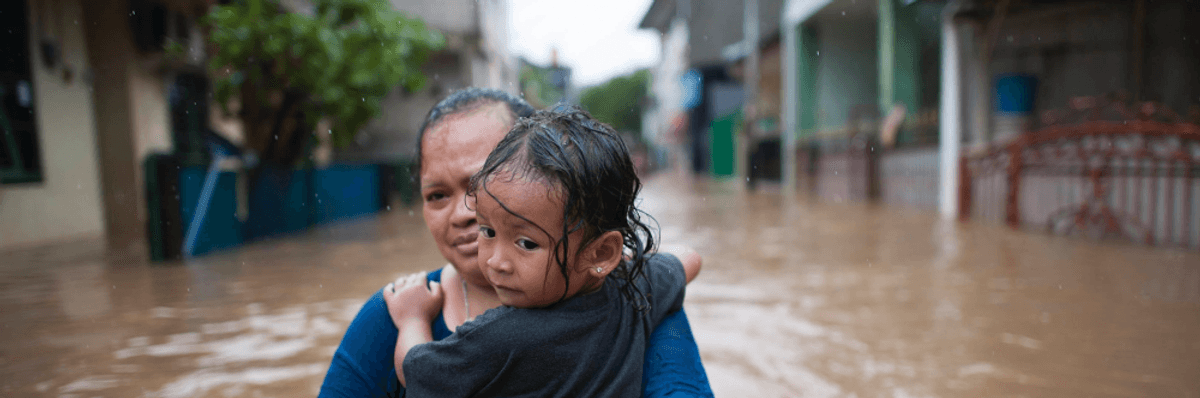
Woman and child in flood in Indonesia. (Photo: World Meteorological Organisation, Flickr/Climate Visuals)
Climate Refugee Ruling Sets 'Global Precedent'
'Governments must consider a heating planet’s imminent threat to Pacific peoples’ lives.'
It is unlawful for governments to return people seeking asylum from countries where the climate crisis threatens their lives, a landmark ruling by the UN Human Rights Committee has found.
The decision sets a 'global precedent', Amnesty International said yesterday in response to the ground-breaking asylum case.
The judgment is a result of a case brought forward in February 2016 against the government of New Zealand by Ioane Teitiota, a man from the Pacific nation of Kiribati, after authorities denied his claim of asylum as a 'climate refugee'.
Clear message
He was deported from New Zealand to Kiribati in September 2015. The UN Human Rights Committee delivered its decision on the case earlier this month.
Kate Schuetze, Amnesty International's Pacific Researcher, said: "The decision sets a global precedent.
"It says a state will be in breach of its human rights obligations if it returns someone to a country where - due to the climate crisis - their life is at risk, or in danger of cruel, inhuman or degrading treatment triggered.
"The message is clear: Pacific Island states do not need to be under water before triggering human rights obligations to protect the right to life.
"The Pacific Islands are the canary in the coal mine for climate induced migrants. Low-lying island states such as Kiribati and Tuvalu are only one or two metres above sea level.
"The people there are exposed to severe climate impacts today, including limited access to habitable land, clean drinking water and subsistence living.
"Governments must consider this dangerous reality and a heating planet's imminent threat to Pacific peoples' lives and livelihoods."
Ioane Teitiota
Teitiota says he faced land disputes and difficulties accessing safe drinking water in his home country as the result of the climate crisis, and therefore was forced to migrate with his family to New Zealand where he applied for refugee status after his visa expired in 2010.
He was denied asylum by New Zealand's Immigration and Protection Tribunal, the Court of Appeal and the Supreme Court.
He then took his case to the UN Human Rights Committee on the grounds that New Zealand violated his right to life under the International Covenant on Civil and Political Rights, by deporting him to Kiribati.
While the Committee found that Teitiota's deportation had not been unlawful because he didn't face an immediate danger to his life in Kiribati, it recognised that climate change represented a serious threat to the right to life and therefore decision-makers need to take this into account when examining challenges to deportation.
The Committee's decision suggests that future claims might be successful where the evidence shows "the effects of climate change in receiving states may expose individuals to a violation of their rights".
All states have the human rights duty to protect people from the harmful effects of the climate crisis, including displacement. It is therefore imperative that urgent action is taken to keep the temperature rise as low as possible and no higher than 1.5degC.
Court ruling
The full decision by the Committee is available here. It stated that: "Without robust national and international efforts, the effects of climate change in receiving states may expose individuals to a violation of their rights under articles 6 or 7 of the Covenant, thereby triggering the non-refoulement obligations of sending states."
Two Committee members formally dissented from the finding, and supported Teitiota's claim.
Duncan Laki Muhumuza, of Uganda, stated that the "conditions of life laid out by the author - resulting from climate change in the Republic of Kiribati, are significantly grave, and pose a real, personal and reasonably foreseeable risk of a threat to his life under Article 6(1) of the [International Convention on Civil and Political Rights].
"Moreover, the Committee needs to handle critical and significantly irreversible issues of climate change, with the approach that seeks to uphold the sanctity of human life."
This article is based on a press release from the Fondation Cartier pour l'art contemporain.
We are at a crossroads
This country and this world are at a monumental crossroads. In a few short weeks, US voters will have an opportunity to beat back the forces of fascism and confront the billionaires who are rigging the economy, our media system, and our democracy, making it increasingly impossible for ordinary people to get by. We’re not just talking about the election. We’re talking about what must be done once these fascist elements are vanquished from power. We need a bolder set of solutions than what either major party has so far been willing to offer and a working-class movement ready to fight like hell for it. Trump didn't emerge from nowhere. The conditions that fueled MAGA authoritarianism were created by decades of radical neoliberal economic policies and a corrupt political system dominated by corporate interests. They slashed taxes on the super-rich, promising that the benefits would trickle down. They said giveaways to the corporate titans would make life more affordable for the rest of us. It was all bullshit. And when a bitter, betrayed populace searches for someone to blame, right-wing demagogues have little trouble finding scapegoats. People know when they're being lied to, but you won't hear any of this from the corporate media. Only independent journalism—powered and funded by people who believe in building a better world—can deliver truly trustworthy daily news. Our Fall Campaign is underway, and we need your help. To power our newsroom through the rest of the year, we need to raise $125,000 by midnight on October 31. So if you share our vision, please contribute whatever you can to sustain our work. |
It is unlawful for governments to return people seeking asylum from countries where the climate crisis threatens their lives, a landmark ruling by the UN Human Rights Committee has found.
The decision sets a 'global precedent', Amnesty International said yesterday in response to the ground-breaking asylum case.
The judgment is a result of a case brought forward in February 2016 against the government of New Zealand by Ioane Teitiota, a man from the Pacific nation of Kiribati, after authorities denied his claim of asylum as a 'climate refugee'.
Clear message
He was deported from New Zealand to Kiribati in September 2015. The UN Human Rights Committee delivered its decision on the case earlier this month.
Kate Schuetze, Amnesty International's Pacific Researcher, said: "The decision sets a global precedent.
"It says a state will be in breach of its human rights obligations if it returns someone to a country where - due to the climate crisis - their life is at risk, or in danger of cruel, inhuman or degrading treatment triggered.
"The message is clear: Pacific Island states do not need to be under water before triggering human rights obligations to protect the right to life.
"The Pacific Islands are the canary in the coal mine for climate induced migrants. Low-lying island states such as Kiribati and Tuvalu are only one or two metres above sea level.
"The people there are exposed to severe climate impacts today, including limited access to habitable land, clean drinking water and subsistence living.
"Governments must consider this dangerous reality and a heating planet's imminent threat to Pacific peoples' lives and livelihoods."
Ioane Teitiota
Teitiota says he faced land disputes and difficulties accessing safe drinking water in his home country as the result of the climate crisis, and therefore was forced to migrate with his family to New Zealand where he applied for refugee status after his visa expired in 2010.
He was denied asylum by New Zealand's Immigration and Protection Tribunal, the Court of Appeal and the Supreme Court.
He then took his case to the UN Human Rights Committee on the grounds that New Zealand violated his right to life under the International Covenant on Civil and Political Rights, by deporting him to Kiribati.
While the Committee found that Teitiota's deportation had not been unlawful because he didn't face an immediate danger to his life in Kiribati, it recognised that climate change represented a serious threat to the right to life and therefore decision-makers need to take this into account when examining challenges to deportation.
The Committee's decision suggests that future claims might be successful where the evidence shows "the effects of climate change in receiving states may expose individuals to a violation of their rights".
All states have the human rights duty to protect people from the harmful effects of the climate crisis, including displacement. It is therefore imperative that urgent action is taken to keep the temperature rise as low as possible and no higher than 1.5degC.
Court ruling
The full decision by the Committee is available here. It stated that: "Without robust national and international efforts, the effects of climate change in receiving states may expose individuals to a violation of their rights under articles 6 or 7 of the Covenant, thereby triggering the non-refoulement obligations of sending states."
Two Committee members formally dissented from the finding, and supported Teitiota's claim.
Duncan Laki Muhumuza, of Uganda, stated that the "conditions of life laid out by the author - resulting from climate change in the Republic of Kiribati, are significantly grave, and pose a real, personal and reasonably foreseeable risk of a threat to his life under Article 6(1) of the [International Convention on Civil and Political Rights].
"Moreover, the Committee needs to handle critical and significantly irreversible issues of climate change, with the approach that seeks to uphold the sanctity of human life."
This article is based on a press release from the Fondation Cartier pour l'art contemporain.